

Exercise bike for bad knees at a glance
Choose by features you can check, and start gently.
Step-through frame, backrest, resistance steps and seat fit, with the Arthritis Foundation and research behind them. Details below.
Short answer
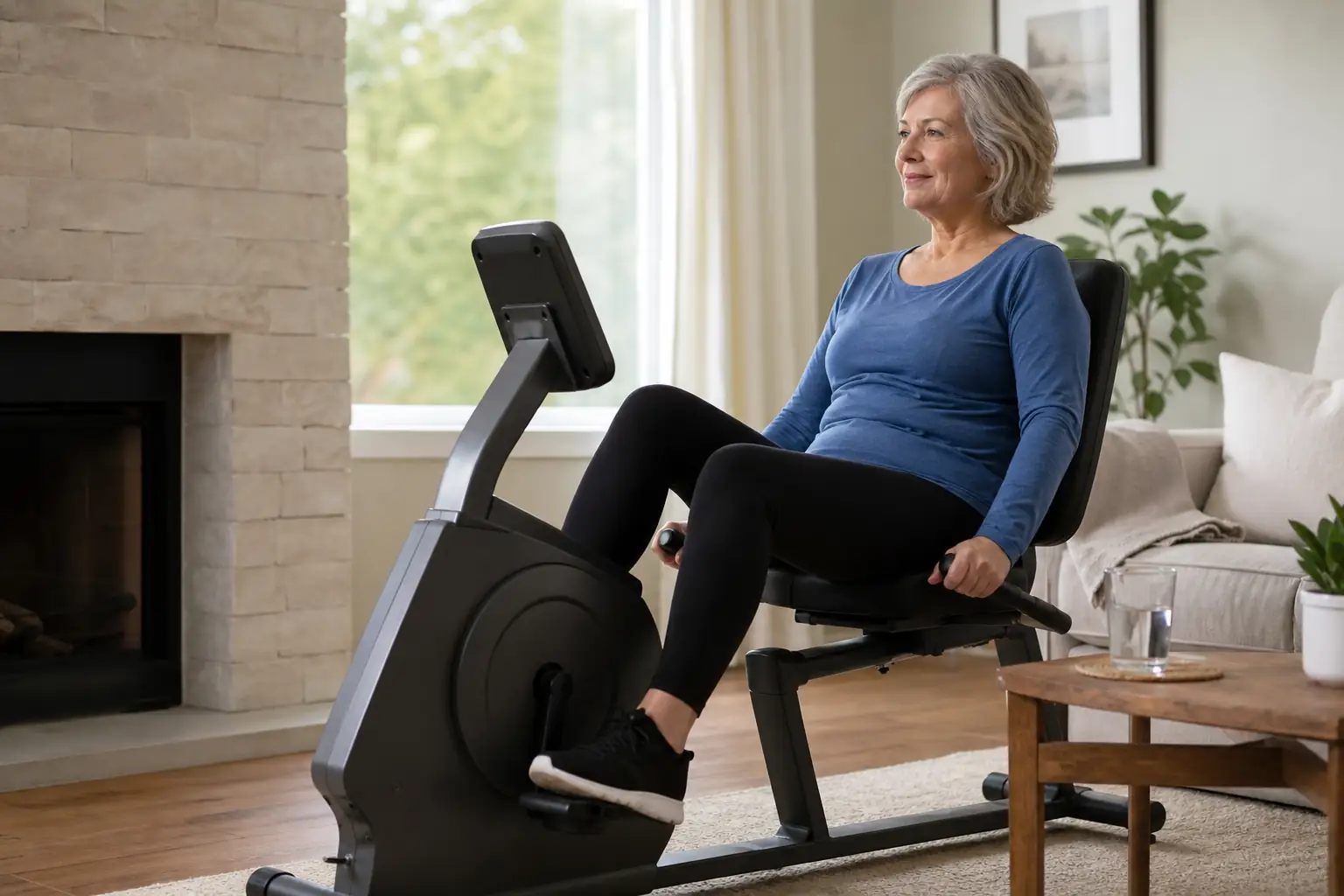
The best exercise bike for bad knees lets you start gently: a step-through frame, a supportive seat, fine resistance steps and an adjustable saddle. Check with your doctor or physical therapist first.
Key takeaways
- Choose by features: step-through frame, backrest, fine resistance steps and an adjustable seat.
- Start with 20 easy minutes, 3 to 5 days a week, and add resistance slowly.
- Set the seat so the knee keeps a slight bend at the bottom of the stroke.
- Ask your doctor or physical therapist first; this page is not medical advice.
This guide turns “easy on the knees” into bike features you can check, and links the rankings that fit them.
Exercise Bike for Bad Knees: What “Easy on the Knees” Means on an Exercise Bike
A bike is low impact because you stay seated and nothing lands on the joints. The Arthritis Foundation describes stationary biking as a low-impact fit for people with arthritis, and notes that you can add resistance slowly. The American Academy of Orthopaedic Surgeons’ patient site, OrthoInfo, lists a stationary bike, even a recumbent one, as aerobic exercise for people who cannot walk well or have balance problems.
Research looks at groups, not at your knees. A 2021 meta-analysis in Clinical Rehabilitation looked at 11 studies (724 participants) of stationary cycling in people with knee osteoarthritis, pooling 8 of them, and found lower reported pain than no exercise, while the gains in stiffness and everyday function were smaller than the researchers’ threshold for a clearly meaningful change. This is not medical advice: ask your doctor or physical therapist whether and how to ride.
- Step-through frame: a low entry makes getting on and off easier.
- Backrest: a supported seat is a steadier position than an upright saddle.
- Fine resistance steps: a low first setting and small increases let you build slowly.
- Seat adjustment: the saddle position sets how much your knee bends.
- Weight rating and stability: a rated frame that does not rock is safer to climb onto.
Which Bike Types Have the Features That Matter
We track 56 exercise bikes. This is how the types compare on the features above, from the Amazon US listings:
| Type | Bikes | Step-through frame | Backrest | Micro-adjustable resistance | Seat position adjustment stated |
|---|---|---|---|---|---|
| Recumbent | 16 | 16 of 16 | 16 of 16 | 1 of 16 | 9 of 16 |
| Upright | 6 | 1 of 6 | 0 of 6 | 1 of 6 | 1 of 6 |
| Spin (indoor cycling) | 16 | 0 of 16 | 0 of 16 | 11 of 16 | 5 of 16 |
| Folding upright | 5 | 0 of 5 | 0 of 5 | 0 of 5 | 1 of 5 |
Check Amazon for current pricing and availability.
How to Set Up the Bike to Be Gentle on the Knees
The Arthritis Foundation gives a short list for riding comfortably, and it fits any of the bikes below.
- Set the seat: on an upright bike, about hip height so you keep a slight bend in the knee at the bottom of the stroke and never lock it out. Our bike seat height calculator gives a starting point.
- Push and pull: pedal in full circles, not only down, so the front and back of the legs share the work.
- Start small: 20 minutes, 3 to 5 days a week, or 5 minutes at a time, at an easy pace with no added resistance at first.
- Raise resistance slowly: add one step at a time, and take it back down if the pedal stroke turns jerky.
- Stop if it hurts: OrthoInfo advises resting for at least a day if using the equipment is painful, then making the effort easier.
Features to Check Before You Buy
Use the listing to confirm the features, because the same product name can cover several versions.
- Lowest resistance: the first setting should feel almost free; bikes with 8 steps jump further per click than bikes with 16 or a micro-adjustable knob.
- Seat range: check the stated user height range, and for a recumbent whether the seat slides on a rail.
- Pedal fit: straps or cages keep the foot centered; loose feet shift the load.
- Console and monitor: time and resistance level are enough; you do not need a screen.
- Returns: if a bike does not fit, you will want an easy return window.
Exercise Bikes to Look At First
Three picks from our rankings that match the features above.
Easiest to get on and off

Horizon 5.0R
FitScore 69.5/100
A step-through recumbent with a backrest, 8 resistance levels and a 400-lb user rating. Ranked #1 in our best recumbent bike guide, FitScore 69.5 for that intent.
Check Price on AmazonSeat slides on a rail

Schwinn 230
FitScore 64.7/100
A recumbent with a slider-rail seat and 16 resistance levels, to set the knee bend. Ranked #4 in our best recumbent bike guide, FitScore 64.7 for that intent.
Check Price on AmazonMicro-adjustable resistance

Schwinn IC3
FitScore 74/100
An upright-style indoor cycling bike with micro-adjustable resistance and 4-way seat and handlebar adjustment. Ranked #1 in our best spin bike guide, FitScore 74 for that intent.
Check Price on AmazonHow Much to Ride
The CDC adult guidelines suggest at least 150 minutes of moderate activity a week, and note that activity can be split into short bouts. Build toward that, starting from the Arthritis Foundation’s 20 minutes, and let comfort set the pace. Our exercise bike workouts include easy 15 and 20-minute sessions.
Checklist Before You Buy
5 checks
Tap a number to check off that step.
- 01
Ask your doctor or physical therapist before you start.
- 02
Choose a step-through frame and backrest if getting on and off is hard.
- 03
Check the lowest resistance and the size of each step.
- 04
Set the seat so the knee keeps a slight bend.
- 05
Start with easy 20-minute rides and stop if it hurts.
Common Mistakes to Avoid
Mistake 1Setting the saddle too low or too high.
Mistake 2Starting with resistance on.
Mistake 3Riding through pain.
Mistake 4Buying on the screen instead of the fit.
The Bottom Line
- The Arthritis Foundation describes stationary biking as a low-impact fit for people with arthritis and advises starting with 20 minutes, 3 to 5 days a week, at an easy pace with no added resistance.
- A 2021 meta-analysis of stationary cycling in knee osteoarthritis (11 studies, 724 participants, 8 pooled) found lower reported pain than no exercise; stiffness and function gains were smaller.
- All 16 recumbents in our pool have a backrest and a step-through frame, against 1 of 6 uprights and 0 of 16 spin bikes.
- 11 of 16 spin bikes offer micro-adjustable resistance; recumbents have a median of 11.5 resistance levels.
Our Top Picks
 Easiest to get on and offHorizon 5.0RFitScore69.5/100Check on Amazon
- Seat slides on a railSchwinn 230FitScore64.7/100Check on Amazon
- Micro-adjustable resistanceSchwinn IC3FitScore74/100Check on Amazon
Frequently Asked Questions
Look for a step-through recumbent with a backrest and fine resistance steps; see our best recumbent bike ranking for the top models, and check with your doctor first.
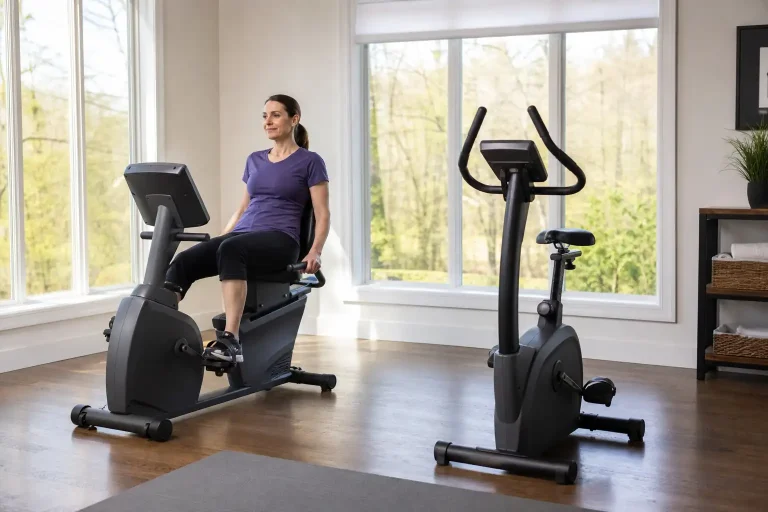
A recumbent gives a backrest and an easier step-through entry; an upright puts you in a more bike-like position. Choose the one that feels comfortable and see our recumbent vs upright comparison.
On an upright bike, about hip height so the knee keeps a slight bend at the bottom of the pedal stroke, according to the Arthritis Foundation.
The Arthritis Foundation suggests starting with 20 minutes, 3 to 5 days a week, or 5 minutes at a time, at an easy pace.
Start with none and add one step at a time; if the pedal stroke turns jerky or your knees complain, go back down.
Explore More Exercise Bike Guides
Best Exercise Bike for Seniors (2026): 5 Easy-Access Picks
Best Recumbent Bike (2026): 5 Picks for Comfortable Home Cardio
Recumbent vs Upright Exercise Bike: Which Is Better for You? (2026)
Benefits of an Exercise Bike: What Regular Riding Does (and Does Not Do) (2026)
Best Exercise Bike for Home (2026): 5 Picks Ranked by FitScore
Best Spin Bike for Home (2026): 5 Indoor Cycling Bikes Ranked
This article contains affiliate links. If you click through and make a purchase, we may earn a small commission at no extra cost to you. As an Amazon Associate, we earn from qualifying purchases. We do not show prices because they change constantly: product details and availability can change at any time, so please check the current price and details directly on Amazon. Learn more. Amazon and the Amazon logo are trademarks of Amazon.com, Inc. or its affiliates.
