Short answer
Most walkers need a belt of at least 20 × 50 inches, joggers 20 × 55 inches and runners 20 × 60 inches. Add length if you are over 6 feet tall, run at 10 mph or faster or have a long stride, and choose 22 inches wide if you are tall or broad. The calculator gives your exact minimum.
Key takeaways
- Length depends on speed and height; width depends on body size and stability.
- Base minimums: 20 × 50 in for walking, 20 × 55 in for jogging, 20 × 60 in for running.
- Slow walking at 3 mph or less works on walking pad belts of about 16 × 40 in.
- Size the belt for the tallest and fastest person who will use the treadmill.
Belt size is the spec that decides whether a treadmill feels roomy or cramped. Too short and you shorten your stride or drift toward the motor hood; too narrow and you watch your feet instead of the road ahead.
Enter your height, how you train, your fastest planned speed and, if you like, your stride. The calculator shows the minimum belt width and length and lists the in-stock models from our rankings that meet it.
Treadmill Belt Size Calculator
recommended minimum belt (width × length)
- ProForm Pro 900020 × 60 in belt, up to 12 mph. Ranked in our Best Treadmill with Classes guide.
- NordicTrack T Series 1620 × 60 in belt, up to 12 mph. Ranked in our Best Treadmill with Screen guide.
- NordicTrack Commercial 245022 × 60 in belt, up to 14 mph. Ranked in our Best Premium Treadmill guide.
- Horizon 7.4 AT22 × 60 in belt, up to 12 mph. Ranked in our Best Durable Treadmill guide.
- NordicTrack Commercial 175022 × 60 in belt, up to 12 mph. Ranked in our Best Treadmill for HIIT guide.
- BORGUSI CTM510317.5 × 45.3 in belt, up to 8.5 mph. Ranked in our Best Cheap Treadmill guide.
- Sole F8022 × 60 in belt, up to 12 mph. Ranked in our Best Treadmill with Heart Rate Monitor guide.
- XTERRA TR7520 × 60 in belt, up to 12 mph. Ranked in our Best Treadmill with Automatic Incline guide.
- NordicTrack Commercial LE22 × 60 in belt, up to 12 mph. Ranked in our Best Treadmill for Heavy People guide.
- NordicTrack Commercial 125022 × 60 in belt, up to 12 mph. Ranked in our Best Durable Treadmill guide.
- THERUN T1517 × 47.2 in belt, up to 10 mph. Ranked in our Best Affordable Treadmill guide.
- NordicTrack T Series 1020 × 60 in belt, up to 12 mph. Ranked in our Best Treadmill for Jogging guide.
- Sole F6522 × 60 in belt, up to 12 mph. Ranked in our Best Treadmill for Jogging guide.
- ECHANFIT 551918.11 × 47.24 in belt, up to 10 mph. Ranked in our Best Compact Treadmill with Incline guide.
- Peloton Tread20 × 59 in belt, up to 12.5 mph. Ranked in our Best Treadmill with Classes guide.
- ECHANFIT CTM551820 × 50 in belt, up to 12 mph. Ranked in our Best Incline Trainer guide.
- Horizon 7.0 AT20 × 60 in belt, up to 12 mph. Ranked in our Best Treadmill for Weight Loss guide.
- NordicTrack T Series 720.1 × 55.1 in belt, up to 10 mph. Ranked in our Best Treadmill for Seniors guide.
- Schwinn SFT4.320 × 60 in belt, up to 12 mph. Ranked in our Best Treadmill Without Subscription guide.
- ProForm Carbon TLX20 × 60 in belt, up to 12 mph. Ranked in our Best Mid-Range Treadmill guide.
- WELLFIT TM02920 × 50 in belt, up to 10 mph. Ranked in our Best Compact Treadmill guide.
- Horizon T20220 × 60 in belt, up to 12 mph. Ranked in our Best Budget Treadmill guide.
- XTERRA TR6520 × 55 in belt, up to 10 mph. Ranked in our Best Treadmill with Heart Rate Monitor guide.
- Sole F63-202620 × 60 in belt, up to 12 mph. Ranked in our Best Treadmill 300 Lb Capacity guide.
- NordicTrack T 6.5 S20 × 55 in belt, up to 10 mph. Ranked in our Best Mid-Range Treadmill guide.
- XTERRA TRX100016 × 50 in belt, up to 10 mph. Ranked in our Best Affordable Treadmill guide.
- VITALWALK TM10GY18 × 49 in belt, up to 10 mph. Ranked in our Best Incline Trainer guide.
- Schwinn 81520 × 60 in belt, up to 12 mph. Ranked in our Best Treadmill for Apartment guide.
- ProForm Carbon TL18 × 55 in belt, up to 10 mph. Ranked in our Best Budget Treadmill guide.
- Acezoe P1415.75 × 40.16 in belt, up to 7.5 mph. Ranked in our Best under Desk Treadmill guide.
- NordicTrack T Series 518 × 55 in belt, up to 10 mph. Ranked in our Best Budget Treadmill guide.
- Horizon T10120 × 55 in belt, up to 10 mph. Ranked in our Best Treadmill for Shared Spaces guide.
- Sunny Health & Fitness SF-T140712.6 × 42.1 in belt, self-paced manual. Ranked in our Best Manual Treadmill guide.
- TREAFLOW 721017.7 × 47.2 in belt, up to 10 mph. Ranked in our Best Incline Trainer guide.
- Cardirun TM03716 × 36 in belt, up to 6.2 mph. Ranked in our Best under Desk Treadmill guide.
- Trisomy D216 × 37.5 in belt, up to 6 mph. Ranked in our Most Compact Treadmill guide.
- SereneLife SLFTRD26BT15.7 × 39.3 in belt, up to 6 mph. Ranked in our Most Compact Treadmill guide.
- Schwinn 81020 × 55 in belt, up to 10 mph. Ranked in our Best Treadmill with Handle guide.
- Schwinn SFT3.516 × 50 in belt, up to 10 mph. Ranked in our Best Treadmill for Small Spaces guide.
- SereneLife SLFTRD1813.4 × 39.3 in belt, up to 6 mph. Ranked in our Best Treadmill for Low Ceilings guide.
- AKLUER TW140L15.7 × 39.4 in belt, up to 4 mph. Ranked in our Best Treadmill for Low Ceilings guide.
- THERUN X115 × 38 in belt, up to 6.2 mph. Ranked in our Best Budget Walking Pad guide.
- Merax 3.0 HP Folding Treadmill15.35 × 41.73 in belt, up to 10 mph. Ranked in our Best Treadmill on a Tight Budget guide.
- Schwinn SFT3.116 × 50 in belt, up to 10 mph. Ranked in our Best Treadmill for Shared Spaces guide.
- THERUN X216 × 40 in belt, up to 7.6 mph. Ranked in our Best Budget Walking Pad guide.
- Merax Foldable Incline Treadmill14.17 × 40.94 in belt, up to 8 mph. Ranked in our Best Treadmill on a Tight Budget guide.
- TREAFLOW Walking Pad15 × 36 in belt, up to 6 mph. Ranked in our Best Budget Walking Pad guide.
- WalkingPad P116.5 × 40 in belt, up to 3.75 mph. Ranked in our Best Folding Treadmill under Bed guide.
- CURSOR FITNESS X5FD 40% Incline Treadmill15.4 × 38.6 in belt, up to 6.2 mph. Ranked in our Best Incline Trainer guide.
- XBD 480J-A15 × 35.5 in belt, up to 4 mph. Ranked in our Best Budget Walking Pad guide.
- Trisomy HSM-T12C115 × 36.2 in belt, up to 6 mph. Ranked in our Best Folding Treadmill with Desk guide.
- Sunny Health & Fitness SF-X721020 × 51 in belt, up to 5 mph. Ranked in our Best Incline Trainer guide.
- WalkingPad R3 Hybrid+17.3 × 47.2 in belt, up to 7.5 mph. Ranked in our Best Folding Treadmill with Desk guide.
- rongle QZDXJ-003 Curved Manual Treadmill15.75 × 51.2 in belt, self-paced manual. Ranked in our Best Manual Treadmill guide.
- THERUN 2-in-1 Treadmill15 × 38 in belt, up to 6.2 mph. Ranked in our Best Folding Treadmill under Bed guide.
- judvx Walking Pad Treadmill with Vibration14.2 × 34.4 in belt, up to 4 mph. Ranked in our Best Walking Pad for Plus Size guide.
- Sole C8019 × 62 in belt, self-paced manual. Ranked in our Best Curved Treadmill guide.
- RUNOW 6310CB Curved Treadmill17 × 48 in belt, self-paced manual. Ranked in our Best Curved Treadmill guide.
- JOROTO F50PRO Curved Manual Walking Pad15.75 × 41.34 in belt, self-paced manual. Ranked in our Best Manual Treadmill guide.
- Sunny Health & Fitness SF-X711017.7 × 59 in belt, self-paced manual. Ranked in our Best Curved Treadmill guide.
How the Calculation Works
The calculator uses rules of thumb, not a formula from a standards body. They follow the stride logic and height table in our treadmill belt size guide: the faster you go and the taller you are, the longer your stride and the more room you need in front and behind.
First it decides how you will use the belt. It takes the higher of your main use and your top speed: up to 4.5 mph counts as walking, 4.6 to 6 mph as jogging and above 6 mph as running. Walking with a top speed of 3 mph or less counts as slow walking.
Then it applies the adjustments listed here, in order. Belt sizes are written width × length, in inches, and describe the running surface, not the overall frame.
- Base sizes: slow walking 16 × 40 in, walking 20 × 50 in, jogging 20 × 55 in, running 20 × 60 in.
- Over 6 ft: walking and jogging move up one size (+5 in), and the width goes to 22 in.
- Over 6 ft 2 in: +2 in of length.
- Running at 10 mph or faster: +2 in of length and 22 in of width.
- Long stride: +2 in of length. Wide stance or broad build: 22 in of width.
- Cap: 62 in, because few home treadmills are longer than 60 to 62 in.
Which Models Show Up in the List
The list includes the treadmills and walking pads that are currently in stock and ranked in our buying guides. A model appears when its belt is at least as wide and as long as your result and its top speed reaches the speed you entered. Manual treadmills have no motor-set top speed, so only their belt size is checked.
Models within 2 inches of your result appear with a dashed border. They may still suit you, but read the note on stride and speed in their guide before you buy. Belt sizes come from the Amazon US listing first, then the manufacturer.
Belt Width vs Belt Length
Length matters most for speed. Running adds a flight phase, so each stride covers more ground and you need a buffer at the back in case you drift. Width matters most for comfort and confidence: on a 16-inch belt your feet land close to the side rails, while 20 to 22 inches lets you swing your arms and look ahead.
A shorter, narrower belt is a fair trade when space is tight and you mostly walk. Compact treadmills around 45 to 50 inches and walking pads around 40 inches fold small and still work for walking. For regular running, compare the long-deck picks in our best treadmill for jogging and best premium treadmill guides.
Link to This Calculator
You are welcome to link to this calculator from your site or forum post. Copy the code below.
Checklist Before You Buy
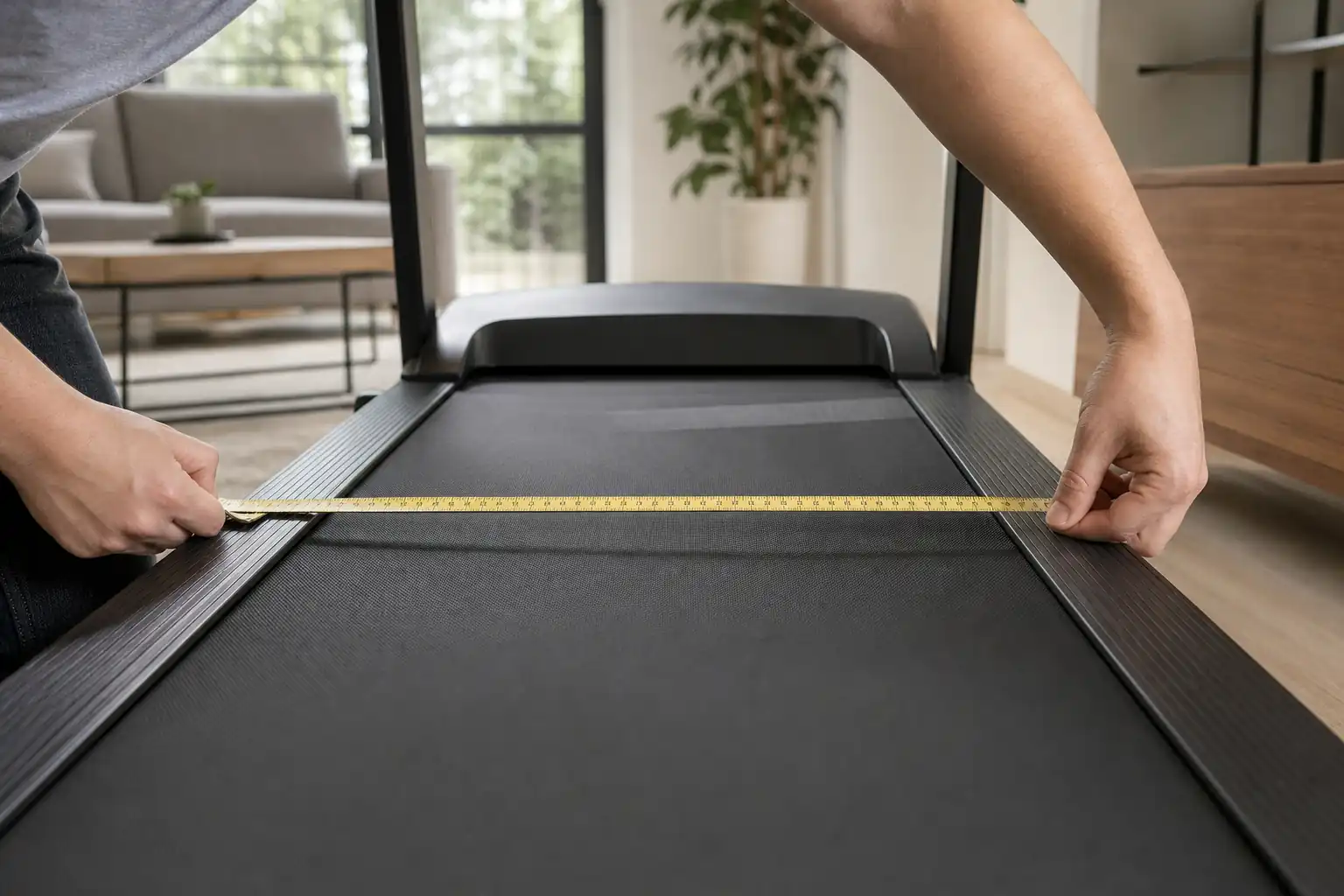
- Find the running surface size (width × length), not the overall dimensions.
- Size for the tallest and fastest person in the household.
- Check that the top speed reaches your fastest planned pace.
- Confirm the bigger deck still fits your room, doorway and ceiling.
Common Mistakes to Avoid
- Reading the overall frame length as the belt length.
- Buying a walking pad for jogging or running.
- Sizing for the shortest user instead of the tallest.
- Ignoring width when you are tall or broad.
The Bottom Line
- Checks 60 in-stock treadmills and walking pads from our rankings.
- 18 of them have a belt at least 60 in long; 7 are 22 × 60 in or larger.
- Works in feet and inches or centimeters.
- Free to use and to link.
Frequently Asked Questions
At least 20 × 50 inches for walking, 20 × 55 inches for jogging and 20 × 60 inches for running, with more length if you are tall, fast or have a long stride.
It can work for shorter runners at easy paces, but most runners are more comfortable on 60 inches, and runners over about 6 feet should treat 60 inches as the minimum.
Yes for most adults. Choose 22 inches if you are over about 6 feet tall, broad, heavier or prefer more room to drift.
For running, about 22 × 62 inches if you can find it, and 22 × 60 inches at the very least. For walking, 22 × 55 inches or longer.
Yes for slow, steady walking up to about 3 mph, such as under a desk. For brisk walking or jogging, a longer deck is safer and more comfortable.
Most listings write width × length, so 20 × 60 means 20 inches wide and 60 inches long. Check the listing wording, as a few reverse the order.