

Short answer
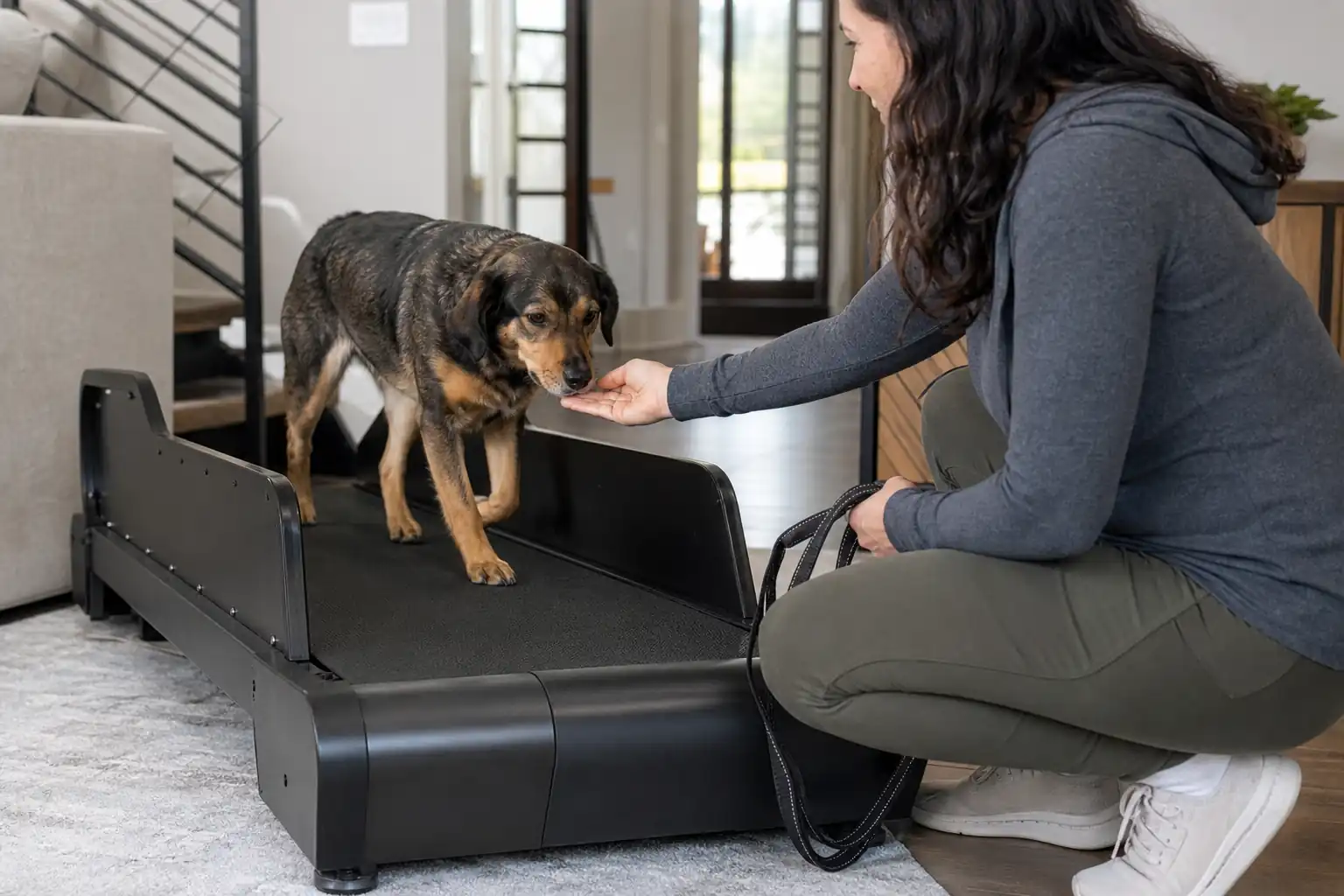
To train a dog on a treadmill, let your dog explore the machine while it is off, reward every calm step with treats, then turn it on at the slowest speed with the dog beside it. Add short sessions of a minute or two, build up gradually, always supervise, and never tie the leash to the machine.
Key takeaways
- Train in stages: machine off, motor noise, slowest speed, then longer sessions.
- Treats and choice build confidence; force builds fear.
- Add time before speed, and progress only when your dog is relaxed.
- Stop at stress or fatigue signs and go back one stage next time.
- Supervise every session and never attach the leash to the machine.
- Check with your veterinarian first, especially for puppies, seniors and flat-faced breeds.
A treadmill can give a dog a reliable outlet on days when a walk is not possible, such as during storms, heat waves or a busy week. It only works if the dog is comfortable on it, and comfort comes from a slow, reward-based introduction rather than a single long session. Most problems owners describe, from a dog that leaps off the side to one that freezes at the sound of the motor, trace back to moving too fast in the first week.
This guide walks through each stage, from the first sniff of a switched-off machine to a steady routine, with a session-length table you can use as a general starting point. It applies to dog-specific treadmills like the ones in our best treadmill for dogs guide. If your dog is a puppy, a senior, a brachycephalic breed or has joint, heart or breathing issues, talk to your veterinarian before you start.
Before You Start: Vet Check, Setup and Gear
Treadmill work is exercise, so the first step happens away from the machine. Ask your veterinarian whether treadmill walking suits your dog, how long sessions should be and what pace makes sense, especially for puppies whose joints are still developing, older dogs, dogs carrying extra weight and dogs with joint, heart or breathing conditions. Flat-faced breeds deserve extra caution: a 2020 study of heat-related illness in dogs found that brachycephalic dogs had greater odds of heat-related illness, and that most cases with a recorded trigger were linked to exercise.
Place the treadmill in a quiet room your dog already knows, on a level floor, with space at the back so nothing sits right behind the rear roller. Keep the room cool and have water nearby. Clear away toys, cords and other pets during sessions so your dog has one thing to focus on.
You need small, soft, high-value treats your dog can eat quickly, a flat collar or a well-fitted harness, a short leash you will hold in your hand if your dog needs guidance, and the treadmill safety key or remote within reach. If you have not picked a machine yet, look for side panels, a low starting speed and a remote control; our best treadmill for dogs roundup compares five models on these points.
- Vet first: puppies, seniors, brachycephalic breeds and dogs with joint, heart or breathing issues.
- Room: familiar, quiet, cool, level floor, clear space behind the belt.
- Gear: soft treats, harness or flat collar, a hand-held leash, safety key or remote.
Step 1: Let Your Dog Explore the Treadmill While It Is Off
Leave the treadmill unplugged for the first sessions. Let your dog sniff it, walk around it and investigate the side panels. Reward any interest with a treat and calm praise. If your dog seems unsure, scatter a few treats on the floor near the machine and then on the edge of the deck so approaching it becomes a game.
When your dog is relaxed around the machine, lure one paw onto the stationary belt, then two, then all four. Reward each step. Let your dog stand on the belt, eat a few treats and step off whenever it wants. Choice matters here: a dog that learns it can leave tends to stay calmer when the belt later moves.
Repeat these short sessions over a day or more, until your dog hops on by itself when you approach the treadmill. Many owners rush this step because it looks like nothing is happening, but a dog that is confident on a still belt is far easier to train once the motor starts.
Pro tip: Feed a few meals or a lick mat on the stationary belt. Linking the treadmill with food makes the machine part of the routine instead of a strange object.
Step 2: Introduce Motor Noise, Then the Slowest Speed
Dogs react to sound and vibration before they react to movement. With your dog standing next to the treadmill, not on it, plug the machine in and turn the belt on at its slowest setting. Treat and praise while the motor runs for a few seconds, then switch it off. Repeat until the hum no longer gets more than a glance.
Next, with the belt stopped, ask your dog to step on and face forward toward the console. Stand at the front of the treadmill, slightly to the side, with treats at your dog’s nose height to keep its head up and its body centered. Start the belt at the lowest speed the machine allows. Several dog treadmills we compare, including the FYC 2-in-1 and the Lifepro PawRunner, list 0.5 mph as their minimum speed.
Aim for a few moving steps, then stop the belt and reward generously. That is a full success for the first moving session. In a 2022 study on acclimating dogs to treadmill locomotion, handlers began at 0.5 mph, advanced only when a dog appeared comfortable and lowered speed or incline when stress appeared. The same rule works at home: progress follows the dog, not the calendar.
- Turn the motor on with the dog off the belt first.
- Dog on a stopped belt, facing forward, before you start it.
- Lowest speed only; stop after a few calm steps and reward.
- Keep incline at zero during training.
Step 3: Build Session Length Gradually
Once your dog walks calmly at the slowest speed, add time before you add speed. Keep sessions short and end while your dog is still relaxed and interested, not when it starts to drift toward the back of the belt. Two or three short sessions spread over a week usually teach more than one long session.
The table below is a general starting point for a healthy adult dog, not a prescription. Your veterinarian’s advice on duration and pace overrides it, and many dogs need more time at each stage. For reference, the working dogs in the 2022 acclimation study had sessions capped at 10 minutes of treadmill time, with a walking warm-up and cool-down.
Increase speed only in small steps and only after several calm sessions at the current pace. The right speed is a relaxed walk or easy trot where your dog moves naturally, with its head up and its body in the middle of the belt. A dog that has to hurry to keep up is going too fast.
| Stage | Belt | Session length (general starting point) | Move on when |
|---|---|---|---|
| 1. Explore | Off, unplugged | A few minutes of treats and sniffing | Dog steps on by itself and stays relaxed |
| 2. Sound | On, dog beside the machine | Seconds of motor noise, repeated | Motor noise gets no reaction |
| 3. First steps | Slowest speed | Under a minute of walking | Dog walks calmly and takes treats |
| 4. Short walks | Slowest speed | About 1 to 3 minutes | Several calm sessions in a row |
| 5. Building | Slow walk, small speed steps | About 3 to 10 minutes | Dog stays centered with head up |
| 6. Routine | Pace your vet agrees with | As your vet advises for your dog | Ongoing; keep supervising every session |
Check Amazon for current pricing and availability.
Signs Your Dog Needs to Stop
Watch your dog’s body language the whole time. In the 2022 acclimation study, handlers treated looking to the side, panting that did not match the effort, disengaging from the food reward and ears pulled back as signs of stress, and responded by lowering speed or incline. Those cues are easy to spot at home if you stand where you can see your dog’s face.
Stop the belt right away if your dog tries to jump off, drifts to the back of the belt, stumbles, limps, pants hard or refuses treats it would normally take. End the session calmly, let your dog step off and offer water. Go back one stage next time. If limping, coughing, collapse or heavy breathing appear, stop treadmill work and contact your veterinarian.
Heat is the hidden risk. Treadmills keep dogs out of the sun, but a warm room and steady effort can still overheat a dog, especially a flat-faced breed or a heavier dog. Keep sessions in a cool room and shorten them on warm days.
- Stress: looking away, ears pinned back, tail tucked, refusing treats.
- Fatigue: drifting to the rear of the belt, slowing, stumbling.
- Physical: limping, heavy panting, coughing or noisy breathing.
- Escape: trying to jump over or under the side panels.
Watch out: Panting hard, drooling heavily or seeming unsteady after exercise can signal overheating. Stop, move your dog somewhere cool, offer water and call your veterinarian.
Supervision and Leash Safety: The Non-Negotiables
Stay with your dog for every second the belt moves. Even a dog that has used a treadmill for months can be startled by a noise, step off awkwardly or tire faster on a warm day. Keep the remote or safety key in your hand so you can stop the belt instantly, and never leave the room with the machine running.
Never tie, clip or hook your dog’s leash to the treadmill. If your dog slips, sits or stops while the belt keeps moving, a fixed leash can drag it toward the rear of the belt or pull hard on its neck. Some dog treadmill listings mention a front leash hook or a crossbar; our advice is to leave the leash unattached and hold it loosely in your hand, or skip it once your dog walks reliably.
After each session, unplug the treadmill and store the safety key and remote out of reach of children and pets. A 2021 CPSC warning about one home treadmill reported children and a pet being injured beneath the machine and advised storing the safety key away from the device. That habit applies to any treadmill in a home with pets.
- You stay beside the treadmill the entire session.
- Remote or safety key in your hand, not on the console out of reach.
- Leash held loosely in your hand, never attached to the machine.
- Unplug after use and store the key away from the treadmill.
Best Overall

FYC 2-in-1 Dog Treadmill
FitScore 51.1/100
A 41.3 x 15.7-inch belt, a 0.5 mph minimum speed and a remote, so you can start slowly and stop the belt from beside your dog.
Ranked in our Best Treadmill for Dogs guide
Check Price on AmazonBest Warranty

Lifepro PawRunner
FitScore 50.3/100
Lists a safety key and an emergency stop button, a 0.5 to 7.5 mph range and is sold for small and medium dogs only.
Ranked in our Best Treadmill for Dogs guide
Check Price on AmazonLongest Belt Pick
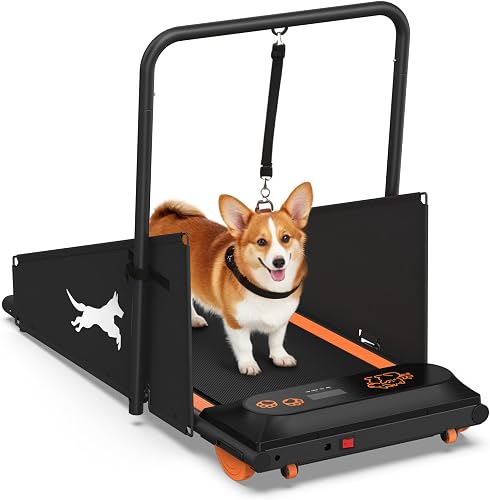
XMKEY Dog Treadmill
FitScore 49.4/100
The longest belt in our roundup at 41.5 inches, side barriers and a listed 30-minute auto-stop. Keep the leash in your hand, not on the hook.
Ranked in our Best Treadmill for Dogs guide
Check Price on AmazonTroubleshooting Common Training Problems
Most setbacks have a simple fix: go back one stage and slow down. A dog that was fine yesterday and nervous today may have been startled by something unrelated, so a short, easy session with extra treats usually resets things. Avoid forcing a dog back onto the belt; that tends to build a lasting dislike of the machine.
Size matters too. If your dog’s stride looks cramped or its back feet keep reaching the rear edge, the belt may be too short for it. Measure your dog from nose to base of tail and compare it with the belt length on the product page before you buy; our best treadmill for dogs guide lists belt length and width for each pick.
| Problem | Likely cause | What to try |
|---|---|---|
| Freezes when the motor starts | Noise introduced too fast | Return to motor-on with the dog beside the machine; pair the sound with treats |
| Jumps off the side | Speed too high or session too long | Lower the speed, shorten sessions, check that side panels are fitted |
| Turns around on the belt | Lure position too low or to the side | Hold treats at nose height in front of the console |
| Drifts to the back | Fatigue, or speed too low for the stride | End the session; next time adjust speed in small steps |
| Only works for food | Normal early in training | Space treats out gradually as the routine settles |
Choosing a Treadmill That Makes Training Easier
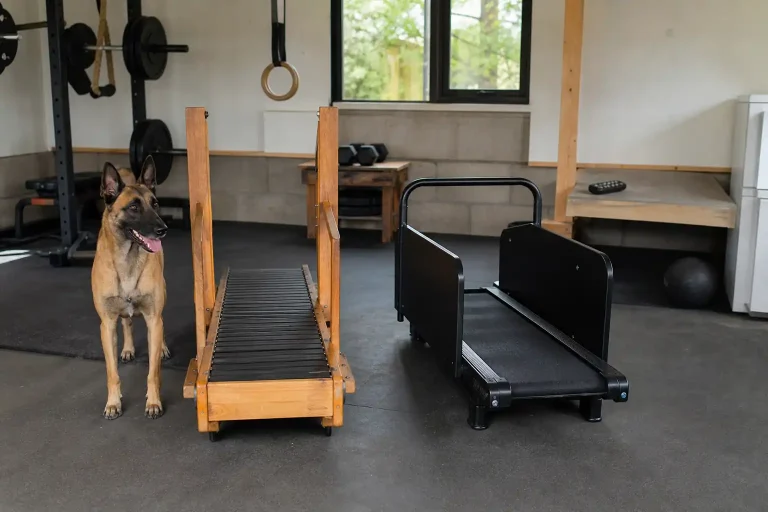
The right machine removes friction from every step above. A low minimum speed lets the first moving steps be truly gentle. Side panels guide your dog forward and make it harder to step off sideways. A remote lets you stand at your dog’s head while controlling the belt. A belt long enough for your dog’s stride keeps its gait natural.
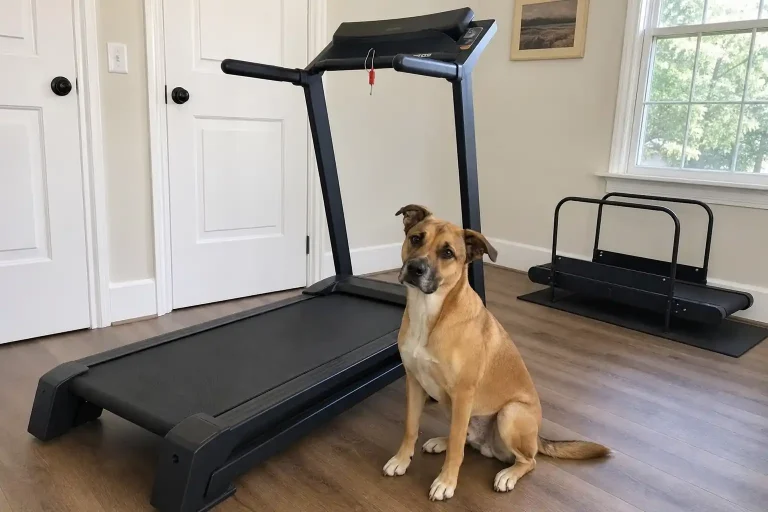
All five picks in our best treadmill for dogs guide are motorized and sized for small and medium dogs. If you are weighing a self-powered slatmill against a motorized model, our manual vs motorized dog treadmill comparison covers how each affects training. If you already own a treadmill for yourself, read can dogs use a human treadmill before you put your dog on it.
- Low minimum speed: look for 0.5 mph or similar.
- Side panels: keep your dog centered and facing forward.
- Remote control or emergency stop: stop the belt without leaving your dog.
- Belt length: longer than your dog with room for a full stride.
Checklist Before Every Session
- Your veterinarian has cleared treadmill exercise for your dog.
- The room is cool, quiet and free of other pets and toys.
- Water is available nearby.
- Incline is set to zero and speed to the lowest setting.
- Treats are ready and your dog is not on a full stomach.
- The leash, if used, is in your hand and not attached to the machine.
- The remote or safety key is in your hand.
- Nothing is behind the rear roller.
- You will stay beside the treadmill until the belt stops.
Common Mistakes to Avoid
- Turning the belt on before the dog is comfortable on a stationary deck.
- Starting above the lowest speed or adding incline during training.
- Running one long session instead of several short ones.
- Tying or clipping the leash to the treadmill.
- Leaving the room, even briefly, while the belt is moving.
- Ignoring early stress signals until the dog tries to escape.
The Bottom Line
- Start with the belt off and unplugged; the first goal is a dog that steps on by choice.
- Introduce motor noise with the dog off the belt before the first moving step.
- Begin at the lowest speed the machine allows and keep early sessions to a few minutes.
- Stop at signs of stress: looking away, refusing treats, ears pinned back, lagging at the rear of the belt.
- Hold the leash in your hand if you use one; never clip or tie it to the treadmill.
Our Top Picks
 Best OverallFYC 2-in-1 Dog TreadmillFitScore51.1/100Check on Amazon
- Best WarrantyLifepro PawRunnerFitScore50.3/100Check on Amazon
- Longest Belt PickXMKEY Dog TreadmillFitScore49.4/100Check on Amazon
Frequently Asked Questions
It varies widely by dog. Some dogs walk calmly within a few sessions, while others need weeks; in a 2022 study, working dogs took an average of about 9 sessions to fully acclimate.
Start at the lowest speed the treadmill allows, often 0.5 mph on dog treadmills. Increase only in small steps after several calm sessions.
Early sessions should last from under a minute to a few minutes. Ask your veterinarian how long your dog can safely exercise once it is comfortable.
No. Never tie, clip or hook the leash to a treadmill; if you use a leash, hold it loosely in your hand.
No. Stay beside the treadmill with the remote or safety key in your hand for every session.
Ask your veterinarian first. Puppies have developing joints, so a vet should decide whether and how much treadmill work is appropriate.
It works best as a supplement for bad-weather days or busy schedules. Outdoor walks also provide sniffing, socializing and mental stimulation that a treadmill cannot.
Go back to the machine-off stage, pair it with food and let your dog choose to approach. Move forward only when it is relaxed again.
This article contains affiliate links. If you click through and make a purchase, we may earn a small commission at no extra cost to you. As an Amazon Associate, we earn from qualifying purchases. We do not show prices because they change constantly: product details and availability can change at any time, so please check the current price and details directly on Amazon. Learn more. Amazon and the Amazon logo are trademarks of Amazon.com, Inc. or its affiliates.
