

Short answer
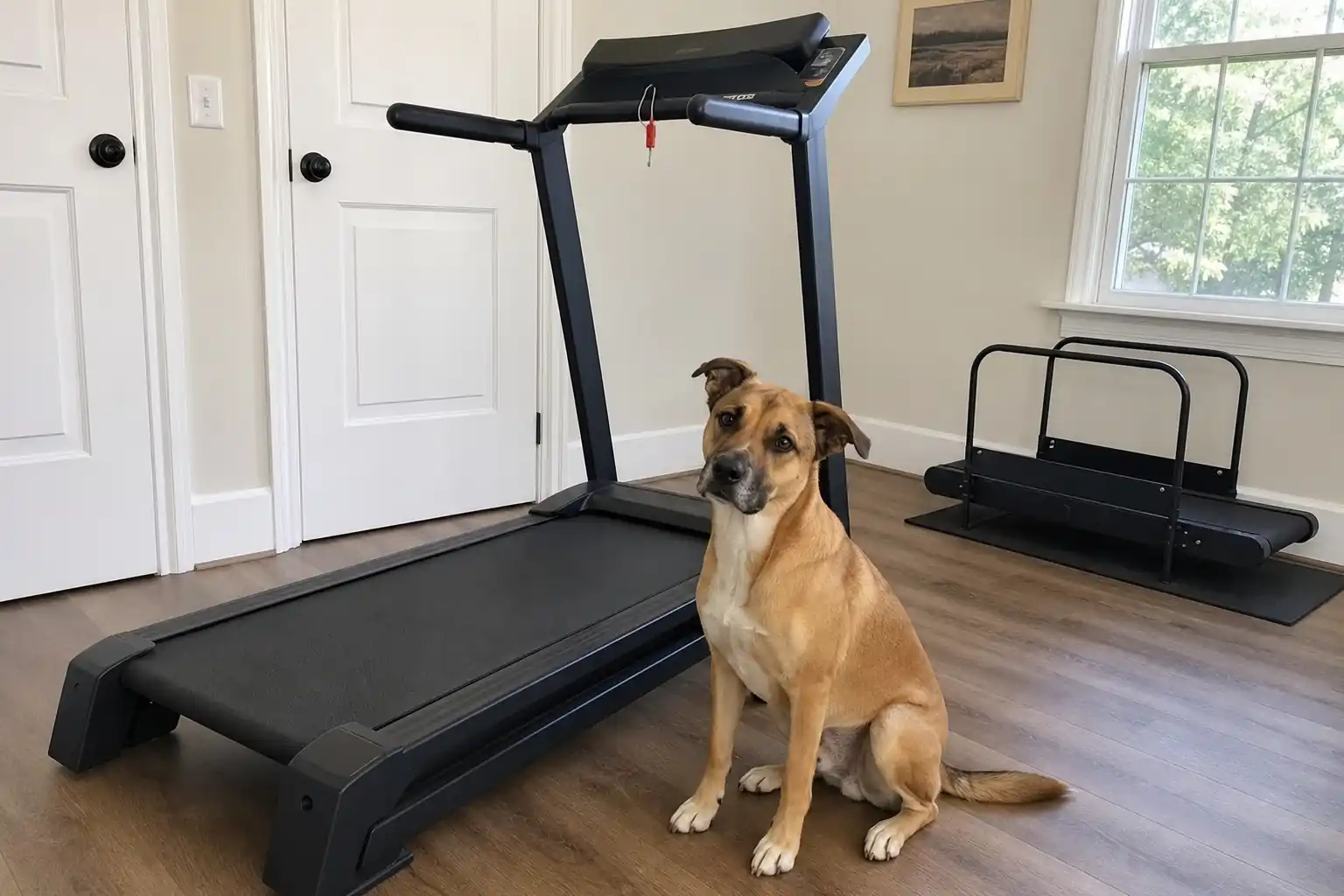
Some dogs can walk on a human treadmill with a slow introduction and constant supervision, but human treadmills are not designed for dogs. Open sides, belt sizes built for people, motor noise and a safety key meant for a human runner add risk. A dog-specific treadmill with side panels, a low start speed and a remote is the safer choice.
Key takeaways
- Dogs can use a human treadmill only with a slow introduction and an owner at the controls.
- Open sides, human-sized belts, motor noise and a human safety key make it riskier than a dog treadmill.
- Dog treadmills add side panels, low start speeds, remotes and dog-sized belts.
- The FYC 2-in-1 is sold as a dog treadmill that converts for compact human use, not the other way around.
- Never tie the leash to any treadmill, always supervise and keep the rear roller area clear.
- Check with your veterinarian before treadmill exercise for puppies, seniors, flat-faced breeds and dogs with health issues.
If you already own a treadmill, using it for your dog seems like an easy win on a rainy day. The honest answer is that it can work for a calm, healthy dog with a careful introduction and an owner standing beside the machine the whole time, but a human treadmill is not designed for dogs, and several of its features work against them.
This guide explains what to check on a human treadmill before a dog ever steps on it: belt length and width, side rails, motor noise, the emergency stop, and the gap at the rear roller. It also covers why dog-specific treadmills exist and how 2-in-1 models fit in. For machines built for dogs, see our best treadmill for dogs guide.
The Short Version: Possible, but Not Designed for Dogs
Nothing physically stops a dog from walking on a human treadmill. What changes is the margin for error. A dog treadmill is built around a four-legged walker that cannot read a console, hold a rail or pull a safety key. A human treadmill assumes the user can do all three. When the user is a dog, the owner has to make up the difference by standing at the controls and watching every step.
For a relaxed, healthy adult dog, a short supervised walk at the slowest speed on a full-size treadmill may be manageable. For a nervous dog, a small dog, a puppy, a senior, a flat-faced breed or a dog with joint, heart or breathing issues, talk to your veterinarian first and consider a dog-specific machine instead. Our best treadmill for dogs guide ranks five of them.
- Can work: calm, healthy adult dog; slowest speed; owner at the console the whole time.
- Rethink: nervous or small dogs, puppies, seniors, flat-faced breeds, dogs with health issues.
- Never: leash tied to the machine, dog left alone, incline or high speed during training.
Belt Length and Width: Sized for People, Not Dogs
Human treadmills size the belt around a human stride. Full-size running treadmills commonly have long belts built for running strides, while walking pads and compact walking treadmills have shorter, narrower belts. Neither size was chosen for a dog. A large belt gives a small dog room to wander, turn around or drift sideways; a short walking pad may leave a medium dog with a cramped stride.
Dog treadmills land in a narrower range. The five motorized picks in our best treadmill for dogs guide list belts from 35.43 to 41.5 inches long and 14.2 to 15.7 inches wide, sized for small and medium dogs. Width matters as much as length: a belt that is only as wide as needed helps keep a dog walking straight, especially when side panels frame it.
Before trying any treadmill, measure your dog from nose to base of tail and compare it with the belt length, leaving room for a full stride. Some dog treadmill makers publish dog-size limits; the Lifepro PawRunner listing, for example, recommends pets up to 35.4 inches tall and 29.5 inches long.
| Dog treadmill | Belt (L x W, inches) | Speed range (listed) | Role in our guide |
|---|---|---|---|
| FYC 2-in-1 Dog Treadmill | 41.3 x 15.7 | 0.5 to 6 mph | Best Overall |
| Lifepro PawRunner | 38.6 x 14.2 | 0.5 to 7.5 mph | Best Warranty |
| XMKEY Dog Treadmill | 41.5 x 15.7 | Up to 6 mph | Longest Belt Pick |
| ACIDBOLT Dog Treadmill | 39.3 x 15 | Up to 7.5 mph | Best Folding Pick |
| YHUBHSIS Dog Treadmill | 35.43 x 14.76 | 0.5 to 4 mph | Best for Small Dogs |
Check Amazon for current pricing and availability.
Side Rails and Open Sides
Human treadmills have side rails at hand height and open space below them. A person uses the rails for balance; a dog walks under them. That means nothing stops a dog from stepping off sideways onto the frame or the floor while the belt is moving, which is when slips and twisted legs happen.
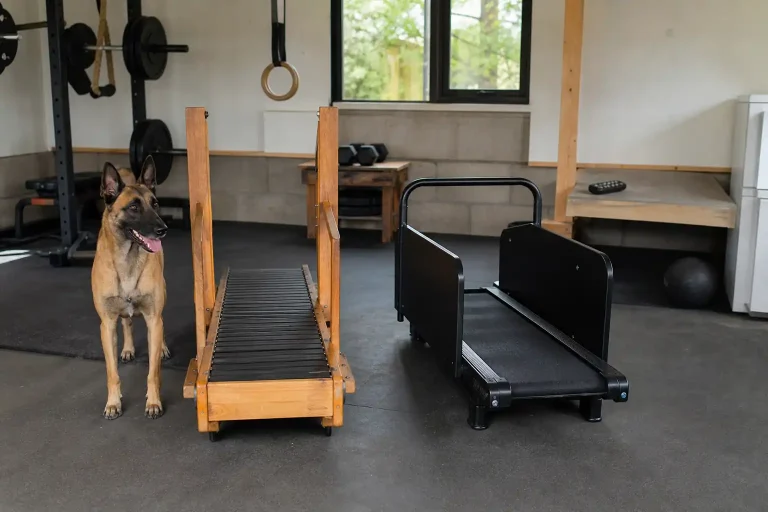
Dog treadmills close in that gap with side panels or screens that run along the belt at dog height. Several of our picks, including the XMKEY, ACIDBOLT and YHUBHSIS, list side barriers or screens. They guide the dog forward, make stepping off harder and reduce visual distractions. You still supervise, but the machine is doing part of the work.
Do not improvise panels from boxes or furniture placed against a running belt. Anything that touches the belt or sits near the rear roller can be pulled in. If you use a human treadmill, the safer option is to stand close on the open side and keep the session very short.
Speed, Controls and the Emergency Stop
On a human treadmill, the emergency stop is usually a safety key with a cord that clips to the runner. If the runner falls back, the key pulls out and the belt stops. A dog cannot wear that clip in a useful way, and attaching anything from the machine to your dog is a bad idea. The stop has to come from you: stand at the console with your hand near the key or stop button for the entire session.
Dog treadmills are built around remote control. Most of our picks include a remote, so you can stand at your dog’s head, offer treats and stop the belt without leaning over the console. The Lifepro PawRunner listing also mentions a safety key and an emergency stop button, and the XMKEY listing mentions a 30-minute auto-stop.
Speed range matters too. Human running treadmills are designed to reach running speeds and step up in small increments, which is fine, but it is easy to press the wrong button. Dog treadmills cap speed lower; the YHUBHSIS, for example, tops out at 4 mph. Whatever you use, start at the slowest setting and keep incline at zero during training.
- Stand at the console or hold the remote for the whole session.
- Never clip the safety key cord or a leash to your dog.
- Slowest speed only at first; no incline during training.
Best Warranty

Lifepro PawRunner
FitScore 50.4/100
Lists a safety key, an emergency stop button and a remote, plus a 0.5 mph minimum speed. Sold for small and medium dogs only.
Ranked in our Best Treadmill for Dogs guide
Check Price on AmazonLongest Belt Pick
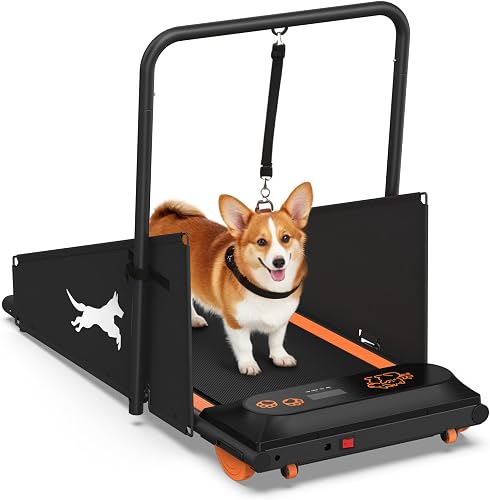
XMKEY Dog Treadmill
FitScore 49.4/100
Dual side barriers, a listed 30-minute auto-stop and a remote with quick-speed buttons. Hold the leash in your hand rather than using the hook.
Ranked in our Best Treadmill for Dogs guide
Check Price on AmazonBest Folding Pick

ACIDBOLT Dog Treadmill
FitScore 44/100
Two side screens to keep your dog centered, a remote and a folding frame for smaller homes.
Ranked in our Best Treadmill for Dogs guide
Check Price on AmazonMotor Noise and Vibration
Dogs notice sound and vibration that people tune out. A human treadmill motor, belt slap and the thud of a running deck can unsettle a dog before the belt even moves. Larger running treadmills also tend to have more powerful motors and heavier decks, which can make startup louder.
Dog treadmill listings focus on quiet operation. Manufacturers of our picks claim figures such as under 55 dB for the FYC, under 50 dB for the XMKEY and under 45 dB for the YHUBHSIS. These are listing claims, not our measurements, and any motor needs a gradual introduction.
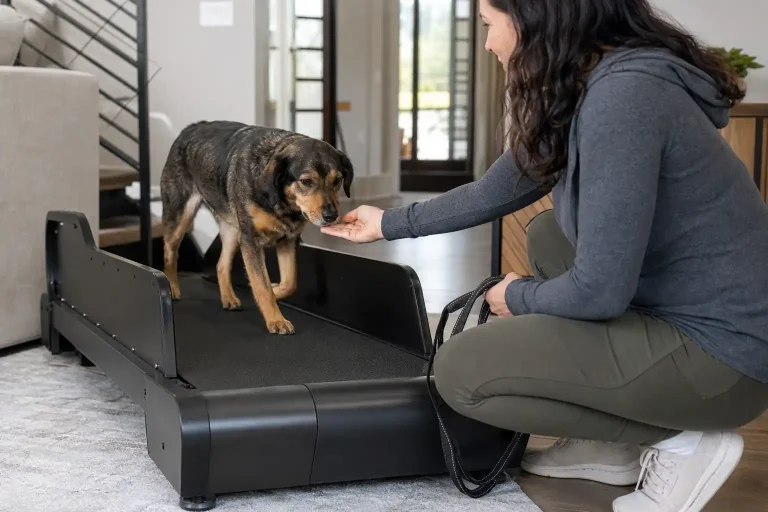
Whatever machine you use, introduce the motor with your dog standing beside the treadmill, not on it, and pair the sound with treats. Our guide on how to train a dog on a treadmill walks through this off-then-on approach step by step.
Rear Roller, Gaps and Household Safety
The rear of any motorized treadmill is the part to respect most. A dog that sits, lies down or turns while the belt keeps moving is carried toward the rear roller, and paws, tails, fur and leashes can be caught in the gap. In a 2021 CPSC warning about one home treadmill, the agency reported children and a pet being injured beneath the machine, and advised unplugging it and storing the safety key away from the device when not in use.
Keep a clear zone behind the treadmill, never let your dog lie on or behind the machine, and keep other pets and children out of the room while it runs. When the session ends, stop the belt, let your dog step off, unplug the treadmill and put the key away. These habits apply to dog treadmills as well, but they matter even more on a human treadmill with open sides.
Heat is the other household risk. Treadmill sessions happen indoors, yet a 2020 study of heat-related illness in dogs found most cases with a recorded trigger were linked to exercise, and brachycephalic dogs had greater odds of heat-related illness. Keep the room cool and the sessions short.
Watch out: Never tie or clip a leash to any treadmill. If your dog stops while the belt moves, a fixed leash can drag it toward the rear roller or pull on its neck.
Why Dog-Specific Treadmills Exist
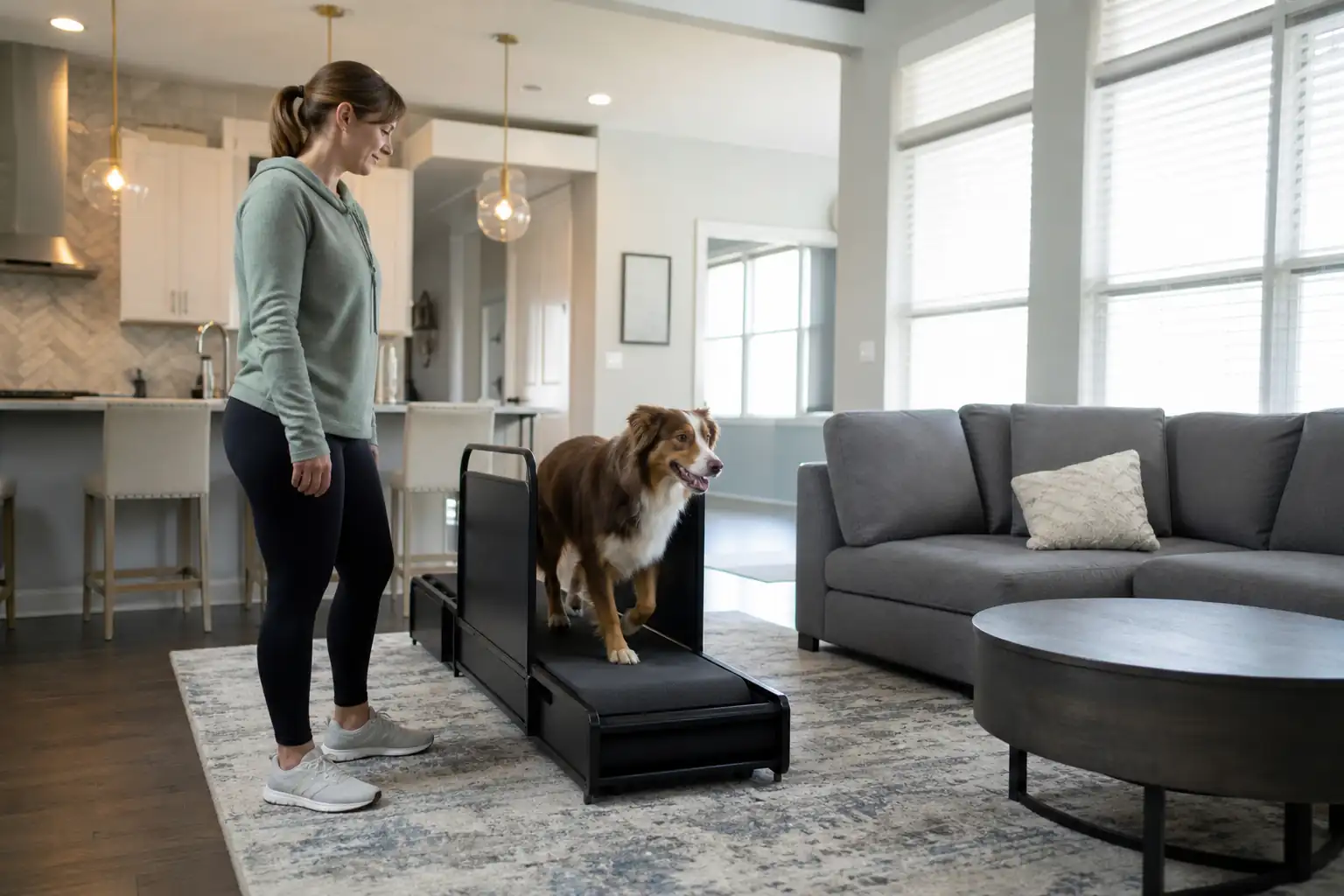
Dog treadmills solve the problems above in hardware. Side panels replace open sides. Low minimum speeds, often 0.5 mph on our picks, make the first moving steps gentle. Remotes let you control the belt from your dog’s head. Belts are sized for small and medium dogs, and footprints are compact enough for a living room.
They are not risk-free, and the same rules apply: constant supervision, short sessions, no attached leash, and a vet check for at-risk dogs. Our best treadmill for dogs guide compares five motorized models on belt size, speed range, side protection and warranty. If you are also weighing a self-powered slatmill, see our manual vs motorized dog treadmill comparison.
- Side panels at dog height instead of open sides.
- Low minimum speed for gentle starts.
- Remote control so you can stand with your dog.
- Belts sized for dogs rather than human strides.
2-in-1 Models: Dog and Human Use
A few dog treadmills are sold for both uses. The FYC 2-in-1 Dog Treadmill, our top pick, is described in its listing as a two-in-one treadmill: once the handrails are removed, it can be used as a compact treadmill for a person, with a 0.5 to 6 mph range and a 41.3 x 15.7-inch belt. The YHUBHSIS listing similarly says its side panels and armrests can be removed to use it as a compact under-desk treadmill.
That conversion runs from dog to human, not the other way around. These machines are built as dog treadmills first, with side protection and a dog-sized belt, and they can serve as a compact walking treadmill for you. A full-size human treadmill does not become a dog treadmill by adding a few treats. If you want one machine for both, a 2-in-1 dog model is the more sensible starting point, but expect compact walking-pad proportions for your own use rather than a running treadmill.
Best Overall

FYC 2-in-1 Dog Treadmill
FitScore 51.1/100
Sold as a 2-in-1 per its listing: a dog treadmill with removable handrails for compact human use, 0.5 to 6 mph and a remote.
Ranked in our Best Treadmill for Dogs guide
Check Price on AmazonBest for Small Dogs

YHUBHSIS Dog Treadmill
FitScore 42.5/100
Its listing describes removable side panels and armrests for under-desk human use; the 35.43-inch belt and 4 mph cap suit small dogs.
Ranked in our Best Treadmill for Dogs guide
Check Price on AmazonBest Warranty
Lifepro PawRunner
FitScore 50.4/100
A dedicated dog treadmill with a lifetime warranty listed in our data, a safety key and an emergency stop button.
Ranked in our Best Treadmill for Dogs guide
Check Price on AmazonIf You Use Your Own Treadmill Anyway: Safety Rules
If your veterinarian agrees and your dog is calm and healthy, follow these rules on a human treadmill. They are the same principles as on a dog treadmill, applied more strictly because the machine offers less protection. The full training sequence is in our guide on how to train a dog on a treadmill.
- Ask your veterinarian first, especially for puppies, seniors, flat-faced breeds and dogs with joint, heart or breathing issues.
- Introduce the machine while it is off and unplugged, with treats.
- Turn the motor on with your dog beside the treadmill before the first moving step.
- Use the slowest speed and zero incline; keep early sessions to a minute or two.
- Stand at the console with your hand by the stop button or safety key the whole time.
- Hold any leash loosely in your hand; never tie it to the treadmill.
- Keep the area behind the rear roller clear and other pets out of the room.
- Stop at signs of stress, fatigue or heat, and unplug the treadmill after every session.
Common Mistakes to Avoid
- Assuming a human treadmill is safe for dogs because the belt is large.
- Clipping the safety key cord or the leash to the dog or the machine.
- Starting at a walking speed meant for a person instead of the slowest setting.
- Leaving the open sides unguarded or blocking them with objects near the belt.
- Letting the dog lie on or behind the treadmill while it runs.
- Skipping a vet check for at-risk dogs.
The Bottom Line
- Human treadmills have open sides and side rails at human hand height, so a dog can step or fall off sideways.
- The safety key clips to a person, so a dog cannot stop the belt; you must stay beside the console.
- Belt length and width are sized for human strides, which may be too large or too small depending on the dog.
- Dog treadmills add side panels, low minimum speeds and remotes; our picks list 0.5 mph minimums.
- The FYC 2-in-1 is sold for both dogs and people; its listing says it converts once the handrails are removed.
Our Top Picks
 Best WarrantyLifepro PawRunnerFitScore50.4/100Check on Amazon
- Longest Belt PickXMKEY Dog TreadmillFitScore49.4/100Check on Amazon
- Best Folding PickACIDBOLT Dog TreadmillFitScore44/100Check on Amazon
- Best OverallFYC 2-in-1 Dog TreadmillFitScore51.1/100Check on Amazon
- Best for Small DogsYHUBHSIS Dog TreadmillFitScore42.5/100Check on Amazon
Frequently Asked Questions
Some calm, healthy dogs can with a slow introduction and constant supervision. Human treadmills are not designed for dogs, so a dog-specific model is safer.
It is not automatically harmful, but open sides, belt size and a safety key meant for a person add risk. Keep sessions short, slow and supervised, and ask your veterinarian first.
Dog treadmills add side panels at dog height, low minimum speeds, remote controls and belts sized for dogs. Human treadmills have open sides and controls designed for the person on the belt.
Some are sold as 2-in-1 models. The FYC 2-in-1 listing says it can be used as a compact treadmill for a person once the handrails are removed.
Start at the slowest speed the machine allows and increase only in small steps when your dog walks calmly with its head up. Ask your veterinarian for a target pace.
It is harder, because a large belt and open sides leave a small dog lots of room to drift or step off. A small dog treadmill like the YHUBHSIS is a better fit.
No. Never tie a leash to any part of a treadmill; hold it loosely in your hand if you use one.
This article contains affiliate links. If you click through and make a purchase, we may earn a small commission at no extra cost to you. As an Amazon Associate, we earn from qualifying purchases. We do not show prices because they change constantly: product details and availability can change at any time, so please check the current price and details directly on Amazon. Learn more. Amazon and the Amazon logo are trademarks of Amazon.com, Inc. or its affiliates.
