

Short answer
Choose a motorized dog treadmill if you want to set a slow, steady pace, train a nervous or average-energy dog, or follow a vet-guided routine. Choose a manual slatmill if you have a high-drive, athletic dog that likes to run, want no motor or cord, and can supervise closely while the dog sets the pace.
Key takeaways
- Motorized: you set the pace, which suits gradual training and most pet dogs.
- Manual slatmill: the dog sets the pace, which suits athletic, high-drive dogs.
- Both need constant supervision, short early sessions and a leash that is never attached to the machine.
- All five picks in our dog treadmill guide are motorized; we have not tested a slatmill.
- Check the motor line in the specs, not the product title, to know which type you are buying.
- Talk to your veterinarian before starting either type with an at-risk dog.
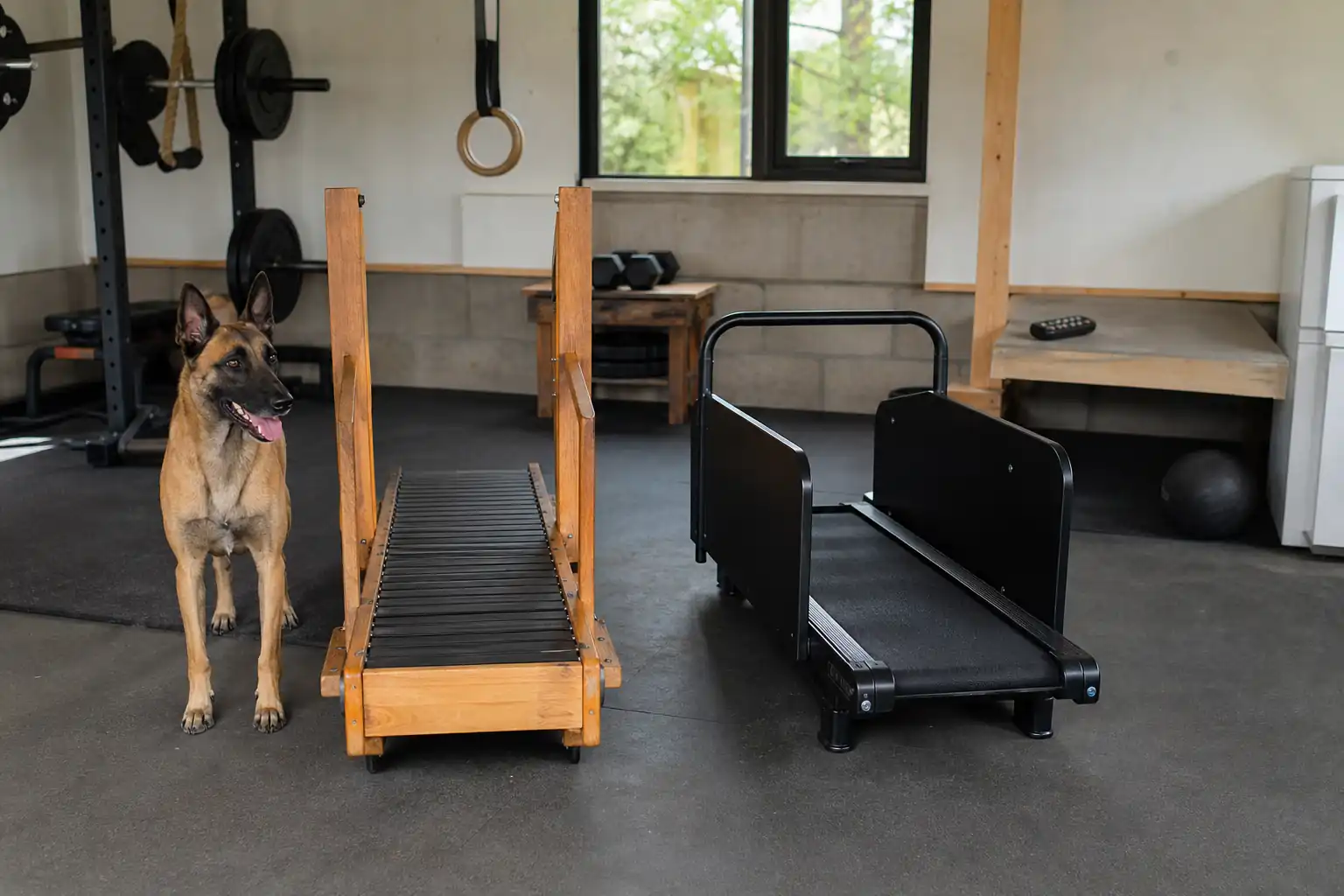
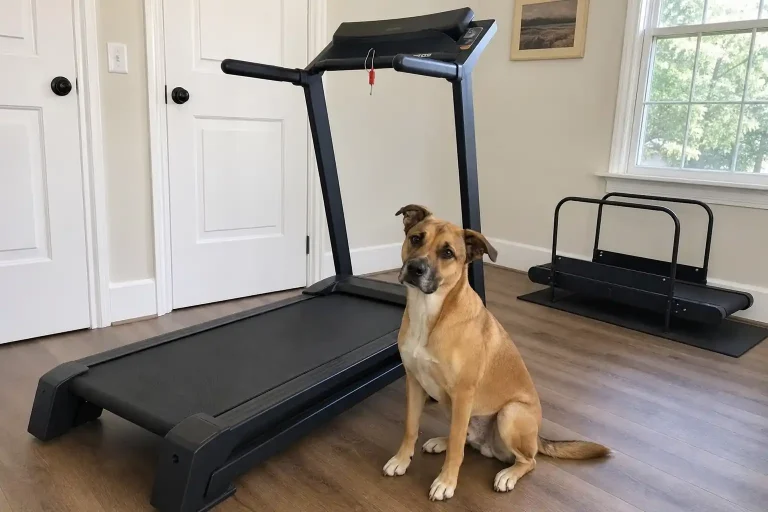
Dog treadmills come in two families. Manual, self-powered machines, most often called slatmills, have a belt that only turns when your dog drives it with its own legs. Motorized dog treadmills have an electric motor that moves the belt at a speed you choose, usually with a remote. Both get a dog moving indoors, but they suit different dogs, different owners and different goals.
This comparison walks through how each works, how they differ on safety, training, intensity, space and noise, and which buyer profile fits which type. Our best treadmill for dogs guide covers five motorized models for small and medium dogs; we say plainly where our testing stops, since we have not reviewed any slatmill.
Manual vs Motorized Dog Treadmill: Side-by-Side
The table sums up the practical differences. The short version: a motorized treadmill puts you in charge of the pace, while a self-powered mill puts your dog in charge. Everything else, from training to noise, follows from that.
Specs below describe the two categories in general terms. Individual models vary, so check the product page and manual for the machine you are considering. For the motorized side, our best treadmill for dogs guide lists belt size, speed range and warranty for each pick.
| Criterion | Manual / self-powered (slatmill, carpet mill) | Motorized dog treadmill |
|---|---|---|
| What moves the belt | The dog, by pushing with its legs | An electric motor |
| Who sets the pace | The dog | You, by console or remote |
| Motor | None (self-powered) | Yes; our picks list 0.5 to 2.5 HP |
| Starting speed | Whatever the dog chooses | Our picks list a low minimum, often 0.5 mph |
| Stopping | Belt slows when the dog stops | You stop the belt with the remote, button or safety key |
| Power needed | None | Wall outlet |
| Best suited to | High-drive, athletic dogs; conditioning | Gradual training, controlled walking, most pet dogs |
| Learning curve | Dog must learn to drive the belt | Dog learns to walk on a moving belt |
| Our coverage | Not tested or ranked | Five models ranked in our Best guide |
Check Amazon for current pricing and availability.
How a Manual Slatmill Works
A slatmill replaces the continuous rubber belt with a track of individual slats that roll over bearings. There is no motor. When your dog walks or runs, its push turns the track; when it slows, the track slows; when it stops, the track coasts to a stop. Carpet mills work on the same self-powered principle with a carpet-style running surface. Some models add resistance or a brake, so read the specs of any mill you consider.
Because the dog supplies all the power, a self-powered mill rewards dogs that like to move fast and push hard. Owners of working breeds and sport dogs often use them for conditioning. The flip side is that a dog that is unsure, low-energy or still learning may simply stand still, and you cannot ask the machine to keep a gentle walking pace for it.
Without a motor, a slatmill has no cord, no electronics to fail and no motor hum. It still has moving parts that need care, and the open slat track and frame need the same supervision as any treadmill. We do not recommend specific slatmills because we have not tested any; all of our ranked picks are motorized.
- Power: none (self-powered); the dog drives the track.
- Pace: set by the dog, from a stop to a sprint.
- Best for: athletic, high-drive dogs that already like to run.
How a Motorized Dog Treadmill Works
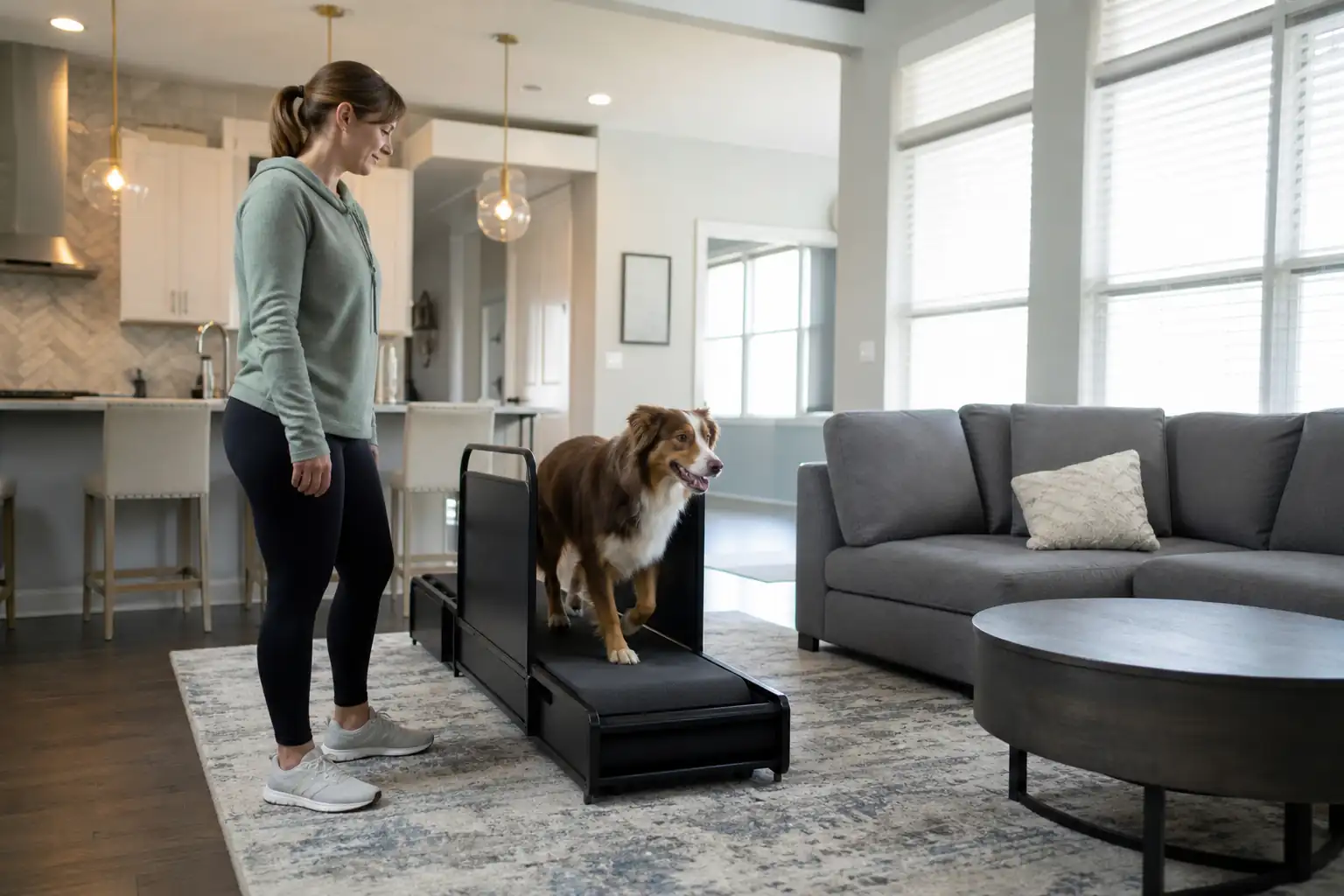
A motorized dog treadmill looks like a compact walking treadmill with side panels. An electric motor turns a continuous belt at the speed you select on a console or remote, and your dog walks to match it. Most models in this category are sized for small and medium dogs: the belts in our best treadmill for dogs guide range from 35.43 to 41.5 inches long and from 14.2 to 15.7 inches wide.
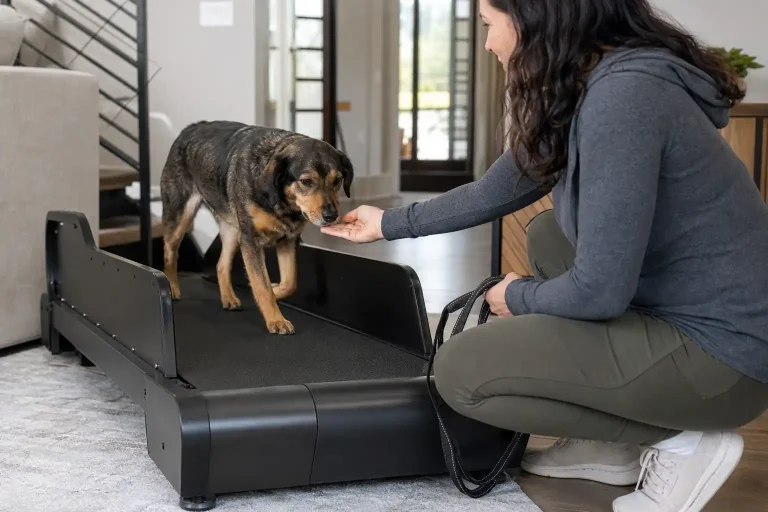
The key advantage is control. You can start at a crawl, hold a steady walking pace for a set time and stop the belt from beside your dog. That makes motorized models easier to use for gradual training, for dogs on a vet-guided exercise plan and for owners who want predictable sessions. Several of our picks add preset programs, an LCD display and side screens that help keep a dog centered.
Watch the listing wording: one of our picks, the ACIDBOLT Dog Treadmill, uses the word slatmill in its product title, but it is a motorized treadmill with a 1.5 HP motor and a standard belt. Check the motor line in the specs rather than the title to know which type you are buying.
- Power: electric motor; our picks list 0.5 to 2.5 HP.
- Pace: set by you; our picks top out between 4 and 7.5 mph.
- Best for: most pet dogs, gradual training and controlled walking.
Safety: Who Controls the Pace
Safety is the decisive difference for most households. On a motorized treadmill, the belt keeps moving until you stop it, so a dog that sits, turns or stumbles can be carried toward the rear roller. That is why you must stand beside the machine with the remote or safety key in hand. The benefit is that you never ask your dog for more speed than it is ready for.
On a self-powered mill, the track slows when your dog slows, so a tired dog is not pushed along by a motor. The risk runs the other way: an excited, high-drive dog may keep going harder or longer than is good for it, and the owner controls duration rather than speed. Heat matters on both types: a 2020 study of heat-related illness in dogs found that most heat-related illness cases with a recorded trigger were linked to exercise, and that brachycephalic dogs had greater odds of heat-related illness.
The same rules apply to both. Never tie or clip the leash to the machine, stay with your dog for the whole session, start with short sessions and ask your veterinarian before using either type with a puppy, a senior, a brachycephalic breed or a dog with joint, heart or breathing issues.
- Motorized: you limit speed; you must be ready to stop the belt instantly.
- Manual: belt stops when the dog stops; you must limit duration and intensity.
- Both: constant supervision, leash never attached, cool room, vet check first.
Watch out: Some motorized listings mention a leash hook or crossbar. Do not attach the leash to the machine while the belt moves; hold it loosely in your hand.
Best Warranty

Lifepro PawRunner
FitScore 50.4/100
Lists a safety key and an emergency stop button plus a remote, with a 0.5 to 7.5 mph range for small and medium dogs.
Ranked in our Best Treadmill for Dogs guide
Check Price on AmazonBest Overall

FYC 2-in-1 Dog Treadmill
FitScore 51.1/100
Our top pick: 0.5 to 6 mph, remote control and a 41.3 x 15.7-inch belt for controlled, gradual sessions.
Ranked in our Best Treadmill for Dogs guide
Check Price on AmazonLongest Belt Pick
XMKEY Dog Treadmill
FitScore 49.4/100
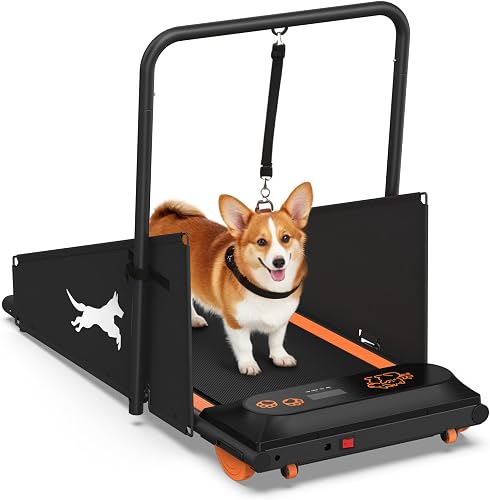
Side barriers, a listed 30-minute auto-stop and quick-speed buttons on the remote help you keep sessions predictable.
Ranked in our Best Treadmill for Dogs guide
Check Price on AmazonTraining Curve and Exercise Intensity
Motorized treadmills fit a step-by-step introduction: machine off, motor noise, slowest speed, then longer sessions. In a 2022 study on treadmill acclimation in working dogs, handlers used a motorized treadmill, started at 0.5 mph and raised speed only when each dog appeared comfortable. That level of fine control is hard to reproduce on a self-powered mill. Our guide on how to train a dog on a treadmill lays out the full progression.
A slatmill asks the dog to learn a different skill: pushing the track to make it move. Confident, food- or toy-motivated dogs often pick it up quickly; cautious dogs may not want to start the track at all. Intensity is set by the dog, so a slatmill session can range from an easy walk to an all-out run depending on its drive.
If your goal is steady low-intensity walking for a pet dog, a motorized treadmill is usually the simpler path. If your goal is conditioning an athletic dog that loves to run, a self-powered mill can be the better fit, provided you limit session length and watch closely for fatigue and heat.
Space, Noise, Power and Upkeep
Motorized dog treadmills need a wall outlet and produce some motor noise. Manufacturers of our picks claim low figures, such as under 55 dB for the FYC and under 45 dB for the YHUBHSIS; these are listing claims, not our measurements. Dogs are sensitive to sound and vibration, so introduce the motor gradually whatever the number says. Only one of our five picks, the ACIDBOLT, is listed as folding.
Self-powered mills need no outlet and have no motor, so the main sound is the track and the dog. Without electronics there is less to fail, but bearings, slats and frames still need inspection and cleaning. They are often built for larger, athletic dogs, so check the footprint and weight in the specs against your space.
Warranty differs by model rather than by type. Among our motorized picks, the Lifepro PawRunner lists lifetime coverage, three models list 1 year and the YHUBHSIS lists 3 months, according to our best treadmill for dogs data. Check the current terms on the product page before you buy.
| Factor | Manual / self-powered | Motorized |
|---|---|---|
| Outlet needed | No | Yes |
| Main noise source | Track and paws | Motor, belt and paws |
| Electronics | None | Console, remote, motor controller |
| Folding | Varies by model | One of our five picks folds (ACIDBOLT) |
| Routine care | Inspect slats, bearings and frame; clean track | Clean belt, check tension and alignment per manual |
Which Should You Choose?
Match the machine to your dog and to the role you play in each session. Most pet owners who want controlled indoor walks on bad-weather days are better served by a motorized model. A self-powered mill makes more sense for owners of athletic dogs who already run hard and who can supervise intensity closely.
If you already own a human treadmill and wonder whether it could do the job, read can dogs use a human treadmill first; open sides and long, fast belts change the safety picture.
- Nervous or first-time dog: motorized, for a very slow start and full pace control.
- Senior dog or vet-guided routine: motorized, after your veterinarian approves the plan.
- Small apartment: motorized compact or folding model; check belt length against your dog.
- High-drive working or sport dog: a self-powered slatmill can suit, with strict limits on session length.
- No outlet or no motor noise wanted: self-powered mill.
- Owner who wants preset sessions and a remote: motorized.
Best Folding Pick

ACIDBOLT Dog Treadmill
FitScore 44/100
The only folding model in our roundup, with a 1.5 HP motor, a 39.3 x 15-inch belt, side screens and a remote. Motorized despite the slatmill wording in its title.
Ranked in our Best Treadmill for Dogs guide
Check Price on AmazonBest for Small Dogs

YHUBHSIS Dog Treadmill
FitScore 42.5/100
A compact 35.43 x 14.76-inch belt and a 4 mph top speed suit small dogs and gentle walking sessions.
Ranked in our Best Treadmill for Dogs guide
Check Price on AmazonBest Overall
FYC 2-in-1 Dog Treadmill
FitScore 51.1/100
The highest FitScore in our dog guide, with a 41.3-inch belt and a remote for controlled training sessions.
Ranked in our Best Treadmill for Dogs guide
Check Price on AmazonCommon Mistakes to Avoid
- Buying a slatmill for a nervous dog that has never used a treadmill.
- Assuming a listing that says slatmill is self-powered without checking the motor spec.
- Letting a high-drive dog run on a self-powered mill with no time limit.
- Starting a motorized treadmill above its lowest speed.
- Attaching the leash to a leash hook or crossbar while the belt moves.
- Skipping the vet check for puppies, seniors and flat-faced breeds.
The Bottom Line
- A manual slatmill or carpet mill moves only when the dog pushes it; a motorized treadmill moves the belt at a speed you set.
- Motorized models let you start very slowly, which suits gradual training and controlled walking.
- Self-powered mills let the dog speed up or stop on its own, which suits athletic dogs but makes pace harder to control.
- All five dog treadmills in our Best guide are motorized; we have not tested or ranked a slatmill.
- Either type needs constant supervision, and the leash should never be attached to the machine.
Our Top Picks
 Best WarrantyLifepro PawRunnerFitScore50.4/100Check on Amazon
- Best OverallFYC 2-in-1 Dog TreadmillFitScore51.1/100Check on Amazon
- Longest Belt PickXMKEY Dog TreadmillFitScore49.4/100Check on Amazon
- Best Folding PickACIDBOLT Dog TreadmillFitScore44/100Check on Amazon
- Best for Small DogsYHUBHSIS Dog TreadmillFitScore42.5/100Check on Amazon
Frequently Asked Questions
A motorized treadmill is usually better for most pet dogs because you control the pace. A manual slatmill suits athletic, high-drive dogs that like to run and set their own speed.
A slatmill is a self-powered dog treadmill with a track of slats on bearings. The dog moves the track with its own legs; there is no motor.
They remove the risk of a motor pushing a tired dog, but they make intensity harder to limit. Both types need constant supervision.
Some dogs are wary of motor noise at first. Introduce the sound with the dog off the belt and pair it with treats before the first moving session.
No. All five picks in our best treadmill for dogs guide are motorized, and we have not tested or ranked a slatmill.
You can hold a leash loosely in your hand for guidance, but never tie or clip it to either type of treadmill.
Most motorized dog treadmills on the market are sized for small and medium dogs and start at a slow speed, which suits small dogs well.
This article contains affiliate links. If you click through and make a purchase, we may earn a small commission at no extra cost to you. As an Amazon Associate, we earn from qualifying purchases. We do not show prices because they change constantly: product details and availability can change at any time, so please check the current price and details directly on Amazon. Learn more. Amazon and the Amazon logo are trademarks of Amazon.com, Inc. or its affiliates.
