

Short answer
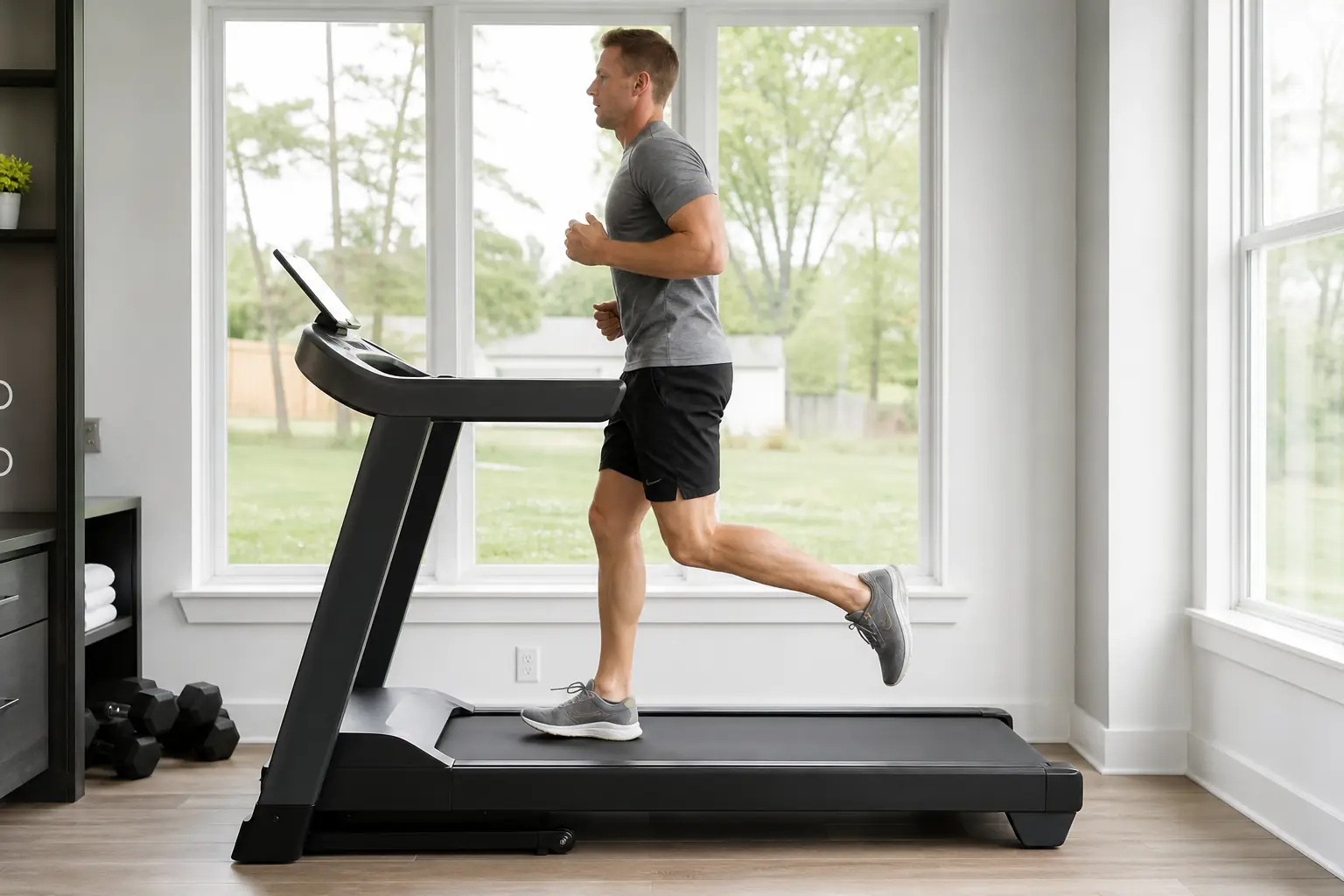
For walking, a 20 × 50 to 20 × 55-inch belt is enough for most adults. For jogging, choose at least 20 × 55 inches. For running, choose 20 × 60 inches, and 22 × 60 inches if you are over about 6 feet tall, heavier or have a wide stride. Walking pads suit slow walking only.
Key takeaways
- 20 × 55 inches suits most walkers; 20 × 60 inches suits most runners.
- Runners over about 6 feet tall should look for 22 × 60 inches.
- Length matters most for speed; width matters most for comfort and stability.
- Compact belts of 45 to 50 inches are fine for walking in small rooms.
- Walking pads are for slow walking, not running.
- Size for the fastest, tallest person who will use the treadmill.
Belt size is the spec that decides whether a treadmill feels roomy or cramped. Too short, and you shorten your stride, clip the motor hood or drift off the back at speed. Too narrow, and you watch your feet instead of the road ahead. Too big, and you give up floor space you did not need to lose.
This guide explains how treadmill belt size is measured, the width and length to look for by use and by height, and when a compact deck or walking pad is enough. All example sizes come from the listings of treadmills ranked in our Best guides. If you are still choosing a type of machine, start with our treadmill buying guide.
How Treadmill Belt Size Is Measured
Belt size is written as width × length, in inches, and it describes the running surface you can actually step on: 20 × 60 means 20 inches side to side and 60 inches front to back. The physical belt loop is longer because it wraps around the rollers, so when a listing says “running area” or “running surface,” that is the number to compare.
Belt size is not the same as the treadmill footprint. A treadmill with a 20 × 60-inch belt is usually 73 to 83 inches long and 34 to 38 inches wide overall, because the motor hood, rollers, side rails and uprights add to the frame. Our best treadmill for small spaces guide lists both numbers for each pick.
The table shows the belt sizes you will see most often, with real examples from our rankings.
| Type | Typical belt size | Examples from our guides | Best for |
|---|---|---|---|
| Walking pad | About 15.5–17 × 37–41 in | Trisomy D2 (16 × 37.5), WalkingPad P1 (16.5 × 40) | Slow walking, under-desk use |
| Compact treadmill | About 16–20 × 45–50 in | BORGUSI CTM5103 (17.5 × 45.3), XTERRA TR150 (16 × 50) | Walking, light jogging in small rooms |
| Walking treadmill | 20 × 55 in | Horizon T101, NordicTrack T Series 7 | Walking, incline walking, easy jogging |
| Standard running treadmill | 20 × 60 in | Horizon 7.0 AT, XTERRA TR75, NordicTrack T Series 10 | Jogging and running for most adults |
| Wide running treadmill | 22 × 60 in | Horizon 7.4 AT, Sole TT8, Sole F89 | Tall, heavy or fast runners |
Check Amazon for current pricing and availability.
Belt Length by Use: Walking, Jogging and Running
Length is the dimension that changes most with speed. When you walk, your feet stay close together and one foot is always on the belt. When you jog and run, your stride gets longer and you spend part of each step in the air, so you need room in front to land and room behind as a buffer. A belt that feels fine at 3 mph can feel tight at 7 mph.
The CDC counts walking at 2.5 mph or faster as moderate-intensity activity, and most treadmill walking happens between 2 and 4 mph. In that range, 50 to 55 inches of length is enough for most adults. Once you jog regularly, 55 inches is the practical minimum, and runners should look for 60 inches.
| Use | Minimum size | Better size | Why |
|---|---|---|---|
| Slow walking (under 3 mph) | 16 × 40 in | 18 × 50 in | Short, close steps; a walking pad works |
| Brisk and incline walking | 18 × 50 in | 20 × 55 in | Longer steps and a natural arm swing |
| Jogging (about 4.5–6 mph) | 20 × 55 in | 20 × 60 in | Flight phase starts; you need a front and rear buffer |
| Running (6 mph and up) | 20 × 60 in | 22 × 60 in | Long strides; room to drift without stepping off |
| Sprints and fast intervals | 22 × 60 in | 22 × 60 in or longer | Longest strides and the most fore-aft movement |
Pro tip: Buy for your fastest planned speed, not your usual one. If you will ever jog or do intervals, a 60-inch deck saves you from outgrowing the treadmill.
Belt Length by Height
Taller people take longer steps at the same speed, so height shifts every recommendation above. There is no official height chart from a standards body, so the table below is our rule of thumb, built from the stride logic above and the deck sizes in our rankings. Treat it as a starting point and size up when in doubt.
For walking, height matters less: even tall walkers rarely need more than 55 inches. For running, it matters a lot. A runner over about 6 feet tall on a 55-inch deck often feels the need to shorten the stride or run close to the motor hood. That is why our best treadmill for tall runners guide only ranks 60-inch decks, and most of them are 22 inches wide.
| User height | Walking | Jogging | Running |
|---|---|---|---|
| Under 5 ft 6 in | 50 in | 55 in | 55–60 in |
| 5 ft 6 in to 6 ft | 50–55 in | 55–60 in | 60 in |
| 6 ft to 6 ft 3 in | 55 in | 60 in | 60 in, 22 in wide |
| Over 6 ft 3 in | 55–60 in | 60 in | 60 in or longer, 22 in wide |
Best for Tall Runners

Horizon 7.4 AT
FitScore 88.6/100
A 22 × 60-inch belt with a 3.5 CHP motor, 0–15% incline and a 350-lb rating, plus QuickDial speed and incline controls. Read our review.
Ranked in our The Best Treadmill For Tall Runners guide
Check Price on AmazonMost Stable Deck

Sole TT8
FitScore 86/100
A non-folding 22 × 60-inch deck with a 4 HP motor, 15% incline, 6% decline and a 400-lb capacity. Read our review.
Ranked in our The Best Treadmill For Tall Runners guide
Check Price on AmazonBest Smart Pick

NordicTrack Commercial 2450
FitScore 85.8/100
A 22 × 60-inch deck, up to 14 mph and a -3% to 12% range; iFIT classes need a paid membership. Read our review.
Ranked in our The Best Treadmill For Tall Runners guide
Check Price on AmazonBelt Width: 16 vs 18 vs 20 vs 22 Inches
Width is about comfort and confidence more than stride. On a narrow belt, your feet land close to the side rails and you tend to look down, which is tiring and makes it easier to catch a rail. A wider belt lets you drift a little side to side, swing your arms freely and look ahead.
Twenty inches is the standard for home running and suits most adults. Twenty-two inches is worth it for heavier users, people with broad shoulders or a wide gait, and anyone who feels hemmed in. The Arthritis Foundation suggests a belt at least 22 inches wide and 50 inches long so walkers with arthritis have room to move and are less likely to step off by accident. Our best treadmill for heavy people and best treadmill for seniors guides weigh width heavily.
- 16 inches: walking pads and the smallest compact treadmills; fine for slow, steady walking.
- 18 inches: compact treadmills; workable for walking and short jogs.
- 20 inches: the standard for full-size home treadmills, suitable for running.
- 22 inches: premium and heavy-duty decks; the most room for tall, heavy or fast users.
Compact Belts: When a Shorter Deck Is Enough
A shorter, narrower deck is a fair trade if you mostly walk and space is tight. Compact treadmills with belts around 45 to 50 inches long fold up small, weigh less and still allow brisk walking, incline walking and short, easy jogs for average-height users. They are a poor choice for regular running, especially if you are tall.
Walking pads go further: belts around 16 × 40 inches, no tall console and top speeds that often stop at 4 to 6 mph on the models we rank. They are designed for walking at a desk or in front of the TV. Our best compact treadmill and most compact treadmill guides compare the trade-offs model by model.
Widest Compact Belt

WELLFIT TM029 FOLD
FitScore 77.4/100
A 20 × 50-inch belt on a folding frame, with up to 15% incline and 10 mph, so walkers keep a full-width surface. Read our review.
Ranked in our Best Compact Treadmill guide
Check Price on AmazonBest Cushioned Compact

ECHANFIT 5519
FitScore 75/100
An 18 × 47-inch belt with up to 15% incline and a 400-lb listed capacity, sized for walking and light jogging.
Ranked in our Best Compact Treadmill guide
Check Price on AmazonSmallest Footprint

BORGUSI CTM5103
FitScore 71.6/100
A 17.5 × 45.3-inch belt in a frame about 54 inches long, with up to 15% incline for incline walking. Read our review.
Ranked in our Best Compact Treadmill guide
Check Price on AmazonIncline, Speed and the Usable Part of the Belt
You never use the full listed length. You need a little room in front so your toes do not touch the motor hood and a buffer behind so a missed step does not put you off the back. That buffer matters more as speed rises, which is why the jump from 55 to 60 inches is so noticeable for runners.
Incline changes how you use the belt. On a steep grade you take shorter, more upright steps and tend to stay near the front, so a 50 to 55-inch deck works for most incline walkers. Running on an incline still needs a long deck. If steep walking is your main workout, see our best incline trainer and best treadmill with incline guides.
A longer belt also gives you more room when you step off to the side rails or straddle the belt to start. Always clip the safety key to your clothing so the belt stops if you drift back too far, and keep the space behind the treadmill clear, as your owner manual specifies.
Watch out: If you catch yourself watching your feet or touching the hood with your toes, the belt is too short for your speed. Slow down or move to a longer deck rather than shortening your stride.
How to Check Belt Size Before You Buy
Start with the listing or spec sheet and look for “running surface,” “running area” or “belt size.” If a listing gives only the overall dimensions, do not guess; check the manufacturer specification or the questions section before buying. Then compare it with the tables above for your height and fastest planned speed.
Next, think about who else will use it. A treadmill shared by a 5 ft 4 in walker and a 6 ft 2 in runner should be sized for the runner. Finally, check that the bigger deck still fits your room, ceiling and doorway. A 22 × 60-inch treadmill is long and heavy, and our best treadmill for apartments guide shows which full-size decks fold.
- Find the running surface size, not just the overall dimensions.
- Match length to your fastest planned speed and your height.
- Choose 22 inches wide if you are heavy, broad or unsteady.
- Size for the tallest and fastest person in the household.
- Check top speed and motor rating against the same use.
Belt Size Checklist
- Read the running surface size (width × length) on the listing.
- Walking only: 20 × 50 to 20 × 55 inches; walking pad for slow desk walking.
- Jogging: at least 20 × 55 inches.
- Running: at least 20 × 60 inches.
- Over about 6 feet tall and running: 22 × 60 inches.
- Heavier users, arthritis or balance concerns: look for 22 inches wide.
- Size for the tallest, fastest person who will use it.
- Confirm the overall footprint still fits your room.
Common Mistakes to Avoid
- Comparing overall treadmill length instead of the running surface.
- Buying a 50-inch compact deck for regular running.
- Expecting a walking pad to handle jogging.
- Ignoring width and then watching your feet on every step.
- Sizing for the shortest user in a shared household.
- Shortening your stride to fit a short belt instead of slowing down.
The Bottom Line
- Belt size is listed as width × length of the running surface, in inches; 20 × 60 inches is the standard for home running.
- Length matters most for running, because stride length grows with speed; width matters most for comfort, stability and larger users.
- Taller users need more length at the same speed; runners over about 6 feet tall should treat 60 inches as the minimum.
- The Arthritis Foundation suggests a belt at least 22 inches wide and 50 inches long for walkers with arthritis.
- Walking pads usually have belts around 16 × 40 inches and low top speeds, so they are built for walking, not running.
Our Top Picks
 Best for Tall RunnersHorizon 7.4 ATFitScore88.6/100Check on Amazon
- Most Stable DeckSole TT8FitScore86/100Check on Amazon
- Best Smart PickNordicTrack Commercial 2450FitScore85.8/100Check on Amazon
- Widest Compact BeltWELLFIT TM029 FOLDFitScore77.4/100Check on Amazon
- Best Cushioned CompactECHANFIT 5519FitScore75/100Check on Amazon
- Smallest FootprintBORGUSI CTM5103FitScore71.6/100Check on Amazon
Frequently Asked Questions
20 × 60 inches is the best all-around size for home use because it handles walking, jogging and running for most adults. Walkers can use 20 × 55 inches, and tall or heavy runners should look for 22 × 60 inches.
It works for shorter runners at easy paces, but most runners are more comfortable on a 60-inch deck, especially at faster speeds and during intervals.
Yes, for most adults. Choose 22 inches if you are heavier, broad-shouldered, have a wide gait or want extra room for balance.
For walking, 55 inches is enough. For jogging and running, choose a 60-inch deck, and consider 22 inches wide for the most room.
Yes, for most people walking at normal speeds. Taller walkers who take long strides may prefer 55 inches.
Most walking pads are built for walking, with belts around 40 inches long and low top speeds. A few allow light jogging, but none replaces a 60-inch running deck.
Not directly. Cushioning depends on the deck and suspension, but larger decks are more common on premium models that also have better cushioning.
Explore More Treadmill Guides
The Best Treadmill For Tall Runners: 5 Long-Deck Picks for Confident Strides
Best Compact Treadmill (2026): 5 Space-Saving Picks
Best Treadmill for Running (2026): Top 5 Picks
Best Treadmill for Walking: 5 Standout Home Picks for 2026
Treadmill Buying Guide (2026): How to Choose the Right Home Treadmill
Best Walking Pad (2026): 5 Picks for Home and Under-Desk Walking
This article contains affiliate links. If you click through and make a purchase, we may earn a small commission at no extra cost to you. As an Amazon Associate, we earn from qualifying purchases. We do not show prices because they change constantly: product details and availability can change at any time, so please check the current price and details directly on Amazon. Learn more. Amazon and the Amazon logo are trademarks of Amazon.com, Inc. or its affiliates.
