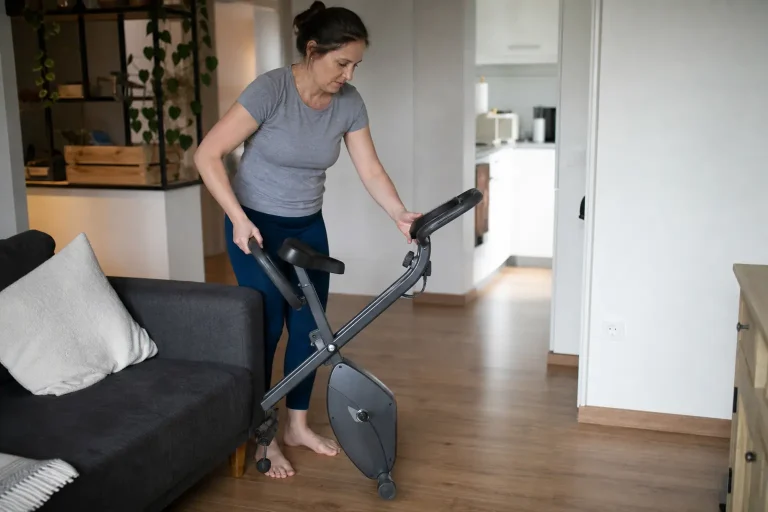
Bike Seat Height Calculator
1Your inseam
Saddle height, 109% method
–
A starting point, not a medical fitting. If you feel knee, hip or back pain, lower the effort and see a professional.
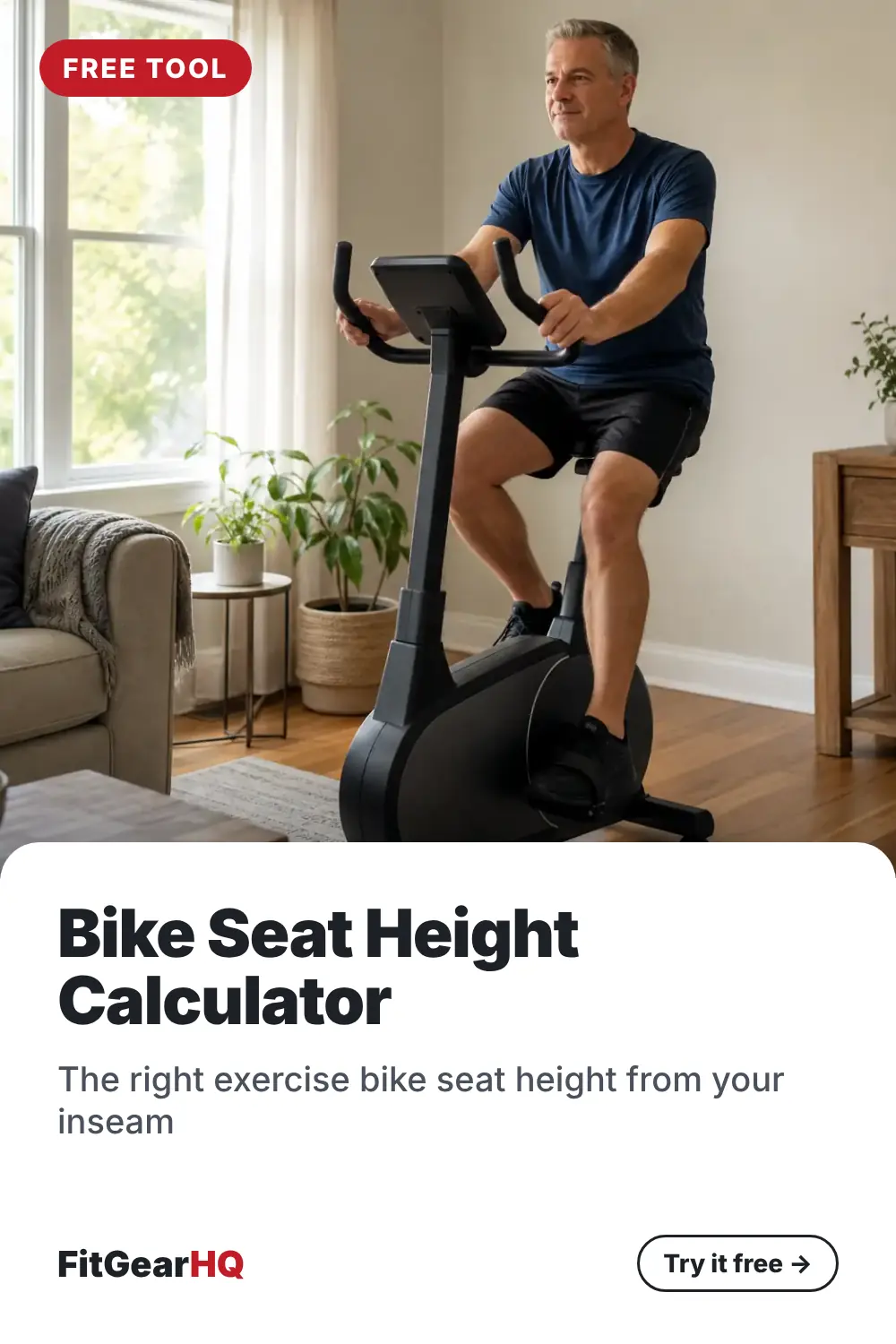
Free tool · Updated November 5, 2026
The right seat height from one measurement
A seat that is too low strains the knees; too high, it rocks your hips. Enter your inseam for two classic starting heights, then fine-tune with a simple heel check.
Short answer
A good starting exercise bike seat height is 109% of your inseam, measured from the pedal at its lowest point to the top of the saddle, or 0.883 x inseam from the crank axle. For a 32 in inseam that is about 34.9 in and 28.3 in. Then check that your knee keeps a slight bend at the bottom of the stroke.
Key takeaways
- Start at 109% of your inseam from pedal to saddle top.
- The LeMond formula gives the same height measured from the crank axle.
- Fine-tune so your knee keeps a slight bend at the bottom of the stroke.
- Recumbent seats are set by leg reach, not by these formulas.
Seat height is the first setting to get right on an exercise or spin bike. Too low and your knees bend sharply on every stroke; too high and your hips rock and your feet reach for the pedals.
This bike seat height calculator gives two classic starting points from one measurement, your inseam, then shows how to fine-tune by feel, the way bike fitters do.
How the Two Formulas Work
109% method. Researchers in 1967 found cyclists worked most efficiently with the saddle at about 109% of inseam, measured from the pedal at the bottom of the stroke, in line with the seat tube, to the top of the saddle.
LeMond method. Popularized by the cycling champion Greg LeMond, it multiplies the inseam by 0.883 and measures from the center of the crank axle to the top of the saddle. Because the crank arm adds length below the axle, both methods land close together.
A 2005 study in the Journal of Exercise Physiology Online found no meaningful difference between the two heights, but neither put every rider in the 25 to 35 degree knee angle usually recommended for injury prevention: about two in three riders landed there. That is why the fine-tuning step matters.
Within that range, lower knee angles (a slightly higher seat) were more economical: a 2008 study found riders used less oxygen at a 25 degree knee angle than at 35 degrees or at 109% of inseam, and a 2011 study confirmed it in well-trained cyclists.
| Inseam | 109% method (pedal to saddle) | LeMond (crank axle to saddle) |
|---|---|---|
| 28 in (71 cm) | 30.5 in | 24.7 in |
| 30 in (76 cm) | 32.7 in | 26.5 in |
| 32 in (81 cm) | 34.9 in | 28.3 in |
| 34 in (86 cm) | 37.1 in | 30.0 in |
| 36 in (91 cm) | 39.2 in | 31.8 in |
Fine-Tune: the Heel Check and the Knee Angle
Sit on the saddle and put your heel on the pedal at its lowest point. Your leg should be straight without your hips tilting. When you pedal normally on the ball of your foot, that leaves a slight bend at the knee.
Raise or lower the seat in small steps, about a quarter inch at a time, and ride a few minutes between changes. If your hips rock side to side, the seat is too high; if your knees feel crowded at the top of the stroke, it is too low.
- Spin and upright bikes: note the number on the seat post once it feels right, so every rider can reset it quickly.
- Fore and aft: with the cranks level, your front knee should sit roughly above the pedal axle.
- Shoes: set the height with the shoes you ride in; thick soles change it.
Recumbent and Under-Desk Bikes
On a recumbent bike you sit behind the pedals, so the formulas above do not apply. Slide the seat until your leg is almost straight, with a slight knee bend, when the pedal is furthest from you, and your back rests fully against the backrest.
Under-desk pedalers depend on your chair height: keep your knees below the desk at the top of the stroke. See the best recumbent bike rankings for models with long seat rails.
Choose a Bike That Fits You
A seat can only go as high or low as its post allows. Very tall or short riders should check the rider height range the maker states before buying.
- Tall riders: see the best upright exercise bike and best spin bike rankings, which list rider height ranges.
- Easy step-through: see the best exercise bike for seniors.
- Count the work: the exercise bike calorie calculator estimates the calories of each ride.
Share, Embed or Cite This Calculator
Trainers and gyms are welcome to link to or embed this bike seat height calculator; the result link keeps the numbers entered.
Share this calculator
Send it to a friend, a training partner or your followers. These buttons share the calculator itself, not your results.
Embed the interactive calculator
For websites and blogs. Paste this code where you want the calculator: your visitors use it right on your page. It resizes itself and shows a credit link to FitGearHQ.
Add a link card
For blogs, newsletters and pages that do not allow scripts: a clean card with a picture and one link.
Cite this calculator
- TitleBike Seat Height Calculator
- PublisherFitGearHQ
- URLhttps://fitgearhq.com/bike-seat-height-calculator/
- Updated
More Free Fitness Tools
See them all on Exercise Bike Tools or Fitness Calculators, compare exercise bikes or browse every free fitness tool.
Checklist for Setting Your Seat Height
4 checks
Tap a number to check off that step.
- 01
Measure your inseam barefootUse a book pressed up firmly, floor to its top edge.
- 02
Measure along the seat tubeFrom the pedal at the bottom, or from the crank axle for LeMond.
- 03
Do the heel checkLeg straight with the heel on the pedal at the bottom.
- 04
Change in small stepsAbout a quarter inch at a time, riding between changes.
Common Mistakes to Avoid
Mistake 1Setting the seat by eye
Instead: Most riders set it too low, which loads the knees.
Mistake 2Measuring with shoes on
Instead: Measure the inseam barefoot; set the height in riding shoes.
Mistake 3Using upright formulas on a recumbent
Instead: Recumbent seats are set by leg reach.
Mistake 4Ignoring hip rocking
Instead: Rocking hips mean the seat is too high.
The Bottom Line
- 109% method: saddle height = inseam x 1.09, pedal to saddle top.
- LeMond method: saddle height = inseam x 0.883, crank axle to saddle top.
- Target knee angle at the bottom of the stroke: about 25 to 35 degrees.
- Free, no sign-up; the link keeps your inputs.
Frequently Asked Questions
Start at 109% of your inseam from the pedal at its lowest point to the top of the saddle; for a 32 in inseam, about 34.9 in. Then check your knee keeps a slight bend at the bottom.
Your knees bend sharply at the bottom of the stroke and feel crowded at the top, and you may feel pressure at the front of the knee.
Your hips rock side to side, your toes point down to reach the pedals, or the back of your knee feels stretched.
Saddle height = inseam x 0.883, measured from the center of the crank axle to the top of the saddle.
Only with your heel on the pedal. Pedaling normally on the ball of the foot should leave a slight bend, about 25 to 35 degrees.
Slide it until your leg is almost straight, with a slight bend, when the pedal is furthest from you.
Explore More Exercise Bike Guides
Best Exercise Bike for Home (2026): The Top Picks of Every Bike Type
Best Spin Bike for Home (2026): 5 Indoor Cycling Bikes Ranked
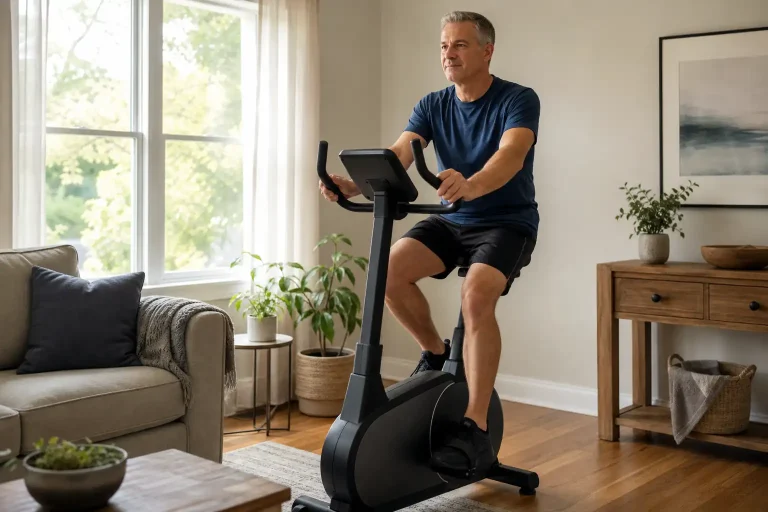
Best Upright Exercise Bike (2026): 5 Picks Ranked by FitScore
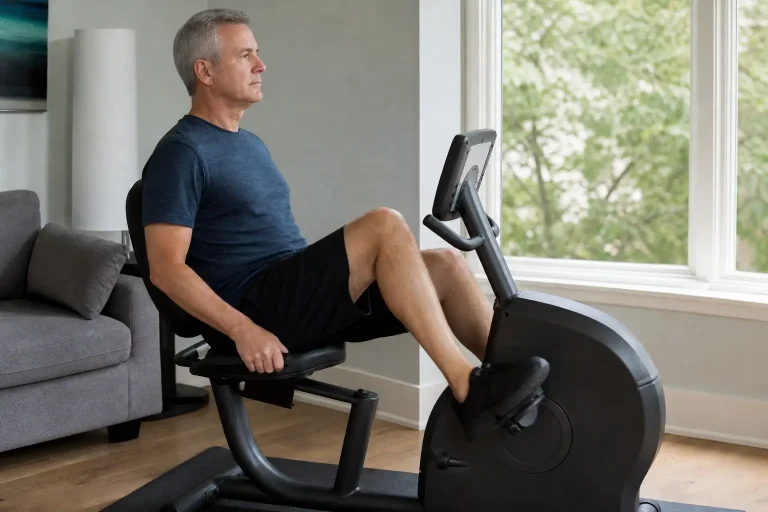
Best Recumbent Bike (2026): 5 Picks for Comfortable Home Cardio
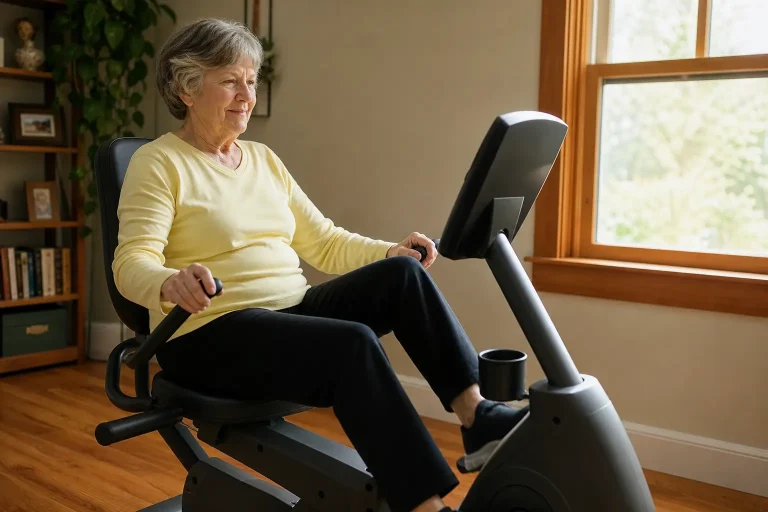
Best Exercise Bike for Seniors (2026): 5 Easy-Access Picks