2K Row Time Calculator
1Your 2K
Faster than this share of ranked racers
–
2K levels at your age, sex and weight class
How you compare with elite athletes: the world record holders
World records: Concept2 world record list for the static RowErg (no slides), read November 3, 2026. Lightweight = men 165 lb (75 kg) or less, women 135 lb (61.5 kg) or less; no weight classes below age 17. Percentiles: Silva-Alonso et al., 2018, official 2,000 m races 2010 to 2014; racers are fitter than the average adult, so the median here is a strong time.
FitGearHQ is independent and not affiliated with Concept2. Concept2, RowErg and PM5 are trademarks of Concept2, Inc.; the formulas are the ones Concept2 publishes for its monitors, so the numbers match what a PM5 shows.

Free tool · Updated November 3, 2026
How good is your 2K?
The 2,000 m is the standard race and fitness benchmark on a rowing machine. Enter your time, age, sex and weight to see where you stand among 15,420 ranked indoor racers, and how far behind the world record holders you would finish.
Short answer
A good 2K row time depends on age, sex and weight. Among ranked indoor racers aged 35, the median 2k row time is 6:50.6 for heavyweight men and 7:56.4 for heavyweight women; the top 10% row under 6:18.7 and 7:16.2. The world records are 5:33.4 (Simon von Dorp) and 6:21.1 (Brooke Mooney). Enter your time below to see your level.
Key takeaways
- Racers are a fit group: matching their median is already a strong 2K.
- Times are fastest in the early-to-mid 20s, then slow gradually with age.
- Weight class matters less than sex: lightweight men are within a few seconds of heavyweights at the same percentile, lightweight women about 15 seconds.
- Compare yourself with your age group record, not just the open record.
A 2K row time is the result of a 2,000 m all-out piece on a rowing machine, the distance of Olympic races and of most indoor rowing championships. It is also the number coaches ask for first. On its own, though, a time says little: 7:30 is excellent for a 60-year-old woman and modest for a 25-year-old heavyweight man.
This calculator places your 2K on published percentile curves by age, sex and weight class, then sets it against the world records of the champions in your category. The tables below the calculator give the same reference times for every age, so you can set a fair goal.
What Is a Good 2K Row Time?
The reference values come from Silva-Alonso and colleagues (Journal of Human Sport and Exercise, 2018), who modeled 15,420 official 2,000 m indoor race results recorded between 2010 and 2014 in the Concept2 online ranking, from age 14 to 70, for heavyweight and lightweight men and women. The tables show the time that puts you in the top 10%, top 25%, at the median, and so on.
Read them with one point in mind: these are people who enter races. A median time here is well above the average gym-goer. As a guide, a heavyweight man aged 35 who rows 7:00.0 is faster than about 40% of ranked racers his age.
| Age, classAge | Top 10%P10 | Top 25%P25 | MedianP50 | Top 75%P75 | Top 90%P90 |
|---|---|---|---|---|---|
| 20, heavyweight | 6:11.6 | 6:22.5 | 6:38.6 | 6:59.1 | 7:20.9 |
| 20, lightweight | 6:25.6 | 6:35.2 | 6:50.0 | 7:08.2 | 7:24.9 |
| 30, heavyweight | 6:14.8 | 6:28.4 | 6:48.4 | 7:13.5 | 7:39.3 |
| 30, lightweight | 6:21.7 | 6:32.0 | 6:49.9 | 7:13.8 | 7:37.2 |
| 40, heavyweight | 6:22.6 | 6:35.4 | 6:52.9 | 7:13.9 | 7:35.7 |
| 40, lightweight | 6:31.1 | 6:41.7 | 6:59.1 | 7:21.5 | 7:42.5 |
| 50, heavyweight | 6:34.7 | 6:47.4 | 7:04.2 | 7:24.3 | 7:45.4 |
| 50, lightweight | 6:45.1 | 6:54.9 | 7:10.3 | 7:29.0 | 7:46.1 |
| 60, heavyweight | 6:51.9 | 7:06.1 | 7:25.2 | 7:47.9 | 8:11.3 |
| 60, lightweight | 7:00.6 | 7:10.7 | 7:26.2 | 7:45.4 | 8:03.6 |
| 70, heavyweight | 7:09.8 | 7:26.1 | 7:48.5 | 8:15.0 | 8:41.4 |
| 70, lightweight | 7:20.7 | 7:30.6 | 7:45.8 | 8:04.8 | 8:23.4 |
| Age, classAge | Top 10%P10 | Top 25%P25 | MedianP50 | Top 75%P75 | Top 90%P90 |
|---|---|---|---|---|---|
| 20, heavyweight | 7:13.7 | 7:28.3 | 7:48.2 | 8:12.5 | 8:39.2 |
| 20, lightweight | 7:36.5 | 7:50.6 | 8:09.7 | 8:32.8 | 8:57.4 |
| 30, heavyweight | 7:08.3 | 7:24.6 | 7:46.4 | 8:12.3 | 8:39.3 |
| 30, lightweight | 7:28.3 | 7:42.3 | 8:02.8 | 8:28.9 | 8:56.9 |
| 40, heavyweight | 7:24.2 | 7:42.7 | 8:06.4 | 8:34.0 | 9:02.5 |
| 40, lightweight | 7:34.9 | 7:49.6 | 8:12.1 | 8:40.8 | 9:10.5 |
| 50, heavyweight | 7:45.8 | 8:02.9 | 8:24.2 | 8:48.1 | 9:12.1 |
| 50, lightweight | 7:45.1 | 8:00.6 | 8:24.9 | 8:56.0 | 9:27.3 |
| 60, heavyweight | 7:54.5 | 8:18.4 | 8:49.6 | 9:26.6 | 10:05.7 |
| 60, lightweight | 8:02.4 | 8:19.0 | 8:45.3 | 9:19.1 | 9:52.5 |
| 70, heavyweight | 8:20.2 | 8:46.0 | 9:20.2 | 10:01.4 | 10:45.5 |
| 70, lightweight | 8:33.4 | 8:51.4 | 9:20.5 | 9:57.9 | 10:34.3 |
2K Row Times of the Champions: World Records by Age
The fastest 2K ever rowed on a static rowing machine is 5:33.4, by Simon von Dorp (NED, 2026); for women it is 6:21.1, by Brooke Mooney (USA, 2021). Concept2 keeps a world record list for every age group from 12 and under to 100 and over, split into heavyweight and lightweight from age 17. The tables below list the 2,000 m holders as published on that list on November 3, 2026.
Records are set at sanctioned events with witnesses and weigh-ins for lightweights; a few categories have no record yet. New marks appear several times a year, so a record shown here can fall.
| Age groupAge | Heavyweight (open below 17)Heavyweight | Lightweight |
|---|---|---|
| 12 and Under | 6:54.3 Lorenzo López Rivadeneira (ARG, 2026) | No weight class |
| 13-14 | 6:16.7 Isaiah Harrison (USA, 2018) | No weight class |
| 15-16 | 5:53.2 Isaiah Harrison (USA, 2020) | No weight class |
| 17-18 | 5:45.5 Gennaro Di Mauro (ITA, 2019) | 6:06.5 Henrik Stephansen (DEN, 2006) |
| 19-29 | 5:33.4 Simon von Dorp (NED, 2026) | 5:56.7 Henrik Stephansen (DEN, 2013) |
| 30-39 | 5:36.6 Rob Waddell (NZL, 2008) | 6:06.0 Eskild Ebbesen (DEN, 2004) |
| 40-49 | 5:47.8 Pavel Shurmei (AIN, 2017) | 6:13.1 Miroslav Vrastil (CZE, 2024) |
| 50-54 | 6:01.0 Luke Wollenschlaeger (RSA, 2023) | 6:24.8 Jesus Gonzalez (ESP, 2025) |
| 55-59 | 6:09.9 Andrew Benko (USA, 2023) | 6:29.6 Mike Smith (USA, 2018) |
| 60-64 | 6:17.8 Richard Tomlinson (AUS, 2025) | 6:40.9 Denis Crowley (IRL, 2023) |
| 65-69 | 6:33.5 Gustave Carl Schoch (CAN, 2020) | 6:46.3 Gérard Le Flohic (FRA, 2021) |
| 70-74 | 6:44.0 Richard Stout (CAN, 2023) | 6:55.8 Raimund Haberl (AUT, 2022) |
| 75-79 | 7:07.3 Jeremy Martin (GBR, 2025) | 7:15.4 Rod Stewart (AUS, 2025) |
| 80-84 | 7:26.6 Paul Guest (AUS, 2019) | 7:40.4 Geoffrey Knight (GBR, 2015) |
| 85-89 | 7:54.2 Mike Hurley (GBR, 2021) | 8:13.6 Robert Spenger (USA, 2010) |
| 90-94 | 8:42.4 Robert Spenger (USA, 2015) | 8:43.6 Philip Price (AUS, 2024) |
| 95-99 | 9:35.9 Allan Coles (AUS, 2022) | 9:55.8 Dean Smith (USA, 2021) |
| 100+ | Not listed | 13:32.6 John Hodgson (GBR, 2010) |
| Age groupAge | Heavyweight (open below 17)Heavyweight | Lightweight |
|---|---|---|
| 12 and Under | 7:19.3 Katherine Feret (USA, 2023) | No weight class |
| 13-14 | 7:06.1 Beckie Leigh (NZL, 2017) | No weight class |
| 15-16 | 6:46.1 Grace McGinley (USA, 2016) | No weight class |
| 17-18 | 6:28.2 Sofia Asoumanaki (GRE, 2015) | 7:04.9 Dimitra Eleni Kontou (GRE, 2022) |
| 19-29 | 6:21.1 Brooke Mooney (USA, 2021) | 6:53.8 Jennifer Casson (CAN, 2018) |
| 30-39 | 6:25.6 Olena Buryak (UKR, 2019) | 6:55.3 Michelle Sechser (USA, 2024) |
| 40-49 | 6:41.8 Meghan Musnicki (USA, 2023) | 7:05.3 Juliane Elander (DEN, 2019) |
| 50-54 | 6:58.0 Joanne Ritchie (CAN, 2012) | 7:18.3 Justine Reston (GBR, 2019) |
| 55-59 | 7:10.1 Anne Bourlioux (CAN, 2016) | 7:26.9 Armelle Hosquet (FRA, 2026) |
| 60-64 | 7:29.7 Nancy Cook (USA, 2025) | 7:35.5 Susan Hooten (USA, 2015) |
| 65-69 | 7:40.5 Susan Hooten (USA, 2018) | 7:44.6 Susan Hooten (USA, 2018) |
| 70-74 | 7:57.7 Ann Elizabeth Wopat (USA, 2024) | 8:03.1 Susan Hooten (USA, 2023) |
| 75-79 | 8:15.5 Mies Bernelot Moens (NED, 2021) | 8:31.4 Elizabeth Feldman (AUS, 2023) |
| 80-84 | 8:47.5 Luanne Mills (USA, 2019) | 9:07.4 Anne Cresswell (AUS, 2018) |
| 85-89 | 10:11.8 Alida Kingswood (CAN, 2021) | 9:29.5 Anne Cresswell (AUS, 2023) |
| 90-94 | 10:29.3 Alida Kingswood (CAN, 2022) | 10:33.3 Alida Kingswood (CAN, 2023) |
| 95-99 | 12:45.4 Valarie Coleman (GBR, 2025) | 14:23.1 Dorothy (Dottie) Stewart (USA, 2018) |
| 100+ | Not listed | 16:35.4 Dorothy (Dottie) Stewart (USA, 2023) |
How Age Changes Your 2K
In the percentile curves, times drop quickly from 14 to the early 20s, bottom out around 23 to 25, then slow in a steady line. Seiler and colleagues (Medicine & Science in Sports & Exercise, 1998) looked at 2,487 men and 1,615 women in indoor races: among the fastest men, times slowed by only about 3% per decade from 24 to 50, then about 7% per decade to 74; for women the decline was close to linear.
Rowing ages well. In a 2025 analysis of world records by age, rowing showed the smallest decline of the sports studied, about 5% per ten years from age 40 to the mid 60s. A masters rower who trains can stay close to the times of their 30s for a long time.
- Pace your 2K. The rowing pace calculator gives the split for any goal time.
- Train by power. Convert a watt target with the watts to split calculator.
- Check your aerobic base. A strong 2K needs a high VO2 max; estimate yours with the VO2 max calculator.
- Row at home. Our best air rowing machines suit hard 2K training.
| 2,000 m time2K | Split /500 mSplit | WattsW |
|---|---|---|
| 6:00.0 | 1:30.0 | 480 |
| 6:15.0 | 1:33.8 | 425 |
| 6:30.0 | 1:37.5 | 378 |
| 6:45.0 | 1:41.2 | 337 |
| 7:00.0 | 1:45.0 | 302 |
| 7:15.0 | 1:48.8 | 272 |
| 7:30.0 | 1:52.5 | 246 |
| 7:45.0 | 1:56.2 | 223 |
| 8:00.0 | 2:00.0 | 203 |
| 8:15.0 | 2:03.8 | 185 |
| 8:30.0 | 2:07.5 | 169 |
| 8:45.0 | 2:11.2 | 155 |
| 9:00.0 | 2:15.0 | 142 |
| 9:15.0 | 2:18.8 | 131 |
| 9:30.0 | 2:22.5 | 121 |
Share, Embed or Cite This Calculator
Coaches, clubs and teams are welcome to link to or embed this 2K row time calculator; the result link keeps the numbers entered.
Share this calculator
Send it to a friend, a training partner or your followers. These buttons share the calculator itself, not your results.
Use this calculator like an app
Put 2K Row Time Calculator on your phone’s home screen: it opens full screen in one tap, like a native app, with no download from a store.
- iPhone (Safari)Tap Share , then Add to Home Screen, then Add.
- Android (Chrome)Tap the menu ⋮, then Add to home screen or Install app.
- ComputerBookmark the page, or in Chrome and Edge use the install icon in the address bar.
Embed the interactive calculator
For websites and blogs. Paste this code where you want the calculator: your visitors use it right on your page. It resizes itself and shows a credit link to FitGearHQ.
Add a link card
For blogs, newsletters and pages that do not allow scripts: a clean card with a picture and one link.
Cite this calculator
- Title2K Row Time Calculator
- PublisherFitGearHQ
- URLhttps://fitgearhq.com/2k-row-time/
- Updated
More Free Fitness Tools
See them all on Fitness Calculators, compare rowing machines or browse every free fitness tool.
Checklist Before Your 2K
4 checks
Tap a number to check off that step.
- 01
Warm up for 10 to 15 minutesInclude a few short pieces at race pace.
- 02
Use the damper setting you train withRace day is not the time to try a new resistance.
- 03
Plan an even splitUse the pace calculator to pick a split you can hold to 1,500 m.
- 04
Weigh yourself the same dayYour weight decides your class and your watts per kg.
Common Mistakes to Avoid
Mistake 1Starting far too fast
Instead: A first 500 m well under your goal split costs more in the last 500 m.
Mistake 2Comparing with the open record only
Instead: Use your age group and weight class for a fair goal.
Mistake 3Rating too high
Instead: Power per stroke sets the split; 2K races are rowed at about 30 to 42 strokes per minute.
Mistake 4Rowing every session all-out
Instead: Save full 2K efforts for planned trials and row most sessions below race pace.
The Bottom Line
- Percentiles: Silva-Alonso et al. 2018, 15,420 official 2,000 m race results, ages 14 to 70.
- World records: Concept2 world record list, RowErg, by sex, weight class and age group.
- Lightweight = men 165 lb (75 kg) or less, women 135 lb (61.5 kg) or less.
- Split = time / 4; watts = 2.80 / (split / 500)^3; free, works with PM5 times.
Frequently Asked Questions
For ranked indoor racers aged 35, the median is about 6:50.6 for heavyweight men and 7:56.4 for heavyweight women. Under 6:18.7 (men) or 7:16.2 (women) is a top 10% time. Use the calculator for your age and weight class.
Among ranked racers, median times rise from the mid 20s: for heavyweight men about 6:41 at 25, 6:53 at 40, 7:04 at 50, 7:25 at 60; for heavyweight women about 7:37 at 25, 8:06 at 40, 8:50 at 60.
5:33.4 for men, by Simon von Dorp (NED, 2026), and 6:21.1 for women, by Brooke Mooney (USA, 2021), on the Concept2 world record list for the static RowErg as of November 3, 2026.
For a heavyweight man it is close to the racing median up to about age 47, better than the median after that, and a top 10% time from about 65. For a woman it is exceptional: inside the top 10% of heavyweight racers at every age and in the top 2% from about 38.
The split is your time divided by 4. Watts = 2.80 / (split / 500)^3, the formula rowing monitors use. A 7:00 2K is a 1:45.0 split and about 302 watts.
Yes. Enter the time from your PM5 workout summary. It is an independent FitGearHQ tool; the records are cited from the list Concept2 publishes.
Explore More Rowing Machine Guides
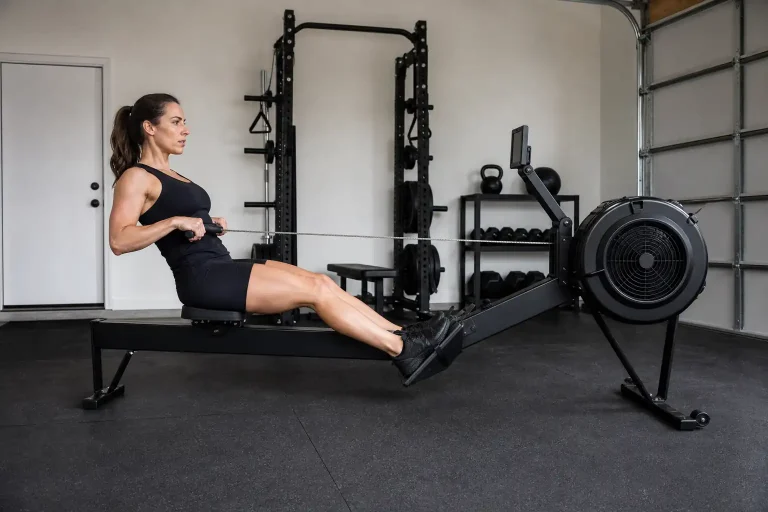
Best Air Rowing Machine (2026): 5 Picks for Hard Training
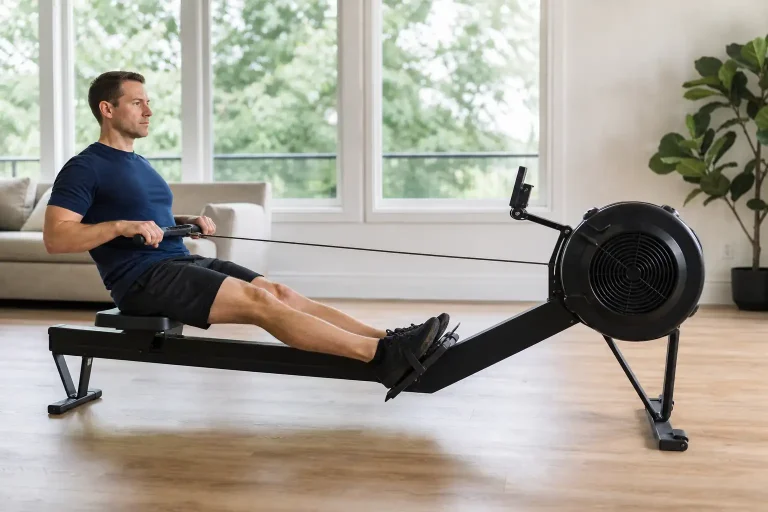
Best Rowing Machine (2026): 5 Top Picks for Home, Ranked
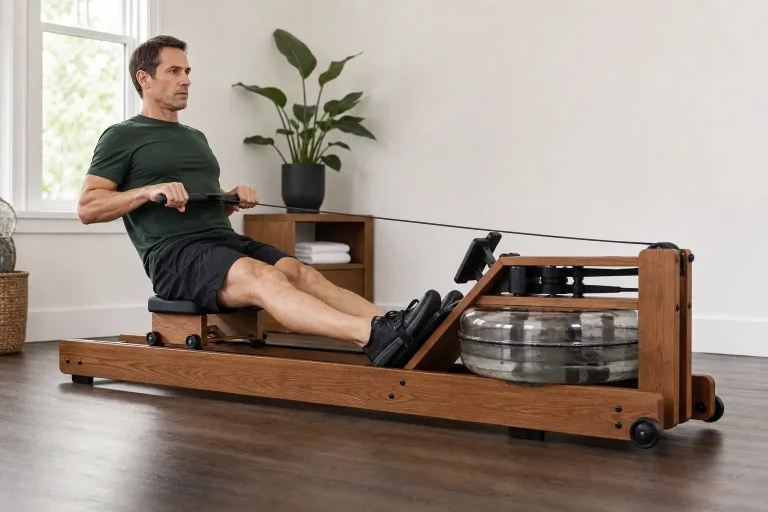
Best Water Rowing Machine (2026): 5 Picks for a Real Water Feel
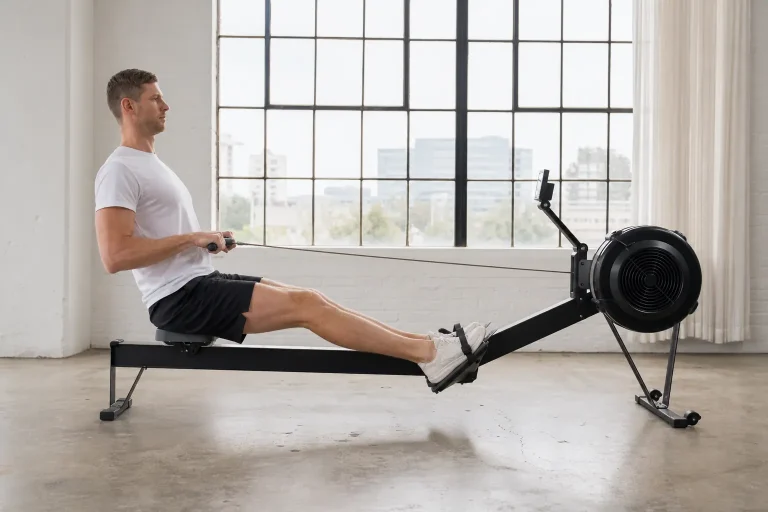
Best Rowing Machine for Tall People (2026): 5 Picks With Room to Row
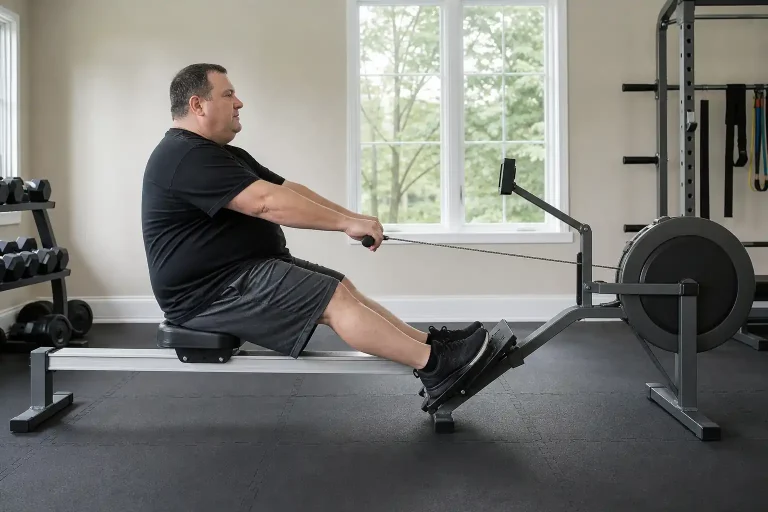
Best Rowing Machine for Heavy People (2026): 5 Picks Rated 300 lb+