VO2 Max Calculator
1About you
2Your heart rate
Estimated VO2 max (ml/kg/min)
–
Where you stand for your age and sex
How you compare with elite athletes (VO2max, ml/kg/min)
Elite values: laboratory VO2max published in peer-reviewed journals (Tønnessen 2015, Bell 2017, Jones 2021, Jones 2006), checked November 3, 2026.
VO2 max by method
Want a measured number? A field test beats any estimate: the Cooper test needs only a track or a treadmill and 12 minutes.
Open the Cooper test calculatorThese are estimates for healthy adults, not a medical test. A maximal effort is hard on the heart: if you are inactive, over 45 (men) or 55 (women), pregnant, or have heart, lung or metabolic symptoms or conditions, ask your doctor before any all-out test, and stop at once if you feel chest pain, dizziness or unusual shortness of breath.
Free tool · Updated November 3, 2026
Your aerobic fitness, no test needed
VO2 max is the most oxygen your body can use in a minute of all-out effort. Two published methods estimate it from numbers you already know: your resting heart rate, and your activity level with your age, sex and BMI.
Short answer
Without a test, VO2 max can be estimated as 15.3 times your maximum heart rate divided by your resting heart rate, or from your activity level, age, sex and BMI. A 35-year-old man with a resting heart rate of 62 gets about 45 ml/kg/min by the heart rate method; at 5 ft 9 in and 180 lb with some weekly running, the non-exercise model gives about 42. Enter your numbers below for your estimate and your rating for your age and sex.
Key takeaways
- VO2 max, in ml/kg/min, is the standard measure of aerobic fitness and one of the best markers of long-term health.
- No-exercise estimates are a starting point: expect an error of about 5 ml/kg/min against a lab test.
- A low resting heart rate and regular vigorous exercise both point to a higher VO2 max.
- For a measured value, run or walk one of the five field and treadmill tests linked below.
A VO2 max calculator usually asks you to run first. This one does not. It uses two published shortcuts that predict VO2 max from data you can collect sitting down: the ratio of your maximum to your resting heart rate, and a regression on your activity habits, age, sex and body size.
Each method has a known error, so the calculator shows both side by side, averages them, and places the result on the same FRIEND percentile scale as our test calculators. If you want a measured number, the last part of the page links to five tests you can do on a track, a treadmill or in a gym.
How the VO2 Max Calculator Works
The heart rate ratio method comes from a Danish study by Uth and colleagues (2004): in trained men, VO2 max was close to 15.3 times maximum heart rate divided by resting heart rate. A fit heart pumps more blood per beat, so it beats slowly at rest while keeping the same maximum.
Maximum heart rate is the weak point of that method. The calculator offers the Tanaka formula (208 – 0.7 x age), the classic 220 – age, or a value you measured yourself in a hard race or test, which is always better.
The non-exercise model of Jackson and colleagues (1990) was built on more than 2,000 adults tested on a treadmill at NASA’s Johnson Space Center. It predicts VO2 max from your physical activity rating, age, sex and either BMI or body fat; the body fat version is slightly more accurate.
| Method | Formula | Example: man, 35, 5 ft 9 in, 180 lbExample |
|---|---|---|
| Heart rate ratio (Uth) | 15.3 x HRmax / HRrest | 15.3 x 183.5 / 62 = 45.3 |
| HRmax, Tanaka | 208 – 0.7 x age | 183.5 bpm |
| HRmax, classic | 220 – age | 185 bpm |
| Non-exercise, BMI (Jackson) | 56.363 + 1.921 x PA-R – 0.381 x age – 0.754 x BMI + 10.987 (men) | PA-R 4, BMI 26.6: 41.7 |
| Non-exercise, body fat (Jackson) | 50.513 + 1.589 x PA-R – 0.289 x age – 0.552 x % fat + 5.863 (men) | PA-R 4, 20% fat: 41.6 |
Your Physical Activity Rating
Pick the line that best describes your usual activity over the last month, not your best week. Vigorous exercise means activity that makes you breathe hard, such as running, cycling, swimming, rowing or a brisk incline walk on a treadmill.
| Rating | Your usual activity over the last month |
|---|---|
| 0 | Avoid walking and exertion (elevator, car whenever possible) |
| 1 | Walk for pleasure, take the stairs, rarely get out of breath |
| 2 | Moderate activity (golf, yard work, weights): 10 to 60 min a week |
| 3 | Moderate activity: more than 1 hour a week |
| 4 | Vigorous exercise (running, cycling, swimming): under 30 min, or under 1 mile run, a week |
| 5 | Vigorous exercise: 30 to 60 min a week, or 1 to 5 miles run |
| 6 | Vigorous exercise: 1 to 3 hours a week, or 5 to 10 miles run |
| 7 | Vigorous exercise: more than 3 hours a week, or more than 10 miles run |
VO2 Max Norms by Age and Sex
Your rating compares the estimate with the FRIEND registry (Fitness Registry and the Importance of Exercise National Database): Kaminsky, Arena and Myers, Mayo Clinic Proceedings, 2015, measured treadmill VO2max of apparently healthy US adults. The 50th percentile is the median of each group; a result in the 75th to 90th percentile is rated excellent.
The elite comparison uses only VO2max values measured in a laboratory and published in peer-reviewed journals: Olympic medal winners, cross-country skiing (distance), men, 84 ml/kg/min (mean of medalists 1990-2013 tested at the Norwegian Olympic Training Center; Tønnessen et al., International Journal of Sports Physiology and Performance, 2015); Chris Froome, multiple Tour de France winner, 84 ml/kg/min (5.91 L/min, tested in 2015 near peak condition; Bell et al., Medicine & Science in Sports & Exercise, 2017); Olympic medal winners, cross-country skiing (distance), women, 72 ml/kg/min (mean of medalists 1990-2013 tested at the Norwegian Olympic Training Center; Tønnessen et al., International Journal of Sports Physiology and Performance, 2015); World-class marathon runners (Nike Breaking2 project, 16 men), 71 ml/kg/min (mean of 16 world-class male distance runners; Jones et al., Journal of Applied Physiology, 2021); Paula Radcliffe, women’s marathon world record holder 2003-2019, 70 ml/kg/min (typical value 1992-2003, single tests from about 65 to 80; Jones, International Journal of Sports Science & Coaching, 2006).
Higher numbers circulate online for famous skiers, runners and cyclists without a published paper behind them, so we leave them out. The bar shows your estimate as a share of each value; a test estimate is less precise than the laboratory measurement of the athletes.
| Group | 10th | 25th | 50th (median)50th | 75th | 90th |
|---|---|---|---|---|---|
| Men 20-29 | 32.1 | 40.1 | 48 | 55.2 | 61.8 |
| Men 30-39 | 30.2 | 35.9 | 42.4 | 49.2 | 56.5 |
| Men 40-49 | 26.8 | 31.9 | 37.8 | 45 | 52.1 |
| Men 50-59 | 22.8 | 27.1 | 32.6 | 39.7 | 45.6 |
| Men 60-69 | 19.8 | 23.7 | 28.2 | 34.5 | 40.3 |
| Men 70-79 | 17.1 | 20.4 | 24.4 | 30.4 | 36.6 |
| Women 20-29 | 23.9 | 30.5 | 37.6 | 44.7 | 51.3 |
| Women 30-39 | 20.9 | 25.3 | 30.2 | 36.1 | 41.4 |
| Women 40-49 | 18.8 | 22.1 | 26.7 | 32.4 | 38.4 |
| Women 50-59 | 17.3 | 19.9 | 23.4 | 27.6 | 32 |
| Women 60-69 | 14.6 | 17.2 | 20 | 23.8 | 27 |
| Women 70-79 | 13.6 | 15.6 | 18.3 | 20.8 | 23.1 |
Measure It With a Test
An estimate from heart rate or activity is a good first look. A field test measures what your body actually does, and each of these calculators turns your result into VO2 max on the same scale. Pick the one that fits your fitness and your equipment.
How to Raise Your VO2 Max
- Add intervals. Short hard efforts, such as 4 x 4 minutes at a high heart rate with easy recovery, raise VO2 max faster than steady sessions alone; see our treadmill HIIT workouts.
- Keep most training easy. Regular easy running or brisk walking builds the base; the heart rate zone calculator sets the right intensity.
- Lose some fat. VO2 max is measured per kilogram of body weight, so losing fat raises it even before your heart and lungs improve.
- Train at home. Incline walking and treadmill intervals work in any weather; compare our best treadmills for running.
Share, Embed or Cite This Calculator
Coaches and trainers are welcome to link to or embed this VO2 max calculator; the result link keeps the numbers entered.
Share this calculator
Send it to a friend, a training partner or your followers. These buttons share the calculator itself, not your results.
Use this calculator like an app
Put VO2 Max Calculator on your phone’s home screen: it opens full screen in one tap, like a native app, with no download from a store.
- iPhone (Safari)Tap Share , then Add to Home Screen, then Add.
- Android (Chrome)Tap the menu ⋮, then Add to home screen or Install app.
- ComputerBookmark the page, or in Chrome and Edge use the install icon in the address bar.
Embed the interactive calculator
For websites and blogs. Paste this code where you want the calculator: your visitors use it right on your page. It resizes itself and shows a credit link to FitGearHQ.
Add a link card
For blogs, newsletters and pages that do not allow scripts: a clean card with a picture and one link.
Cite this calculator
- TitleVO2 Max Calculator
- PublisherFitGearHQ
- URLhttps://fitgearhq.com/vo2-max-calculator/
- Updated
More Free Fitness Tools
See them all on Fitness Calculators, Treadmill Tools or every free fitness tool.
Checklist Before You Estimate Your VO2 Max
4 checks
Tap a number to check off that step.
- 01
Measure your resting heart rate on wakingLying down, before coffee, for a full 60 seconds; repeat over three mornings.
- 02
Use a real maximum if you have oneA chest strap reading from a hard race beats any age formula.
- 03
Rate your usual monthNot your best week: the model was built on typical activity.
- 04
Know your body fat if you canThe body fat model is a little more accurate than the BMI model.
Common Mistakes to Avoid
Mistake 1Taking resting heart rate after coffee or stress
Instead: Caffeine, poor sleep and stress raise it and lower the estimate.
Mistake 2Trusting 220 – age blindly
Instead: Real maximum heart rate can differ from it by 10 to 20 bpm.
Mistake 3Overrating your activity
Instead: A higher rating adds about 2 ml/kg/min per step in the BMI model.
Mistake 4Treating the estimate as a lab value
Instead: Expect an error of about 5 ml/kg/min; a test measures it better.
The Bottom Line
- Heart rate ratio method (Uth et al., European Journal of Applied Physiology, 2004).
- Non-exercise models with BMI or body fat (Jackson et al., Medicine & Science in Sports & Exercise, 1990).
- Percentiles and rating from the FRIEND registry of measured treadmill tests.
- US and metric units; the link keeps your inputs.
Frequently Asked Questions
Two published methods: 15.3 x maximum heart rate / resting heart rate (Uth, 2004), or the Jackson non-exercise model from your activity rating, age, sex and BMI or body fat. The calculator runs both and averages them.
In the FRIEND registry, the median is about 48 ml/kg/min for men in their 20s and 38 for women in their 20s, falling to about 33 and 23 in their 50s. A result above the 75th percentile of your group is excellent.
No-exercise estimates are typically within about 5 ml/kg/min of a lab test. A field test such as the Cooper or Rockport test narrows the error, and a lab test with gas analysis is the reference.
It was developed on trained men, and the authors asked for validation in other groups. Treat it as a rough guide for women, beginners and older adults, and compare it with the non-exercise model.
Watches estimate VO2 max from heart rate and pace during runs, with their own formulas. All these methods are estimates, so differences of a few points are normal.
Combine regular easy aerobic training with one or two interval sessions a week, and lose excess fat. Most untrained people improve noticeably within two to three months.
Train to Raise Your VO2 Max

Treadmill HIIT Workouts (2026): Beginner to Advanced Interval Plans
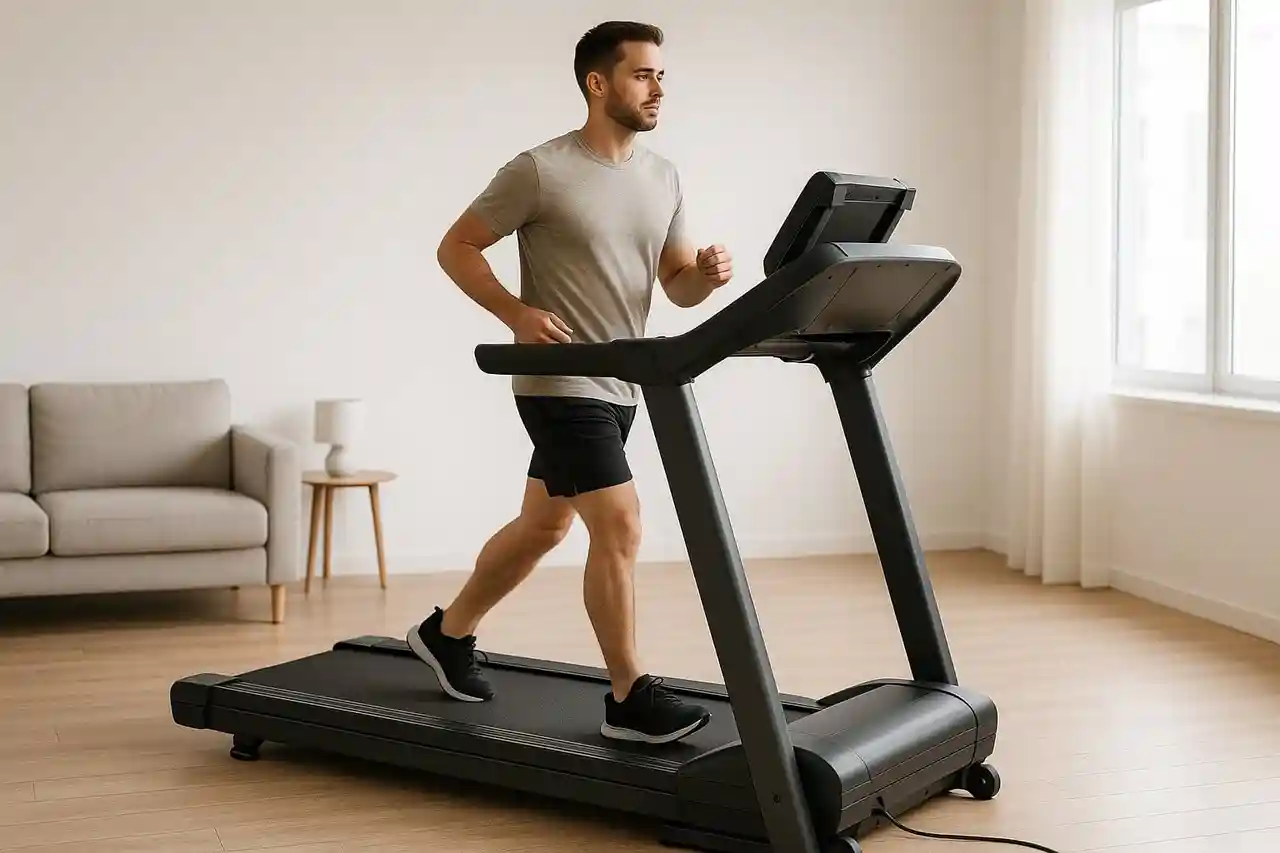
Best Treadmill for Running (2026): Top 5 Picks

Best Treadmill for HIIT and Interval Training (2026): 5 Picks
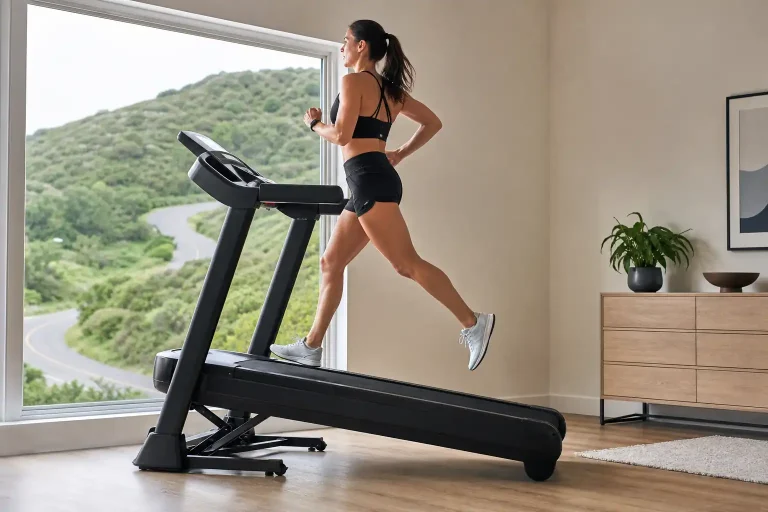
Treadmill Incline vs Outdoor Running (2026): The 1% Rule, Hills and Downhills
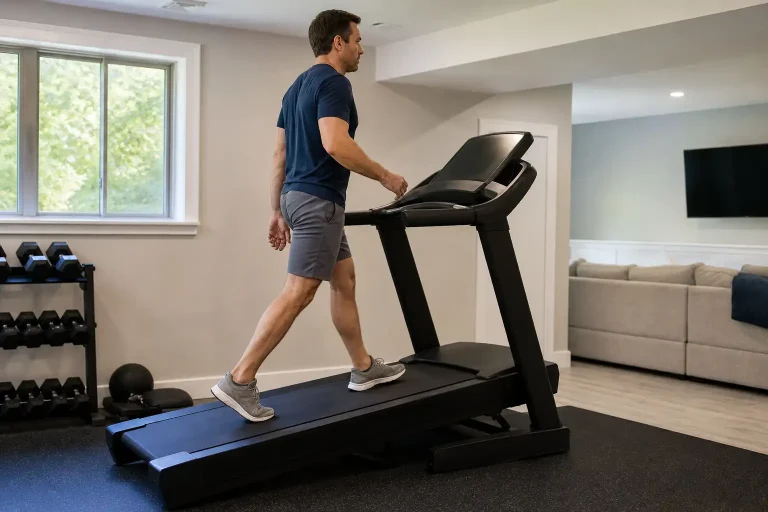
What Is a Good Incline on a Treadmill? (2026) Levels by Goal