

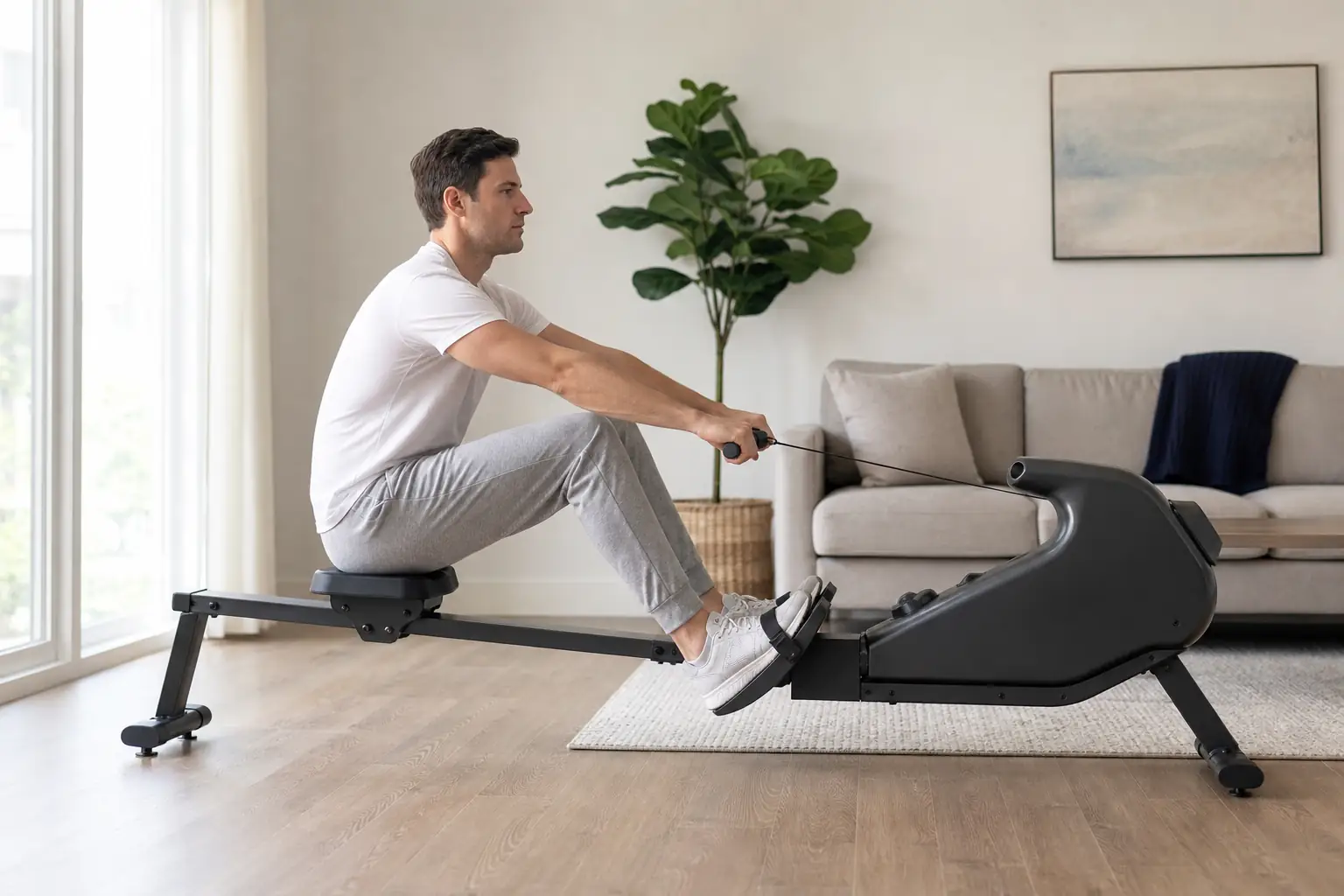
Short answer
A good rowing machine workout for beginners is three easy sessions a week of about 20 to 25 minutes: start with short pieces of 3 to 5 minutes at a talking pace, build to a 20-minute continuous row by week 4, and add one gentle interval day from week 3. Learn the stroke order first: legs, then body, then arms.
Key takeaways
- Row three times a week, about 20 to 25 minutes, at a talking pace.
- Learn the stroke order first: legs, body, arms, then reverse.
- Build to a 20-minute continuous row by week 4, then add intervals.
- Add time before intensity, and keep the damper or level in the middle.
- Talk to your provider first if you have a chronic condition or symptoms.
A rowing machine is one of the friendliest ways to start exercising: you sit down, the movement is smooth, and you control the effort with every stroke. It is also easy to overdo. New rowers often pull hard with the arms, row too fast, and finish the first week with a sore back.
This rowing machine workout for beginners fixes that with a simple 4-week plan. You learn the stroke, row easy, and build time before you add any hard intervals. If you have not bought a rower yet, our best rowing machine for beginners guide ranks five easy-to-start picks by FitScore.
Before Your First Rowing Machine Workout for Beginners
Set up the machine before you row. Strap your feet in so the strap crosses the widest part of your foot, near the base of the toes. The footplate should let your shins come close to vertical at the front of the stroke. Sit tall on the seat, knees bent, arms straight, holding the handle with a relaxed grip.
Choose a middle setting. On an air rower, a damper of 3 to 5 suits most people, as our best air rowing machine guide explains. On a magnetic rower, start around the middle of the level range. A heavy setting does not make the workout better: it makes the stroke slower and loads the back.
Learn three numbers on the monitor: time, the 500 m split (your pace) and the stroke rate in strokes per minute. For the whole first month, keep the stroke rate low, around 18 to 22, and ignore the split. Smooth strokes come first; speed comes later.
- Foot straps over the widest part of the foot.
- Damper 3 to 5, or a middle magnetic level.
- A mat under the rower and 2 feet of space beside it to step on and off.
- Water, a towel, and shoes with a flat sole.
The Stroke in Four Parts
Every stroke has four phases. At the catch you sit at the front: shins close to vertical, arms straight, back tall and leaning slightly forward. On the drive you push with the legs first, then swing the body back a little, then pull the handle to the lower ribs. At the finish your legs are straight, you lean back slightly and the handle touches your body. The recovery reverses the order: arms away, body forward, then bend the knees and slide forward.
A simple count keeps the rhythm right: one count for the drive, two counts for the recovery. The drive is quick and firm, the return is slow and relaxed. Rushing up the slide is the most common reason beginners feel out of breath without moving fast.
If you want more detail on form, our guide on how to use a rowing machine breaks each phase down with common faults and fixes.
| Phase | What you do | Common beginner fault |
|---|---|---|
| Catch | Shins near vertical, arms straight, tall back | Sliding too far forward, heels lifting high |
| Drive | Legs push, then body swings, then arms pull | Pulling with the arms first |
| Finish | Legs straight, slight lean back, handle at lower ribs | Leaning far back or pulling to the chin |
| Recovery | Arms out, body forward, then knees bend | Bending the knees before the handle clears them |
Check Amazon for current pricing and availability.
Pro tip: Drill for day one: row 10 strokes with legs only, 10 with legs and body, then 10 full strokes. Repeat three times as part of your warm-up.
How Hard Should a Beginner Row?
Easy. Nearly every minute of the first two weeks should be at a talking pace. The CDC describes moderate effort as one where you can talk, but not sing, and rates it 5 or 6 on a scale of 0 to 10. Your first sessions can sit even lower, at a 3 or 4, while you learn the stroke.
Breathing tells you the most. If you cannot finish a sentence, slow the stroke rate and push a little less. If you feel nothing at all after 10 minutes, push a little harder with the legs, but keep the same stroke rate. Heart rate is useful later; if you want numbers, our heart rate zone calculator gives your zones, and beginners can aim for zone 2.
From week 3 you will add short “steady-plus” pieces: a notch harder, where you can still speak in short phrases. In week 4, the hard minutes are the first that should feel truly hard, around a 7 on the same scale.
| Effort | Talk test | Effort, 0 to 10 | When in the plan |
|---|---|---|---|
| Easy | Full sentences, relaxed breathing | 3 to 4 | Warm-ups, cool-downs, weeks 1 and 2 |
| Steady | Can talk, cannot sing | 5 to 6 | Continuous rows from week 3 |
| Steady-plus | Short phrases | 6 | Week 3 interval day |
| Hard | A few words only | 7 | Week 4 interval day |
4-Week Rowing Machine Workout Plan for Beginners
This rowing machine workout for beginners uses three sessions a week on non-consecutive days. Each session starts with 5 minutes of easy rowing, including the stroke drill, and ends with 3 minutes easy. The main set grows from 12 minutes of rowing in week 1 to a 20-minute continuous row in week 4.
Repeat a week if it felt hard, or if your back, hips or knees were sore the next day. There is no prize for finishing in exactly 4 weeks. Once week 4 feels comfortable, move on to the sessions in our rowing machine workout library.
| Week | Sessions | Each session | Total time | Goal |
|---|---|---|---|---|
| Week 1 | 3 | 5 min easy + 4 x 3 min easy rowing with 1 min rest + 3 min easy | 22 min | Learn the stroke order; full sentences the whole time |
| Week 2 | 3 | 5 min easy + 3 x 5 min easy with 1 min rest + 3 min easy | 25 min | Longer pieces at the same easy effort |
| Week 3 | 3 | Days 1 and 3: 5 min easy + 15 min steady + 3 min easy. Day 2: 5 min easy + 6 x 1 min steady-plus / 1 min easy + 3 min easy | 23 / 20 min | First continuous row; first gentle intervals |
| Week 4 | 3 to 4 | Days 1 and 3: 5 min easy + 20 min steady + 3 min easy. Day 2: 5 min easy + 6 x 1 min hard / 90 sec easy + 3 min easy | 28 / 23 min | Ready for the full workout library |
Pro tip: Write down the time, distance and average split of each session. By week 4 the same easy effort should cover more meters, which is the clearest sign the plan is working.
A Sample Beginner Week
Rowing works the legs, back and arms together, so rest days matter, especially in the first month. A good week spaces the three rows out and adds one short strength session. The CDC asks adults for 150 minutes of moderate activity a week and 2 days of muscle-strengthening activity; this plan is a first step toward that, not the finish line.
Three sessions of about 25 minutes give you 75 minutes. Add walks or a fourth short row in week 4 and you are close to the 150-minute target. The CDC notes that you can split activity into shorter chunks spread through the week.
| Day | Activity | Notes |
|---|---|---|
| Day 1 | Rowing session | Steady or easy pieces from the plan |
| Day 2 | Rest or a walk | Let the back and legs recover |
| Day 3 | Rowing session | The week’s second session (intervals from week 3) |
| Day 4 | Strength | Squats, push-ups, planks, glute bridges |
| Day 5 | Rowing session | Steady or easy pieces from the plan |
| Day 6 | Optional | Easy walk, bike or an extra short row in week 4 |
| Day 7 | Rest | Full rest |
Progressions: How to Make It Harder Safely
Change one thing at a time. First add time, a few minutes per session per week, until you can row 20 to 30 minutes at a steady pace. Then add a fourth session if your schedule allows. Only then add intensity: one interval day, then perhaps a second, never on back-to-back days.
This order follows the advice of the federal Physical Activity Guidelines for Americans: inactive people should start low and go slow, beginning with lower intensity and gradually increasing how often and how long they are active. The same guidelines note that people who build up gradually to moderate activity have no known risk of sudden cardiac events and a very low risk of muscle, bone or joint injury.
Leave the damper or level where it is while you progress. A heavier setting is not the next step; more time at a steady effort is.
- Weeks 5 and 6: one 30-minute steady row, one 20-minute row, one interval day.
- Then: two interval days and one long steady row of 30 to 40 minutes.
- Later: test yourself over 2,000 m and compare with our 2k row time benchmarks.
- Use our rowing pace calculator to plan splits for longer rows.
Safety Tips for New Rowers
Most people can start rowing without seeing a doctor first. The Physical Activity Guidelines say that adults without a chronic condition, and without symptoms such as chest pain or pressure, dizziness or joint pain, most likely do not need to consult a health care provider before becoming active. If you have heart disease, diabetes, arthritis or another chronic condition, or such symptoms, talk to your provider about the right amount and type of activity.
Stop rowing if you feel chest pain or pressure, faintness, or shortness of breath that is out of proportion to the effort, and get medical help. A new pain in the lower back, knees or wrists is a reason to rest and check your form, not to push through.
Protect your back by keeping it long. Hinge forward from the hips at the catch instead of rounding the spine, and keep the lean back at the finish small. Keep young children and pets away from the rower, because the seat, rail and handle chain or strap move on every stroke.
Watch out: Do not let go of the handle at the finish and let it fly back to the machine. Guide it back to the front with straight arms on every stroke.
Beginner-Friendly Rowers
A beginner needs a rower that fits, runs quietly and starts smoothly at a low setting. The three picks below are the top three of our best rowing machine for beginners ranking, and their FitScores come from that guide, where comfort and ease of use carry more weight than raw performance. All three use magnetic resistance, the quietest system in our scoring.
Best beginner pick

Merach Q1S Magnetic Rowing Machine
FitScore 80.5/100
A compact magnetic rower at 65 inches long, with 16 resistance levels, a 350 lb rating and users up to 6 ft 5 in on the listing. It stands upright for storage on about 1.6 x 2.1 ft of floor. Amazon reviewers describe it as quiet and simple to put together, though some find the top levels too light once they get fitter.
Ranked in our Best Rowing Machine for Beginners guide
Check Price on AmazonEasiest to store

YPOO Magnetic Rowing Machine 350 LB
FitScore 80.3/100
This 65-inch magnetic rower folds and stores upright, lists 16 levels and a 46-inch rail for users from 4 ft 5 in to 6 ft 3 in, and is rated for 350 lb. Its monitor shows stroke rate as well as time, distance and calories, useful for the low-rate rows in this plan. Amazon reviewers find it quiet and easy to put together, though some say it is smaller than they expected.
Ranked in our Best Rowing Machine for Beginners guide
Check Price on AmazonBest monitor for learning

Sunny Health & Fitness Smart Magnetic Rowing Machine SF-RW523021
FitScore 80.2/100
A 50-inch rail, 16 magnetic levels and a monitor that shows 500 m split, stroke rate and heart rate, so you can follow the plan and see your pace improve. It is rated for 300 lb and stands upright after a session. At 79.3 inches long it needs more floor than the other two picks.
Ranked in our Best Rowing Machine for Beginners guide
Check Price on AmazonBeginner Checklist
7 checks
Tap a number to check off that step.
- 01
Foot straps across the widest part of the foot.
- 02
Middle damper or resistance level, not the top.
- 03
Stroke drill in every warm-up: legs, then legs and body, then full strokes.
- 04
Stroke rate around 18 to 22 for the first month.
- 05
Talking pace for nearly every minute of weeks 1 and 2.
- 06
A rest day between rowing days.
- 07
A log of time, distance and split for each session.
Common Mistakes to Avoid
Mistake 1Pulling with the arms before the legs have pushed.
Mistake 2Rushing forward on the recovery.
Mistake 3Setting the damper or level to the maximum.
Mistake 4Rowing hard every session from day one.
Mistake 5Rounding the back at the catch.
Mistake 6Skipping rest days in the first month.
The Bottom Line
- Week 1 is 4 x 3 minutes of easy rowing; week 4 is a 20-minute continuous row plus one interval day.
- The stroke order is legs, body, arms on the drive, then arms, body, legs on the way back.
- Row at a pace where you can talk but not sing; on a 0 to 10 scale, that is a 5 or 6.
- The federal Physical Activity Guidelines advise inactive people to “start low and go slow”.
- Three sessions of about 25 minutes give 75 minutes a week, half of the CDC’s 150-minute target.
Our Top Picks
 Best beginner pickMerach Q1S Magnetic Rowing MachineFitScore80.5/100Check on Amazon
- Easiest to storeYPOO Magnetic Rowing Machine 350 LBFitScore80.3/100Check on Amazon
- Best monitor for learningSunny Health & Fitness Smart Magnetic Rowing Machine SF-RW523021FitScore80.2/100Check on Amazon
Frequently Asked Questions
Start with about 10 to 15 minutes of actual rowing, in short pieces of 3 to 5 minutes, plus a warm-up and cool-down. Build to a 20-minute continuous row over about 4 weeks, three times a week.
Three sessions a week on non-consecutive days is a good start. Add a fourth short session after a few weeks if you recover well. Keep at least one full rest day.
A middle setting: a damper of 3 to 5 on an air rower, or the middle of the level range on a magnetic rower. Heavier settings slow the stroke and load the back without making the workout better for a beginner.
Around 18 to 22 strokes per minute. Keep each stroke long and smooth, with a quick drive and a slower return, and let speed come from a stronger leg push rather than a higher rate.
Yes. You sit down, the movement is smooth and you set the effort with each stroke. Learn the stroke order, row at a talking pace and build time gradually, as the federal activity guidelines advise for people starting out.
Common causes are rounding the back at the catch, leaning too far back at the finish and pulling with the arms before the legs. Rest, check your form with the stroke drill and lower the damper. See a health professional if pain persists.
Explore More Rowing Machine Guides
Best Rowing Machine for Beginners (2026): 5 Easy-to-Start Picks
Rowing Machine Workout Library (2026): Steady, HIIT, Pyramid and 15 to 30-Minute Sessions
Best Magnetic Rowing Machine (2026): 5 Quiet Picks Ranked
Best Folding Rowing Machine (2026): 5 Space-Saving Picks
Types of Rowing Machines (2026): Air, Magnetic, Water, Hydraulic and Hybrid Explained
Rowing Machines
This article contains affiliate links. If you click through and make a purchase, we may earn a small commission at no extra cost to you. As an Amazon Associate, we earn from qualifying purchases. We do not show prices because they change constantly: product details and availability can change at any time, so please check the current price and details directly on Amazon. Learn more. Amazon and the Amazon logo are trademarks of Amazon.com, Inc. or its affiliates.
