

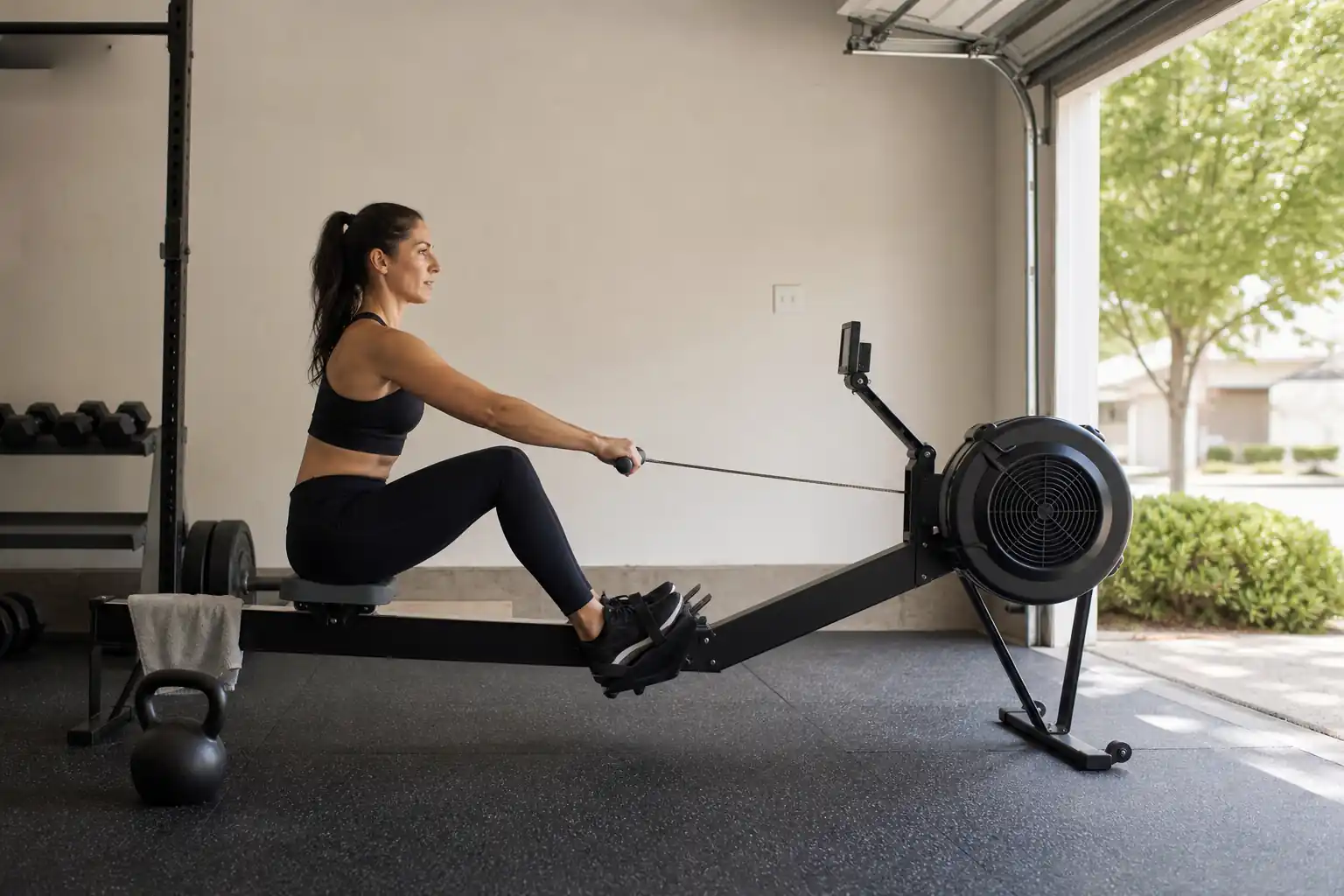
Short answer
A good rowing machine workout matches the day: steady rows at a talking pace most days, and one or two interval sessions a week, such as 6 x 1 minute hard with 75 seconds easy. Warm up for 3 to 8 minutes first. Rowing 30 minutes on 5 days, or 25 minutes at a hard effort on 3 days, meets the CDC weekly aerobic guideline.
Key takeaways
- Mix mostly steady rows with one or two interval days a week.
- Use the talk test, heart rate zones or your own split to set effort.
- Six 1-minute hard efforts with 75 seconds easy is a proven short HIIT session.
- 15 to 30 minutes is a complete rowing machine workout for most people.
- 150 minutes of moderate or 75 minutes of vigorous rowing a week meets the CDC aerobic guideline.
A rowing machine works your legs, back and arms on every stroke, so a short session can feel hard fast. That is a strength and a trap: many people row every session at the same uncomfortable effort, stall, and quit. A good plan mixes easy rows with a few hard ones.
This workout library gives you steady rows, intervals, pyramids and ready-made 15, 20 and 30-minute sessions in simple tables. It explains how hard to row by the talk test, by heart rate and by split, and how long to row each week. New to the machine? Start with our 4-week rowing machine workout for beginners plan.
How to Read a Rowing Machine Workout
Rowing workouts use a few numbers from the monitor. Once you know them, any plan is easy to follow. The most useful is the 500 m split: the time it would take to row 500 meters at your current pace. A split of 2:30 is faster than 2:45. Stroke rate, in strokes per minute, tells you how often you pull. Watts, on monitors that show them, measure your power directly.
Hold the stroke rate fairly low. Most coached plans keep steady rows around 18 to 24 strokes per minute and let it rise for hard intervals. A higher rate with short, rushed strokes looks busy but moves the boat less. Power comes from the legs: push first, then swing the back, then pull with the arms, and reverse that order on the way back.
Resistance is not intensity. On an air rower the damper changes how heavy each stroke feels, but how hard you push sets the workout; our best air rowing machine guide explains damper and drag factor. On a magnetic rower, pick a middle level and change effort with your legs, not by cranking the level to the top.
| Term | What it means | How to use it |
|---|---|---|
| 500 m split | Time to row 500 m at your current pace | Lower is faster; hold it steady within a piece |
| Stroke rate (spm) | Strokes per minute | Steady rows in the high teens to mid 20s; higher in hard intervals |
| Watts | Power you put into the flywheel | Compare hard efforts from week to week |
| Damper or level | How heavy each stroke feels | Middle setting for most workouts |
| Easy / steady / hard | Effort by the talk test | See the intensity table below |
Check Amazon for current pricing and availability.
Rowing Machine Workout Intensity: Talk Test, Heart Rate and Split
You can set effort three ways, and they agree more than you might think. The simplest is the talk test. The CDC describes a moderate effort as one where you can talk, but not sing, and a vigorous effort as one where you cannot say more than a few words without pausing for a breath. On the same CDC scale of 0 to 10, moderate is a 5 or 6 and vigorous starts at 7 or 8.
Heart rate zones give the same idea in numbers. Zones are ranges of your maximum heart rate. A common estimate of maximum is 208 minus 0.7 times your age (the Tanaka formula), and our heart rate zone calculator works out your own zones in beats per minute.
Split is the most precise guide once you know your numbers. Row 10 minutes at a talking pace and note the average split: that is your easy split. Then row a hard 1-minute piece and note it: that is a hard split. Use those two numbers to pace every workout below, and retest every few weeks. To turn a split into a finish time for any distance, use our rowing pace calculator.
| Effort | Talk test | Effort, 0 to 10 | Heart rate zone | Used for |
|---|---|---|---|---|
| Easy | Full sentences | 3 to 4 | Zone 1 to 2 (50% to 70% of max) | Warm-up, cool-down, recovery rows |
| Steady (moderate) | Can talk, cannot sing | 5 to 6 | Zone 2 to 3 (60% to 80% of max) | Steady-state rows |
| Comfortably hard | Short phrases | 6 to 7 | Zone 3 to 4 (70% to 90% of max) | Long intervals, the 30-minute session |
| Hard (vigorous) | A few words only | 7 to 8 | Zone 4 (80% to 90% of max) | Intervals of 1 to 4 minutes |
| Very hard | No talking | 9 to 10 | Zone 5 (90% of max and up) | Short sprints, 20/10 sets |
Pro tip: Heart rate lags behind effort. In a 30-second interval it may not peak until the recovery starts, so pace short pieces by split or feel, and use heart rate for steady rows.
Steady-State Rowing Workouts
Steady rows are the base of any rowing plan. You hold one easy to moderate effort for 15 to 45 minutes, at a pace where you could talk in sentences. They build aerobic fitness, teach a smooth stroke, and leave you fresh enough for the hard days. Most of your weekly minutes should look like this.
Keep the split steady, not the heart rate. On a long row your heart rate drifts up a little even at the same pace, and that is normal. The rate ladder adds focus without adding much strain: you hold the same relaxed effort while the stroke rate climbs every 5 minutes, which teaches you to stay long and smooth at a higher rate.
| Workout | Warm-up | Main set | Cool-down | Total time |
|---|---|---|---|---|
| Easy 20 | 3 min easy | 15 min steady, conversational | 2 min easy | 20 min |
| Steady 30 | 5 min easy | 22 min steady, conversational | 3 min easy | 30 min |
| Long steady 45 | 5 min easy | 35 min steady, conversational | 5 min easy | 45 min |
| Rate ladder 30 | 5 min easy | 4 x 5 min at 18, 20, 22 and 24 strokes per minute | 5 min easy | 30 min |
Rowing Machine HIIT and Interval Workouts
Intervals alternate hard efforts with easy recovery, so you can spend more total time at a high effort than you could in one block. On a rower they are easy to control: the monitor shows split and time, and you can slow down at once without stepping off anything.
The first workout below follows a published protocol. In a 2025 study of 22 healthy, active adults, six 1-minute rowing efforts with 75 seconds of recovery, at 85% of peak power, were compared with a body-weight circuit on the same timing (push-ups, jump squats, mountain climbers, air squats). Both sessions reached 92% to 96% of maximum heart rate and a similar peak oxygen uptake, so the rowing version is a short session with real intensity, and the circuit is a fair swap on days you cannot row.
Do one or two interval sessions a week, never on back-to-back days, and keep the other days steady. Hard means a split you could hold for the whole interval and not much longer. If your split fades by more than a few seconds over the rounds, you started too fast.
| Workout | Warm-up | Work interval | Recovery | Rounds | Total time* |
|---|---|---|---|---|---|
| 1-minute repeats | 5 min easy | 1 min hard | 75 sec easy | 6 | 24 min |
| 30/30 | 5 min easy | 30 sec hard | 30 sec easy | 10 | 20 min |
| 2-minute repeats | 5 min easy | 2 min hard | 2 min easy | 6 | 34 min |
| 4 x 4 | 8 min easy, building | 4 min hard | 3 min easy | 4 | 41 min |
| 20/10 (advanced) | 8 min easy, building | 20 sec very hard | 10 sec rest | 8 | 17 min |
Pro tip: *Total time includes a 5-minute easy cool-down after the last round, in this table and in the pyramid table.
Pyramid Rowing Workouts
Pyramids climb to a longest effort and step back down. The changing lengths make the session pass quickly, and the short pieces at the end let you finish fast with good form. Pace each step by split: the 1-minute steps can be a little faster than the 3 or 4-minute ones.
The stroke-rate pyramid is a technique session in disguise. You keep the same firm push with the legs while the rate climbs to 26 strokes per minute and comes back down. If your stroke gets short or the seat rushes forward as the rate climbs, hold the rate one step lower.
| Workout | Warm-up | Main set | Cool-down | Total time |
|---|---|---|---|---|
| Time pyramid | 5 min easy | 1-2-3-2-1 min hard | Half the work time, easy, after each step | 24 min |
| Long pyramid | 5 min easy | 1-2-3-4-3-2-1 min hard | Half the work time, easy, after each step | 34 min |
| Stroke-rate pyramid | 5 min easy | 1 min each at 20, 22, 24, 26, 24, 22, 20 strokes per minute, twice | 2 min easy between the two rounds | 26 min |
15, 20 and 30-Minute Rowing Workouts
Short sessions are where a rower shines. Because the stroke uses so much muscle, 15 to 30 minutes is enough for a full workout, and you can row before work or during a lunch break. Pick by how you feel: on a tired day, take the steady version of the same length.
Each plan below includes its own warm-up and cool-down. If you train often for a set distance, such as a 2,000 m test, read our guide to a good 2k row time for benchmarks and pacing.
| Length | Warm-up | Main set | Cool-down | Total | Best for |
|---|---|---|---|---|---|
| 15 minutes | 3 min easy | 8 x 30 sec hard / 30 sec easy | 4 min easy | 15 min | Short on time, or a second session of the day |
| 20 minutes | 4 min easy | 6 x 1 min hard / 1 min easy | 4 min easy | 20 min | A classic first interval session |
| 20 minutes, steady | 3 min easy | 15 min conversational | 2 min easy | 20 min | Recovery days and beginners |
| 30 minutes | 5 min easy | 3 x 5 min comfortably hard / 2 min easy | 4 min easy | 30 min | Building stamina for longer pieces |
| 30 minutes, steady | 5 min easy | 22 min conversational | 3 min easy | 30 min | Most days of the week |
How Long Should You Row?
For general health, the CDC asks adults for 150 minutes of moderate activity a week, or 75 minutes of vigorous activity, or an equal mix. You do not have to do it all at once: 30 minutes on 5 days works, and so do shorter sessions spread through the week. The federal Physical Activity Guidelines use a simple rule for mixing: 1 minute of vigorous activity counts about the same as 2 minutes of moderate.
Rowing fits these numbers easily. Steady rows count as moderate activity and hard intervals as vigorous. The same CDC page also asks for 2 days a week of muscle-strengthening activity, which a rower alone does not fully cover.
For a single session, 20 to 30 minutes is plenty for most people. Beginners can start at 10 to 15 minutes and add a few minutes each week. Longer steady rows of 45 minutes or more suit people training for an event; the limit is usually the seat and your form, not your heart and lungs.
| Plan | Sessions | Weekly total | Fits the CDC aerobic guideline? |
|---|---|---|---|
| Steady rows only | 5 x 30 min steady | 150 min moderate | Yes |
| Hard rows only | 3 x 25 min at a hard, few-words effort | 75 min vigorous | Yes |
| Mixed week | 3 x 30 min steady + 2 x 15 min hard | 90 min moderate + 30 min vigorous (counts as 60 moderate) | Yes |
| Busy week | 6 x 15 min steady | 90 min moderate | Not yet: add 60 minutes, or make some sessions hard |
Watch out: Check with your doctor before hard intervals if you have heart, lung or metabolic disease, or symptoms such as chest pain or dizziness when active. Stop rowing at once if you feel chest pain, faintness or unusual shortness of breath.
Full-Body Rowing Workouts: Mixing Rows With Strength
A rower trains the legs, back and arms together, but it is a pulling movement. To balance it, add pushing and core work between rowing pieces. A simple format: row 500 m or 2 minutes, step off, do one strength move, and repeat 4 to 5 times.
Good pairings are push-ups, goblet or air squats, lunges, planks and glute bridges. Keep the strength moves controlled so your heart rate drops a little before the next row. Two of these sessions a week also help you meet the CDC call for 2 days of muscle-strengthening activity.
- Row 2 min steady + 10 push-ups, 5 rounds (about 15 min after your warm-up).
- Row 250 m hard + 15 air squats + 30-second plank, 6 rounds.
- Row 500 m steady + 10 lunges per leg + 12 glute bridges, 4 rounds.
Rowers That Show Your Split
Every workout above is easier when the monitor shows a 500 m split, because that is how you pace the hard pieces. Not every rower shows it. The three picks below list a 500 m split and stroke rate on their Amazon listings; their FitScores come from our best rowing machine ranking, which weighs performance, durability and comfort for general home use.
Best for pacing workouts

Concept2 RowErg
FitScore 78.9/100
The PM5 monitor shows 500 m split, watts, stroke rate and heart rate, and connects by Bluetooth and ANT+ to apps and chest straps. Air resistance with a continuous damper suits every workout on this page, from easy rows to 20/10 sprints, and the frame is rated for 500 lb. The limit is size: it needs 96 inches of floor length, and the fan is the loudest kind of rower.
Ranked in our Best Rowing Machine guide
Check Price on AmazonQuiet split tracking

Sunny Health & Fitness Smart Magnetic Rowing Machine SF-RW523021
FitScore 78.9/100
This magnetic rower lists 16 resistance levels and a monitor that shows 500 m split, stroke rate and heart rate, so you can pace intervals without fan noise. The 50-inch rail suits most adults, it is rated for 300 lb and it stands upright after a session. Magnetic resistance has a fixed top level, so very strong rowers may find the hardest intervals light.
Ranked in our Best Rowing Machine guide
Check Price on AmazonCompact split monitor

Sunny Health & Fitness Compact Smart Magnetic Rower SF-RW524079
FitScore 76.3/100
At 64 inches long, this is the most compact rower here that still lists a 500 m split and stroke rate. It has 16 magnetic levels, a 300 lb rating and upright storage, which suits short sessions in a small room. The 45.7-inch rail is the shortest of the three, so tall rowers should check the fit first.
Ranked in our Best Rowing Machine guide
Check Price on AmazonBefore Your Next Rowing Session
7 checks
Tap a number to check off that step.
- 01
Set the foot straps across the widest part of your foot.
- 02
Pick a middle damper or resistance level.
- 03
Warm up for 3 to 8 minutes, easier than your workout pace.
- 04
Know your easy split and your hard split before intervals.
- 05
Plan the session: steady day or interval day, never two hard days in a row.
- 06
Keep water and a towel within reach, and a mat under the rower.
- 07
Finish with a few easy minutes before you stand up.
Common Mistakes to Avoid
Mistake 1Rowing every session at the same hard effort.
Mistake 2Raising the damper or level to the top to make the workout harder.
Mistake 3Rushing the stroke rate with short, choppy strokes.
Mistake 4Pulling with the arms before the legs have pushed.
Mistake 5Starting intervals too fast and fading in the last rounds.
Mistake 6Skipping the warm-up before hard pieces.
The Bottom Line
- The CDC asks adults for 150 minutes of moderate or 75 minutes of vigorous activity a week, plus 2 days of muscle strengthening.
- Talk test: you can talk but not sing at a moderate effort; you can say only a few words at a vigorous one.
- In a 2025 study, a session of six 1-minute rowing efforts with 75 seconds of recovery reached 92% to 96% of maximum heart rate.
- A 500 m split is your pace; a lower split means faster rowing.
- Most sessions here take 15 to 45 minutes including warm-up and cool-down.
Our Top Picks
 Best for pacing workoutsConcept2 RowErgFitScore78.9/100Check on Amazon
- Quiet split trackingSunny Health & Fitness Smart Magnetic Rowing Machine SF-RW523021FitScore78.9/100Check on Amazon
- Compact split monitorSunny Health & Fitness Compact Smart Magnetic Rower SF-RW524079FitScore76.3/100Check on Amazon
Frequently Asked Questions
For most people, a good week has 2 to 4 steady rows of 20 to 30 minutes at a talking pace and 1 to 2 interval sessions, such as 6 x 1 minute hard with 75 seconds easy. Warm up first and keep hard days apart.
20 to 30 minutes per session is plenty for general fitness. Over a week, aim for 150 minutes of moderate activity or 75 minutes of vigorous activity, as the CDC recommends for adults. Beginners can start with 10 to 15 minutes and build up.
Yes, for a single session. Twenty minutes of intervals or steady rowing works the legs, back and arms and raises your heart rate. Five 20-minute steady rows give 100 minutes; add one or two longer rows to reach 150 minutes a week.
Try 6 rounds of 1 minute hard and 75 seconds easy after a 5-minute warm-up, about 24 minutes in total. In a 2025 study, this format pushed heart rate to 92% to 96% of maximum. 30/30 and 4 x 4 intervals are good alternatives.
There is no single right split. Row 10 minutes at a talking pace and note your average: that is your easy split. Hard intervals are usually several seconds per 500 m faster. Retest every few weeks as you get fitter.
Steady rows usually sit around 18 to 24 strokes per minute, and hard intervals higher. Keep each stroke long, with the legs doing most of the work; a high rate with short strokes adds effort without adding speed.
Explore More Rowing Machine Guides
Rowing Machine Workout for Beginners (2026): A 4-Week Plan
Best Rowing Machine (2026): 5 Top Picks for Home, Ranked
Best Air Rowing Machine (2026): 5 Picks for Hard Training
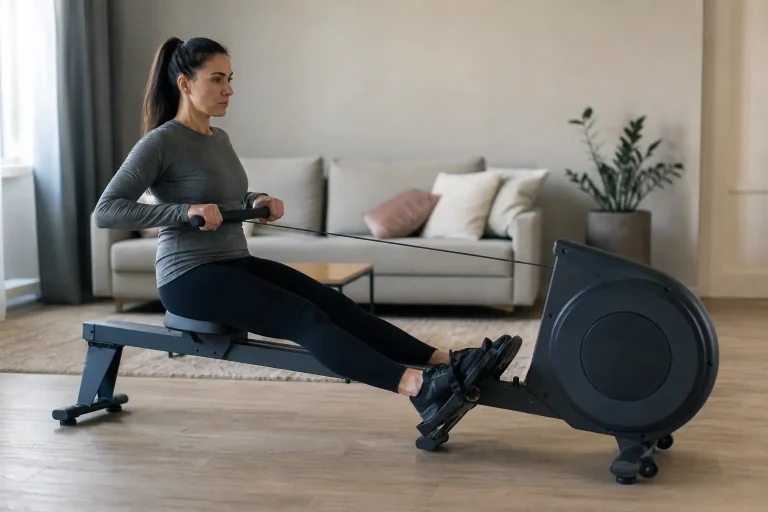
Best Magnetic Rowing Machine (2026): 5 Quiet Picks Ranked
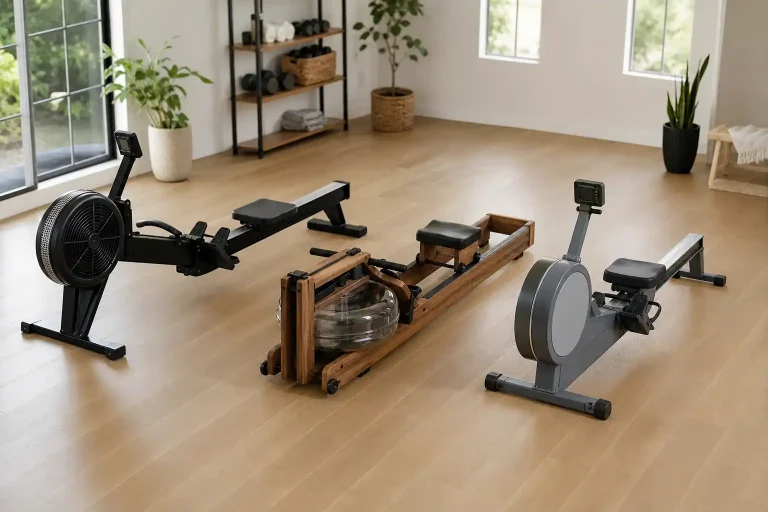
Types of Rowing Machines (2026): Air, Magnetic, Water, Hydraulic and Hybrid Explained
Rowing Machines
This article contains affiliate links. If you click through and make a purchase, we may earn a small commission at no extra cost to you. As an Amazon Associate, we earn from qualifying purchases. We do not show prices because they change constantly: product details and availability can change at any time, so please check the current price and details directly on Amazon. Learn more. Amazon and the Amazon logo are trademarks of Amazon.com, Inc. or its affiliates.
