Rockport Walk Test Calculator
1Your one-mile walk
Estimated VO2max (ml/kg/min)
–
Where you stand for your age and sex
How you compare with documented champions (ml/kg/min)
This is an estimate for healthy adults, not a medical test. A maximal effort is hard on the heart: if you are inactive, over 45 (men) or 55 (women), pregnant, or have heart, lung or metabolic symptoms or conditions, ask your doctor before any all-out test, and stop at once if you feel chest pain, dizziness or unusual shortness of breath.
Free tool · Updated November 1, 2026
A fitness test you can walk
Walk one mile as fast as you can, note your time and heart rate, and get an estimated VO2max with a rating for your age and sex. No running needed, which makes it a good first test.
Short answer
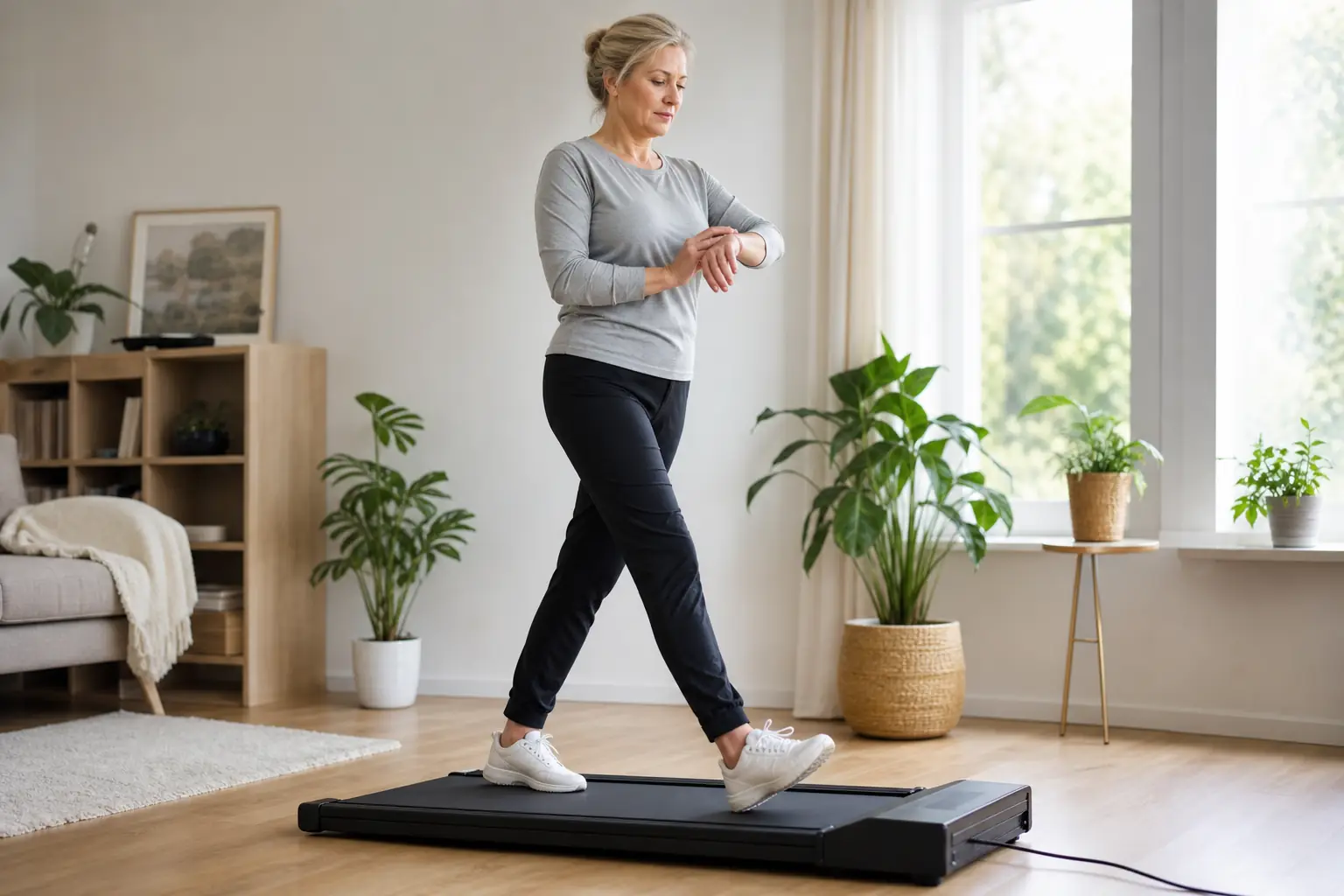
The Rockport walk test estimates VO2max from a one-mile walk done as fast as you can, without running. A 40-year-old man weighing 180 lb who walks the mile in 15:00 and finishes at 140 bpm gets about 38.9 ml/kg/min, close to the median for his age.
Key takeaways
- Walk, do not jog: the equation was built on walking and loses accuracy if you run.
- The heart rate right at the finish matters as much as the time; measure it within 15 seconds.
- It suits beginners, older adults and anyone who cannot run a maximal test.
- A treadmill works if you keep it flat and walk the full mile on the console.
The Rockport walk test was developed in the 1980s by researchers at the University of Massachusetts with the Rockport shoe company, to give non-runners a safe, simple fitness test. You walk one mile as fast as you can and note your time and heart rate.
The calculator applies the published equation to estimate your VO2max, then rates it against measured treadmill tests of US adults of your age and sex, and shows where documented champions sit on the same scale.
How to Do the Rockport Walk Test
Walk easily for five minutes to warm up. Then walk one mile, 4 laps of a 400 m track plus 9 m, as fast as you can without breaking into a jog. Stop the watch at the line and take your pulse at once: count for 15 seconds and multiply by 4, or read a chest strap.
- On a treadmill: keep the belt flat (0 to 1% incline), raise the speed to the fastest walk you can keep, and stop at 1.00 mile on the console. The treadmill pace converter shows the speed for a target mile time.
- Heart rate: a chest strap or a watch that reads well at walking speed is best; see our heart rate zone calculator to use the number in training.
- Retest: every 6 to 8 weeks, on the same course, at the same time of day.
The Rockport Equation
The equation published by Kline and colleagues in 1987 is: VO2max = 132.853 – 0.0769 x weight (lb) – 0.3877 x age + 6.315 x sex (1 for men, 0 for women) – 3.2649 x time (minutes, decimals) – 0.1565 x heart rate. It was validated on adults aged 30 to 69 who walked the mile on a track.
A faster mile and a lower finishing heart rate both raise the estimate: at the same effort, a fitter heart beats slower. Body weight lowers it, because VO2max is expressed per kilogram. The table shows how the result changes with the mile time.
| Mile time | Man, 180 lb (81.6 kg)Man | Woman, 150 lb (68 kg)Woman |
|---|---|---|
| 12:00 /mi (7:27 /km) | 48.7 | 44.7 |
| 13:00 /mi (8:05 /km) | 45.5 | 41.5 |
| 14:00 /mi (8:42 /km) | 42.2 | 38.2 |
| 15:00 /mi (9:19 /km) | 38.9 | 34.9 |
| 16:00 /mi (9:57 /km) | 35.7 | 31.7 |
| 17:00 /mi (10:34 /km) | 32.4 | 28.4 |
| 18:00 /mi (11:11 /km) | 29.1 | 25.1 |
VO2max Norms and Champion Values
The percentile scale in the calculator comes from the FRIEND registry (Fitness Registry and the Importance of Exercise National Database): Kaminsky, Arena and Myers, Mayo Clinic Proceedings, 2015, measured treadmill VO2max of apparently healthy US adults. The 50th percentile is the median: half of the people tested in that group were below it.
The comparison bars use only values that were measured in a laboratory and reported with a source: Oskar Svendsen (Norwegian cyclist), 97.5 ml/kg/min: Lab test at Lillehammer University College in 2012, reported by Norwegian cycling media; often cited as the highest value on record; Chris Froome (Four-time Tour de France winner), 84.6 ml/kg/min: 5.91 L/min at 69.9 kg, tested in 2015; published in Medicine & Science in Sports & Exercise (2017); Paula Radcliffe (Women’s marathon world record holder 2003-2019), 70 ml/kg/min: Yearly average from 1992 to 2003, single tests up to about 80; published by Andrew Jones in the International Journal of Sports Science & Coaching (2006). Many higher numbers circulate online for famous skiers, runners and cyclists without a published test behind them, so we leave them out.
| Group | 10th | 25th | 50th (median)50th | 75th | 90th |
|---|---|---|---|---|---|
| Men 20-29 | 32.1 | 40.1 | 48 | 55.2 | 61.8 |
| Men 30-39 | 30.2 | 35.9 | 42.4 | 49.2 | 56.5 |
| Men 40-49 | 26.8 | 31.9 | 37.8 | 45 | 52.1 |
| Men 50-59 | 22.8 | 27.1 | 32.6 | 39.7 | 45.6 |
| Men 60-69 | 19.8 | 23.7 | 28.2 | 34.5 | 40.3 |
| Men 70-79 | 17.1 | 20.4 | 24.4 | 30.4 | 36.6 |
| Women 20-29 | 23.9 | 30.5 | 37.6 | 44.7 | 51.3 |
| Women 30-39 | 20.9 | 25.3 | 30.2 | 36.1 | 41.4 |
| Women 40-49 | 18.8 | 22.1 | 26.7 | 32.4 | 38.4 |
| Women 50-59 | 17.3 | 19.9 | 23.4 | 27.6 | 32 |
| Women 60-69 | 14.6 | 17.2 | 20 | 23.8 | 27 |
| Women 70-79 | 13.6 | 15.6 | 18.3 | 20.8 | 23.1 |
Share, Embed or Cite This Calculator
Health coaches and walking groups can embed the calculator; the result link keeps the numbers entered.
Share this calculator
Send it to a friend, a training partner or your followers. These buttons share the calculator itself, not your results.
Use this calculator like an app
Put Rockport Walk Test Calculator on your phone’s home screen: it opens full screen in one tap, like a native app, with no download from a store.
- iPhone (Safari)Tap Share , then Add to Home Screen, then Add.
- Android (Chrome)Tap the menu ⋮, then Add to home screen or Install app.
- ComputerBookmark the page, or in Chrome and Edge use the install icon in the address bar.
Embed the interactive calculator
For websites and blogs. Paste this code where you want the calculator: your visitors use it right on your page. It resizes itself and shows a credit link to FitGearHQ.
Add a link card
For blogs, newsletters and pages that do not allow scripts: a clean card with a picture and one link.
Cite this calculator
- TitleRockport Walk Test Calculator
- PublisherFitGearHQ
- URLhttps://fitgearhq.com/rockport-walk-test-calculator/
- Updated
More Free Fitness Tools
See them all on Fitness Calculators, Treadmill Tools or every free fitness tool.
Checklist Before Your Test
4 checks
Tap a number to check off that step.
- 01
Check your health firstAsk your doctor first if you are inactive, have symptoms or take heart medicines.
- 02
Use a measured mileA 400 m track (4 laps plus 9 m) or a treadmill console.
- 03
Wear a heart rate strapOr practise counting your pulse for 15 seconds.
- 04
Warm up for 5 minutesEasy walking before the timed mile.
Common Mistakes to Avoid
Mistake 1Jogging part of the mile
Instead: The equation is for walking; jogging skews the estimate.
Mistake 2Taking the pulse too late
Instead: Heart rate drops fast; count within the first 15 seconds.
Mistake 3Testing after coffee or a big meal
Instead: Both raise heart rate and lower the estimate.
Mistake 4Using a beta blocker without saying so
Instead: It lowers heart rate, so the estimate is not valid.
The Bottom Line
- Equation from Kline and colleagues, Medicine & Science in Sports & Exercise, 1987.
- Inputs: weight, age, sex, time and finish heart rate.
- Percentiles from the FRIEND registry of measured treadmill tests.
- Free to use, share, link and embed.
Frequently Asked Questions
With the Kline equation: 132.853 – 0.0769 x weight (lb) – 0.3877 x age + 6.315 x sex – 3.2649 x time – 0.1565 x heart rate.
There is no single target: the result depends on your heart rate, age, sex and weight. Under 15 minutes is a brisk walk for most adults.
Yes. Keep the incline at 0 to 1%, walk as fast as you can and stop at 1.00 mile.
Adults who cannot or prefer not to run, beginners and older adults; it was validated on people aged 30 to 69.
It tracks lab VO2max reasonably well on average, with an error of a few ml/kg/min for one person.
Every 6 to 8 weeks, in the same conditions.