Bruce Protocol Calculator
1Your Bruce protocol result
Estimated VO2max (ml/kg/min)
–
Where you stand for your age and sex
How you compare with documented champions (ml/kg/min)
Bruce stages: speed, grade and your progress
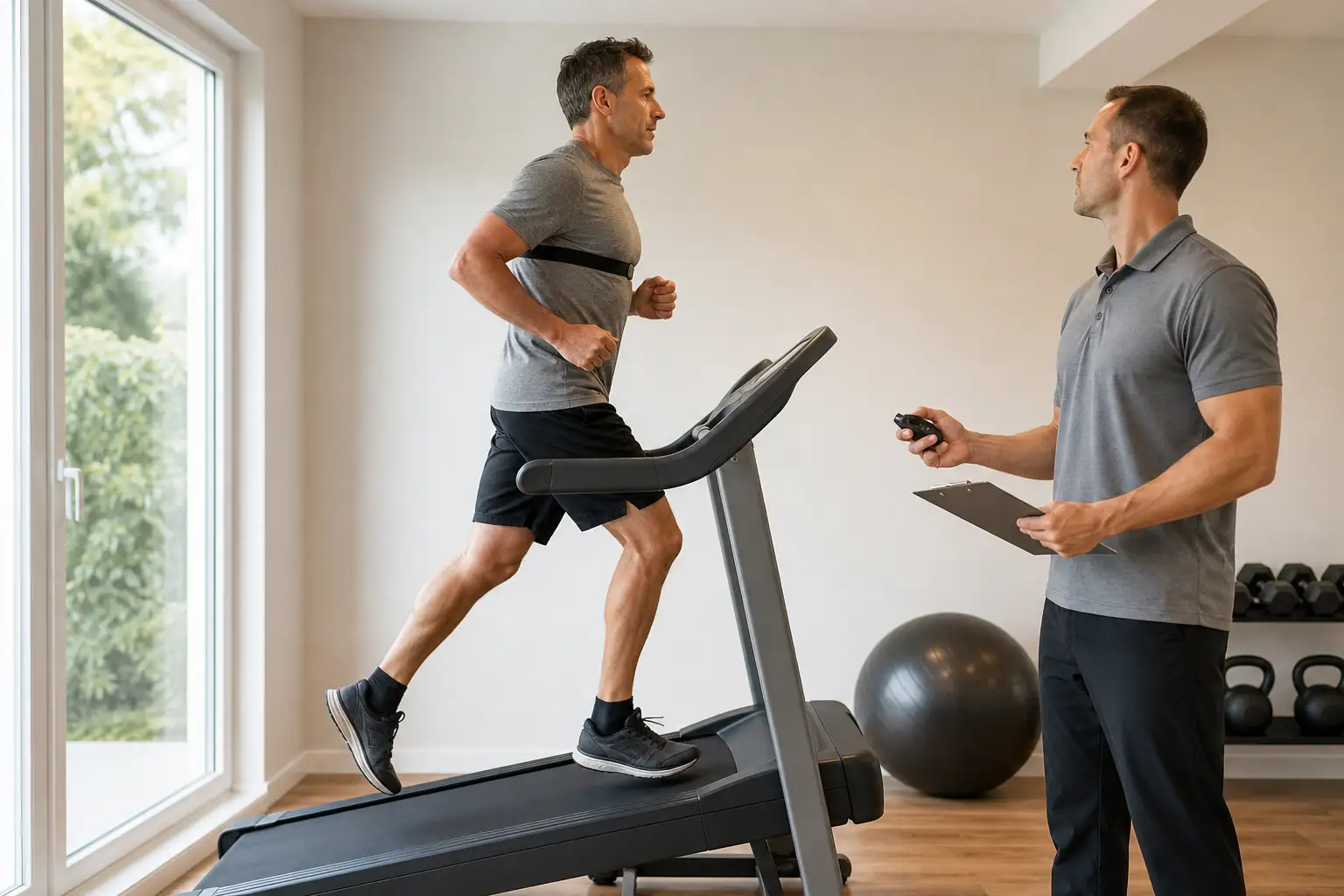
The Bruce protocol is a maximal test usually run in a clinic with ECG monitoring. This is an estimate for healthy adults, not a medical test. A maximal effort is hard on the heart: if you are inactive, over 45 (men) or 55 (women), pregnant, or have heart, lung or metabolic symptoms or conditions, ask your doctor before any all-out test, and stop at once if you feel chest pain, dizziness or unusual shortness of breath.

Free tool · Updated November 1, 2026
The classic treadmill stress test, decoded
Enter how long you lasted on the Bruce protocol to estimate your VO2max and METs, see which stage you reached and how each stage translates to a home treadmill.
Short answer
The Bruce protocol is a treadmill test in 3-minute stages that get faster and steeper, from 1.7 mph at 10% grade up to 6 mph at 22%. Your total time predicts VO2max: 10 minutes gives about 34 ml/kg/min with the Foster equation, 12 minutes about 42.
Key takeaways
- It is a maximal test, normally done in a clinic with ECG monitoring; do not attempt it alone if you have any heart risk.
- Total time is what counts: each extra minute adds about 3 to 4 ml/kg/min in the middle stages.
- Holding the handrails inflates the result, so tests are scored without them.
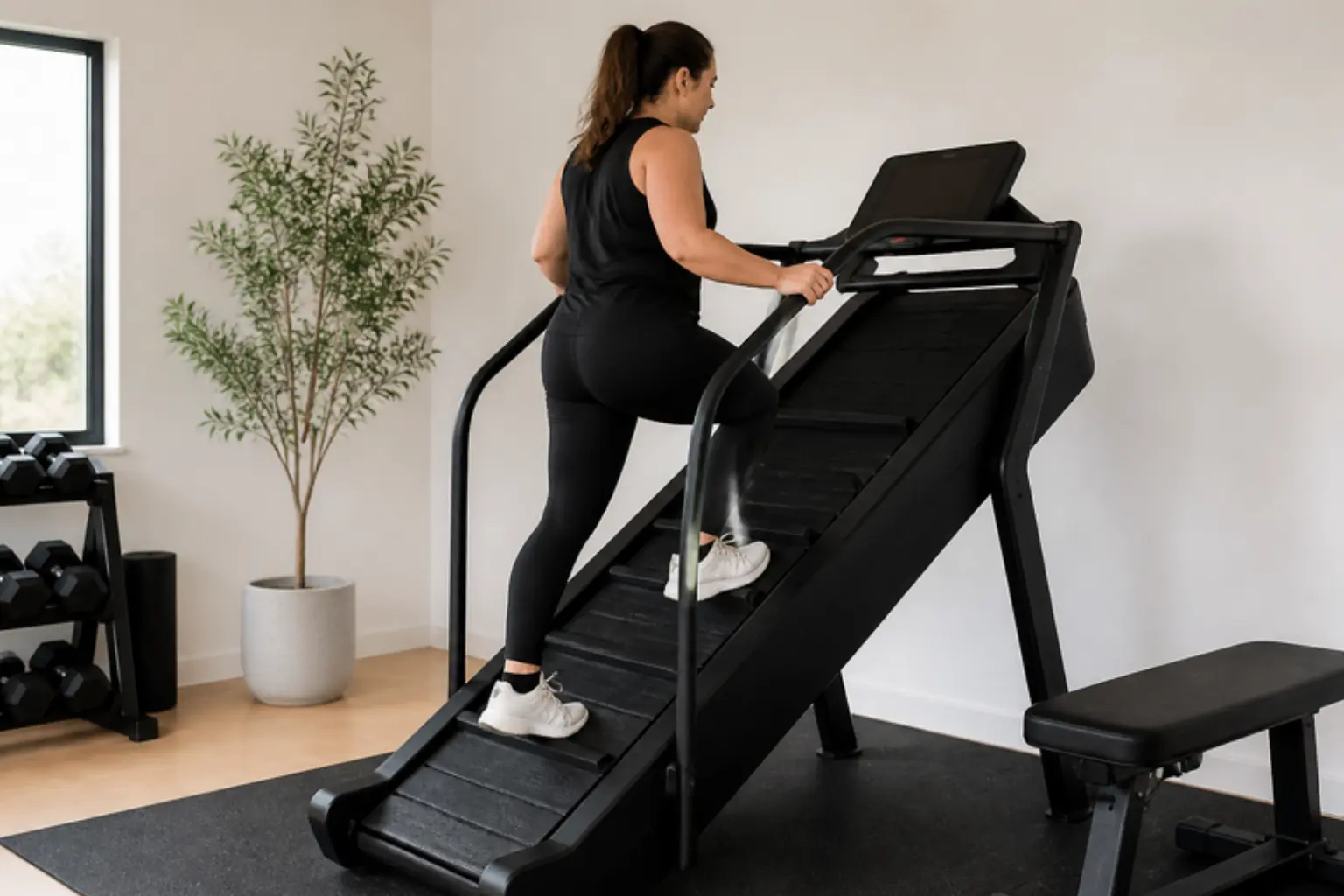
- Most home treadmills reach stage 3 (14%); later stages need an incline trainer.
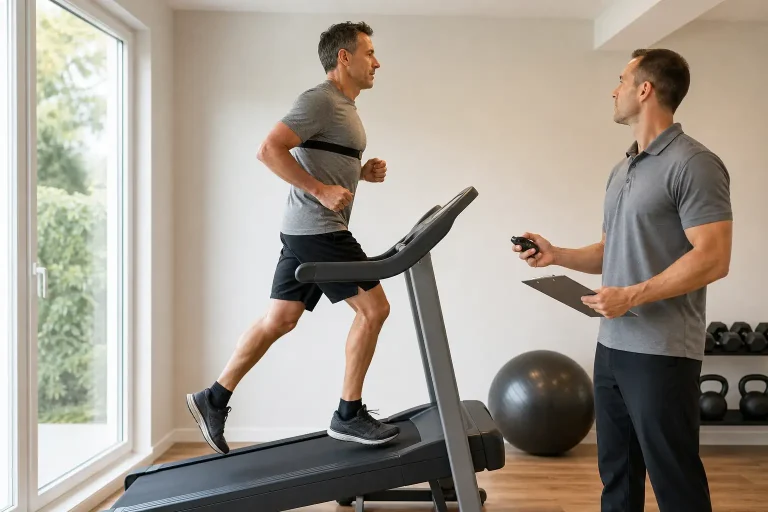
Cardiologist Robert Bruce designed his protocol in the 1960s to test the heart under rising effort. It is still the most widely used treadmill stress test in US clinics, and many sports labs use it to estimate VO2max.
If you have done the test, enter your total time to see your estimated VO2max, METs and the stage you reached. If you want to understand it before a clinic visit, the stage table shows the speed and grade of every stage in mph and km/h.
Bruce Protocol Stages
Every stage lasts 3 minutes. The speed and grade rise together, so the effort climbs steeply: stage 1 is a brisk walk up a hill, stage 4 is a jog up a steep slope, stage 6 a hard run up a 20% grade. Few people go past stage 5.
| Stage | Speed | Grade | Clock | VO2max if you stop at the endVO2max |
|---|---|---|---|---|
| Stage 1 | 1.7 mph (2.7 km/h) | 10% | 0:00 to 3:00 | 14.4 |
| Stage 2 | 2.5 mph (4.0 km/h) | 12% | 3:00 to 6:00 | 20.1 |
| Stage 3 | 3.4 mph (5.5 km/h) | 14% | 6:00 to 9:00 | 30.1 |
| Stage 4 | 4.2 mph (6.8 km/h) | 16% | 9:00 to 12:00 | 42.4 |
| Stage 5 | 5.0 mph (8.0 km/h) | 18% | 12:00 to 15:00 | 55.1 |
| Stage 6 | 5.5 mph (8.9 km/h) | 20% | 15:00 to 18:00 | 66.1 |
| Stage 7 | 6.0 mph (9.7 km/h) | 22% | 18:00 to 21:00 | 73.6 |
How the VO2max Is Estimated
The calculator uses the equation published by Foster and colleagues in 1984 from people tested on the Bruce protocol: VO2max = 14.76 – 1.379 x T + 0.451 x T² – 0.012 x T³, where T is the total time in minutes. It also shows a simpler sex-specific equation, 2.94 x T + 7.65 for men and 2.94 x T + 3.74 for women, as listed in the American College of Sports Medicine’s fitness assessment manual. The two usually agree within a few points.
The equations assume you walked or ran without holding the rails, to true exhaustion. Stopping early because of the steep grade, not fatigue, gives a lower estimate.
Can You Do the Bruce Test on a Home Treadmill?
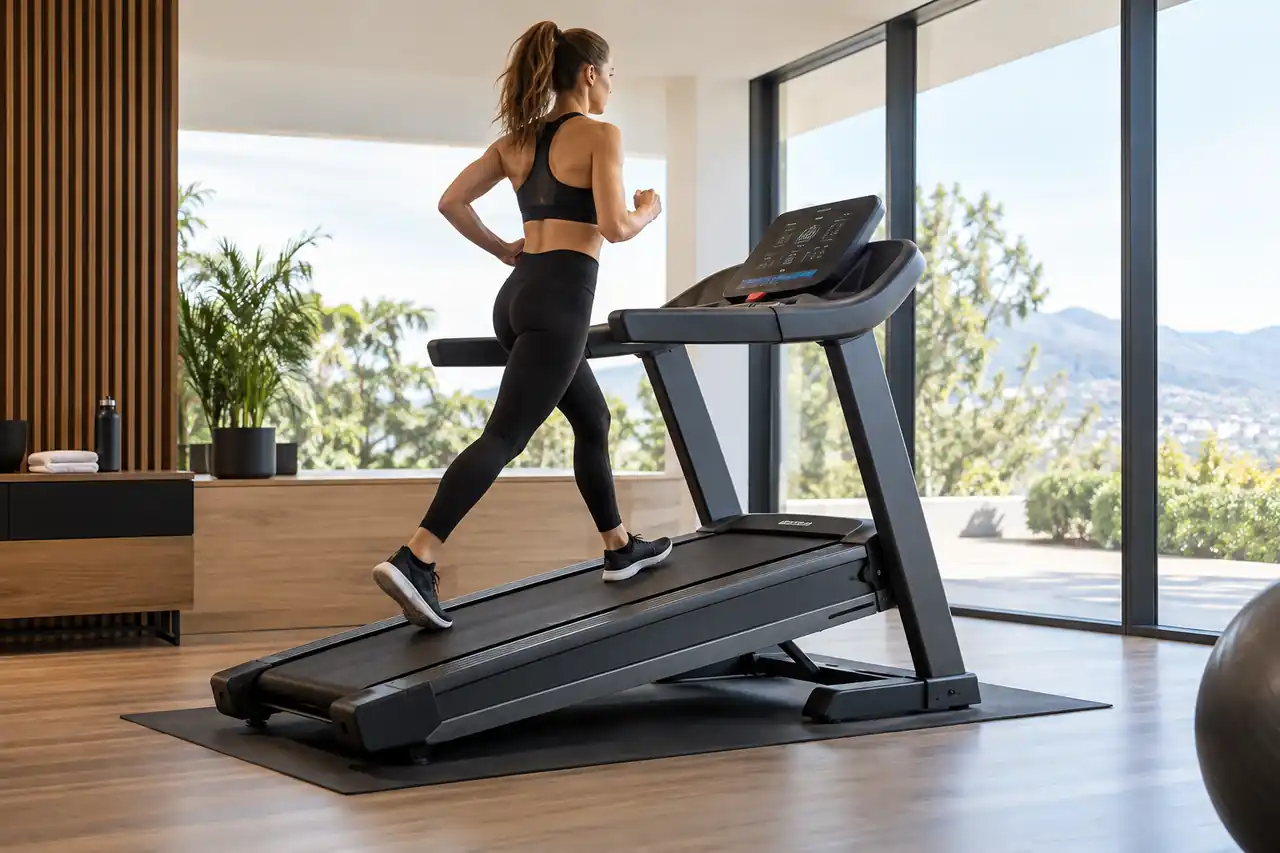
Only with care, and only if you are healthy and cleared for maximal exercise. The protocol needs grades from 10 to 22%: most home treadmills stop at 10 to 15%, so they cover stages 1 to 3. Enter your treadmill’s maximum incline above and the stages it cannot reach turn grey.
- For the full protocol you need an incline trainer that reaches 22% or more; see our best incline trainers and best treadmills with incline.
- Use the safety key and have someone with you; stop at once with chest pain, dizziness or unusual breathlessness.
- For a safer home test, the Rockport walk test or the Cooper test need no steep incline.
- Train by heart rate between tests with our heart rate zone calculator.
VO2max Norms and Champion Values
The percentile scale in the calculator comes from the FRIEND registry (Fitness Registry and the Importance of Exercise National Database): Kaminsky, Arena and Myers, Mayo Clinic Proceedings, 2015, measured treadmill VO2max of apparently healthy US adults. The 50th percentile is the median: half of the people tested in that group were below it.
The comparison bars use only values that were measured in a laboratory and reported with a source: Oskar Svendsen (Norwegian cyclist), 97.5 ml/kg/min: Lab test at Lillehammer University College in 2012, reported by Norwegian cycling media; often cited as the highest value on record; Chris Froome (Four-time Tour de France winner), 84.6 ml/kg/min: 5.91 L/min at 69.9 kg, tested in 2015; published in Medicine & Science in Sports & Exercise (2017); Paula Radcliffe (Women’s marathon world record holder 2003-2019), 70 ml/kg/min: Yearly average from 1992 to 2003, single tests up to about 80; published by Andrew Jones in the International Journal of Sports Science & Coaching (2006). Many higher numbers circulate online for famous skiers, runners and cyclists without a published test behind them, so we leave them out.
| Group | 10th | 25th | 50th (median)50th | 75th | 90th |
|---|---|---|---|---|---|
| Men 20-29 | 32.1 | 40.1 | 48 | 55.2 | 61.8 |
| Men 30-39 | 30.2 | 35.9 | 42.4 | 49.2 | 56.5 |
| Men 40-49 | 26.8 | 31.9 | 37.8 | 45 | 52.1 |
| Men 50-59 | 22.8 | 27.1 | 32.6 | 39.7 | 45.6 |
| Men 60-69 | 19.8 | 23.7 | 28.2 | 34.5 | 40.3 |
| Men 70-79 | 17.1 | 20.4 | 24.4 | 30.4 | 36.6 |
| Women 20-29 | 23.9 | 30.5 | 37.6 | 44.7 | 51.3 |
| Women 30-39 | 20.9 | 25.3 | 30.2 | 36.1 | 41.4 |
| Women 40-49 | 18.8 | 22.1 | 26.7 | 32.4 | 38.4 |
| Women 50-59 | 17.3 | 19.9 | 23.4 | 27.6 | 32 |
| Women 60-69 | 14.6 | 17.2 | 20 | 23.8 | 27 |
| Women 70-79 | 13.6 | 15.6 | 18.3 | 20.8 | 23.1 |
Share, Embed or Cite This Calculator
Trainers and clinics can embed the calculator; the result link keeps the numbers entered.
Share this calculator
Send it to a friend, a training partner or your followers. These buttons share the calculator itself, not your results.
Use this calculator like an app
Put Bruce Protocol Calculator on your phone’s home screen: it opens full screen in one tap, like a native app, with no download from a store.
- iPhone (Safari)Tap Share , then Add to Home Screen, then Add.
- Android (Chrome)Tap the menu ⋮, then Add to home screen or Install app.
- ComputerBookmark the page, or in Chrome and Edge use the install icon in the address bar.
Embed the interactive calculator
For websites and blogs. Paste this code where you want the calculator: your visitors use it right on your page. It resizes itself and shows a credit link to FitGearHQ.
Add a link card
For blogs, newsletters and pages that do not allow scripts: a clean card with a picture and one link.
Cite this calculator
- TitleBruce Protocol Calculator
- PublisherFitGearHQ
- URLhttps://fitgearhq.com/bruce-protocol-calculator/
- Updated
More Free Fitness Tools
See them all on Fitness Calculators, Treadmill Tools or every free fitness tool.
Checklist Before Your Test
4 checks
Tap a number to check off that step.
- 01
Get medical clearanceA maximal test needs a doctor’s go-ahead if you have any heart risk.
- 02
Check your treadmill’s inclineMost home models stop at 10 to 15%, enough for stages 1 to 3 only.
- 03
Clip the safety keyAnd have someone next to the treadmill.
- 04
Do not hold the railsHolding them makes the result look better than it is.
Common Mistakes to Avoid
Mistake 1Testing alone at home with risk factors
Instead: Do it in a clinic with monitoring.
Mistake 2Holding the handrails
Instead: It lowers the effort and inflates the estimate.
Mistake 3Stopping because of the grade, not fatigue
Instead: The estimate then underrates your fitness.
Mistake 4Comparing with a different protocol
Instead: Bruce, Balke and Cooper results use different equations.
The Bottom Line
- Stages from Bruce’s protocol, as listed by the American College of Sports Medicine.
- VO2max = 14.76 – 1.379T + 0.451T² – 0.012T³ (Foster, 1984).
- Percentiles from the FRIEND registry of measured treadmill tests.
- Free to use, share, link and embed.
Frequently Asked Questions
A treadmill test in 3-minute stages of rising speed and grade, used to test the heart and estimate VO2max.
With the Foster equation: 14.76 – 1.379T + 0.451T² – 0.012T³, where T is the total time in minutes.
It depends on age and sex; for a man in his forties, about 11 minutes is near the median of measured tests and 12:30 is above it.
With the Foster equation, finishing stage 1 is about 4 METs, stage 2 about 6, stage 3 about 9 and stage 4 about 12.
No. The equations assume you do not; holding the rails inflates the result.
Up to the incline your treadmill reaches, usually stages 1 to 3, and only if you are cleared for maximal exercise.