Beep Test Audio Player
1Run the test
Tap Start: a 3-second countdown, then run to the far line before each beep. The screen stays on while the test runs.
Your result
Estimated VO2 max (ml/kg/min)
–
Would you have passed?
Official standards found in published rules (2019 to 2026). Each organisation runs its own version, warm-up and judging rules, so treat this as a practice check, not a result.
Free tool · Updated November 1, 2026
The beep test, ready to run anywhere
Play the test from this page with accurate timing, or download the MP3 for a gym or an outdoor field. Then turn your level into a VO2 max estimate and see which entry standards you would meet.
Short answer
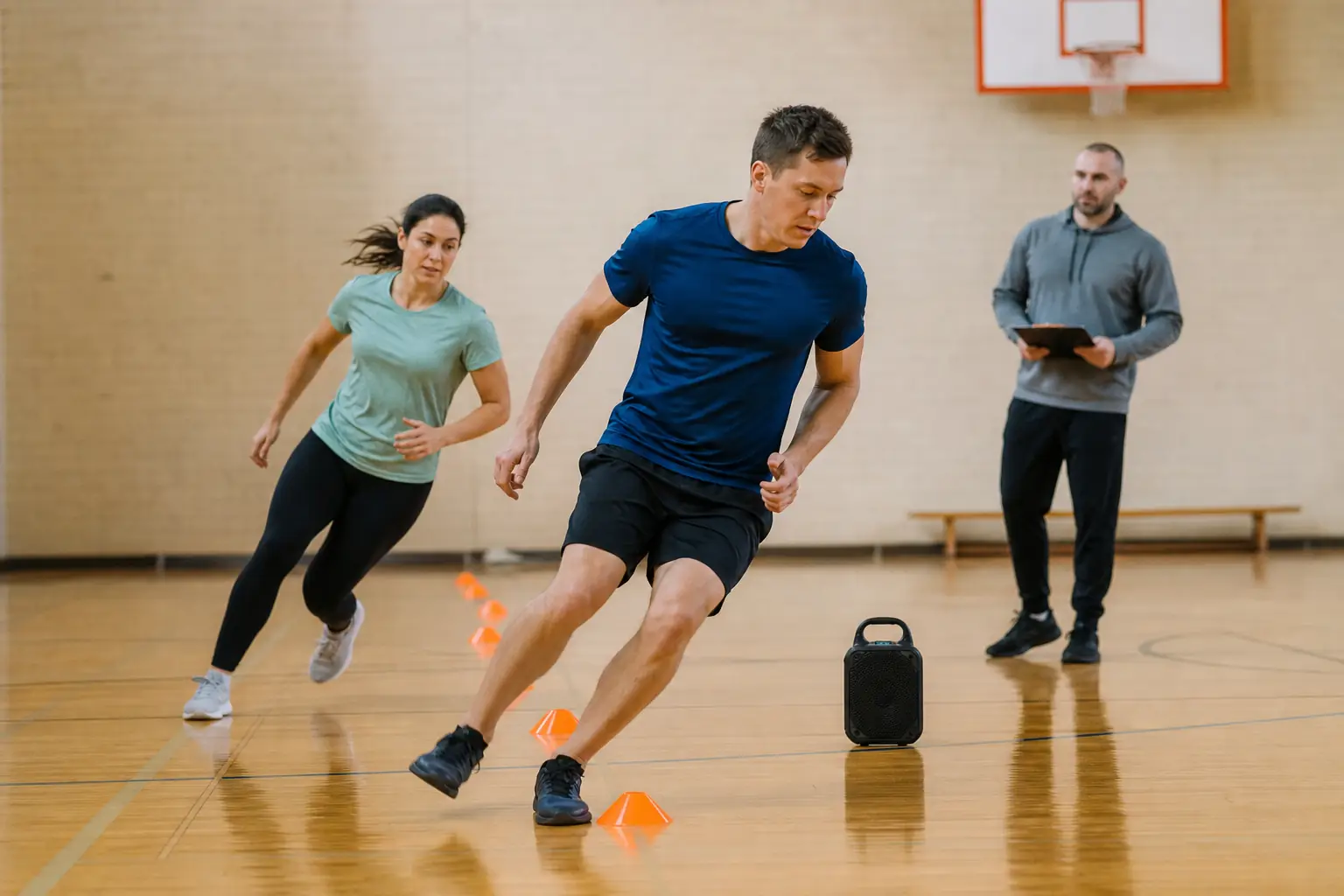
The beep test, or 20 m shuttle run, has you run between two lines 20 meters apart, arriving before each beep. The pace rises every minute, by 0.5 km/h, until you can no longer keep up; your score is the last level and shuttle you reached. Press Start below to run it with accurate timing, or download a free MP3 for the gym or an outdoor field.
Key takeaways
- Two common versions exist: Léger (starts at 8.5 km/h, used in France and Canada) and the UK and Australian test (starts at 8.0 km/h); from level 2 the speeds match.
- Your score is written level.shuttle: 8.4 means the 4th shuttle of level 8.
- The Léger 1988 equation turns your last stage speed into an estimated VO2 max.
- Entry standards vary by organisation, version and sex: check the official rules for your test.
The beep test is the most common field test of aerobic fitness: schools, sports clubs, the military, police and fire services all use a version of it. All you need is a flat 20 m strip, two lines and a loud, accurate recording.
This page gives you both. The player runs the test in your browser with timing locked to your device audio clock, and the MP3 files work on any speaker, indoors or outdoors. Enter your result to estimate your VO2 max and to see which published entry standards you would have met.
Download the Beep Test MP3
Each file starts with a short spoken introduction and a five-second countdown, then plays the full test: one beep per shuttle, a triple beep and a spoken level at each new level. Play the outdoor version through a portable speaker when you test on a field or a track: its beeps are longer and cover a wider range of pitches, so wind and traffic mask them less.
Timing checked on the encoded files: every beep lands within 2 ms of the protocol. Voice generated with the open Kokoro-82M speech model (Apache 2.0 license).
How the Beep Test Works
Mark two lines 20 m apart on a flat, non-slip surface. Start behind one line, run to the other and arrive before the beep, then turn and run back. Each level lasts about one minute and the beeps come closer together as the speed rises by 0.5 km/h. The test ends when you miss the line twice in a row, or when you stop.
The table lists every level of the Léger version, with the UK and Australian figures in the last column. In the Léger version a level ends at the first shuttle that reaches one minute in that level, which is why the shuttle count rises in steps.
| LevelLvl | km/h (Léger)km/h | mph | ShuttlesSh. | Total shuttlesTotal | Level ends atEnds | UK / Australia: km/h / shuttlesUK/AU |
|---|---|---|---|---|---|---|
| Level 1 | 8.5 | 5.3 | 8 | 8 | 1:07 | 8.0 / 7 |
| Level 2 | 9.0 | 5.6 | 8 | 16 | 2:11 | 9.0 / 8 |
| Level 3 | 9.5 | 5.9 | 8 | 24 | 3:12 | 9.5 / 8 |
| Level 4 | 10.0 | 6.2 | 9 | 33 | 4:17 | 10.0 / 9 |
| Level 5 | 10.5 | 6.5 | 9 | 42 | 5:18 | 10.5 / 9 |
| Level 6 | 11.0 | 6.8 | 10 | 52 | 6:24 | 11.0 / 10 |
| Level 7 | 11.5 | 7.1 | 10 | 62 | 7:26 | 11.5 / 10 |
| Level 8 | 12.0 | 7.5 | 10 | 72 | 8:26 | 12.0 / 11 |
| Level 9 | 12.5 | 7.8 | 11 | 83 | 9:30 | 12.5 / 11 |
| Level 10 | 13.0 | 8.1 | 11 | 94 | 10:31 | 13.0 / 11 |
| Level 11 | 13.5 | 8.4 | 12 | 106 | 11:35 | 13.5 / 12 |
| Level 12 | 14.0 | 8.7 | 12 | 118 | 12:36 | 14.0 / 12 |
| Level 13 | 14.5 | 9.0 | 13 | 131 | 13:41 | 14.5 / 13 |
| Level 14 | 15.0 | 9.3 | 13 | 144 | 14:43 | 15.0 / 13 |
| Level 15 | 15.5 | 9.6 | 13 | 157 | 15:44 | 15.5 / 13 |
| Level 16 | 16.0 | 9.9 | 14 | 171 | 16:47 | 16.0 / 14 |
| Level 17 | 16.5 | 10.3 | 14 | 185 | 17:48 | 16.5 / 14 |
| Level 18 | 17.0 | 10.6 | 15 | 200 | 18:51 | 17.0 / 15 |
| Level 19 | 17.5 | 10.9 | 15 | 215 | 19:53 | 17.5 / 15 |
| Level 20 | 18.0 | 11.2 | 15 | 230 | 20:53 | 18.0 / 16 |
| Level 21 | 18.5 | 11.5 | 16 | 246 | 21:55 | 18.5 / 16 |
From Level to VO2 Max
VO2 max is the most oxygen your body can use per minute and per kilogram of body weight, the classic measure of aerobic fitness. Léger and colleagues published in 1988 an equation that estimates it from the speed of your last stage and your age: VO2 max = 31.025 + 3.238 × S − 3.248 × A + 0.1536 × A × S, where S is the speed in km/h and A the age in years, kept at 18 for adults. For an adult, level 8 (12.0 km/h) gives about 44.6 ml/kg/min and level 11 (13.5 km/h) about 53.6.
The estimate is only as good as the test: a slippery floor, a weak recording, poor turns or a lack of motivation all lower the score. For a lab-grade number, a treadmill test with gas analysis is the reference.
Would You Pass? Entry Standards That Use the Beep Test
Several public services publish a minimum level. The calculator checks your result against the ones we could verify in official or primary documents; other organisations use different tests, such as the 1.5-mile or 2-mile runs of the US military and the FBI.
Sources: Léger, Mercier, Gadoury and Lambert, “The multistage 20 metre shuttle run test for aerobic fitness”, Journal of Sports Sciences, 1988 (PubMed); arrêté du 30 novembre 2020 on the French professional firefighter exams (Journal officiel, 1 December 2020); French BPJEPS “Activités de la forme” entry test rules as published by training centres (2026); Police neuchâteloise course navette scale (2019, PDF); ADF Careers, Training for the Pre-entry Fitness Assessment (August 2025, PDF). UK and Australian shuttle counts per level from the Topend Sports beep test tables.
Share, Embed or Cite This Beep Test
Coaches and teachers can embed the player on a team or class page; the link keeps your result.
Share this tool
Send it to a friend, a training partner or your followers. These buttons share the tool itself, not your results.
Use this tool like an app
Put Beep Test Audio Player on your phone’s home screen: it opens full screen in one tap, like a native app, with no download from a store.
- iPhone (Safari)Tap Share , then Add to Home Screen, then Add.
- Android (Chrome)Tap the menu ⋮, then Add to home screen or Install app.
- ComputerBookmark the page, or in Chrome and Edge use the install icon in the address bar.
Embed the interactive tool
For websites and blogs. Paste this code where you want the tool: your visitors use it right on your page. It resizes itself and shows a credit link to FitGearHQ.
Add a link card
For blogs, newsletters and pages that do not allow scripts: a clean card with a picture and one link.
Cite this tool
- TitleBeep Test Audio Player
- PublisherFitGearHQ
- URLhttps://fitgearhq.com/beep-test/
- Updated
More Free Fitness Tools
See them all on Fitness Calculators, Treadmill Tools or every free fitness tool.
Checklist Before You Take the Test
4 checks
Tap a number to check off that step.
- 01
Measure 20 m exactlyUse a tape; 1 m short or long changes every level.
- 02
Pick a non-slip surfaceA gym floor or a dry track; avoid wet grass for a scored test.
- 03
Check the volume firstUse the volume test or the outdoor MP3 and a speaker everyone can hear.
- 04
Warm up and know your versionAsk which version your exam uses: Léger or UK / Australian.
Common Mistakes to Avoid
Mistake 1Rounding the turns
Instead: Put a foot on or over the line, then turn; wide turns cost shuttles.
Mistake 2Starting too fast
Instead: Early levels are slow on purpose; arrive with the beep, not before it.
Mistake 3Testing on a phone speaker outdoors
Instead: Use the outdoor MP3 on a portable speaker.
Mistake 4Comparing scores across versions
Instead: Léger and UK / Australian level 1 differ; compare like with like.
The Bottom Line
- Two lines 20 m apart; one beep per shuttle; a triple beep and a spoken level at each new level.
- Léger: level 1 at 8.5 km/h, +0.5 km/h each level of about one minute.
- Free MP3s: gym and outdoor versions, both protocols.
- Free to use, share, link and embed.
Frequently Asked Questions
It depends on age, sex and sport. Many entry standards sit between level 6 and level 10; trained endurance athletes often pass level 13.
Each level lasts about a minute and there are 21 levels, so the full recording runs about 22 minutes; most people stop well before the end.
Both are 20 m shuttle runs with rising speed. The PACER used in US schools counts laps instead of levels; the idea and the effort are the same.
Enter your level, shuttle and age above: the calculator uses the Léger 1988 equation.
Not properly: the turns are part of the test. A treadmill is great to train for it, though; use the pace converter to match the level speeds.
Yes. The files are free to play for training and testing; please link to this page if you share them.