

Short answer
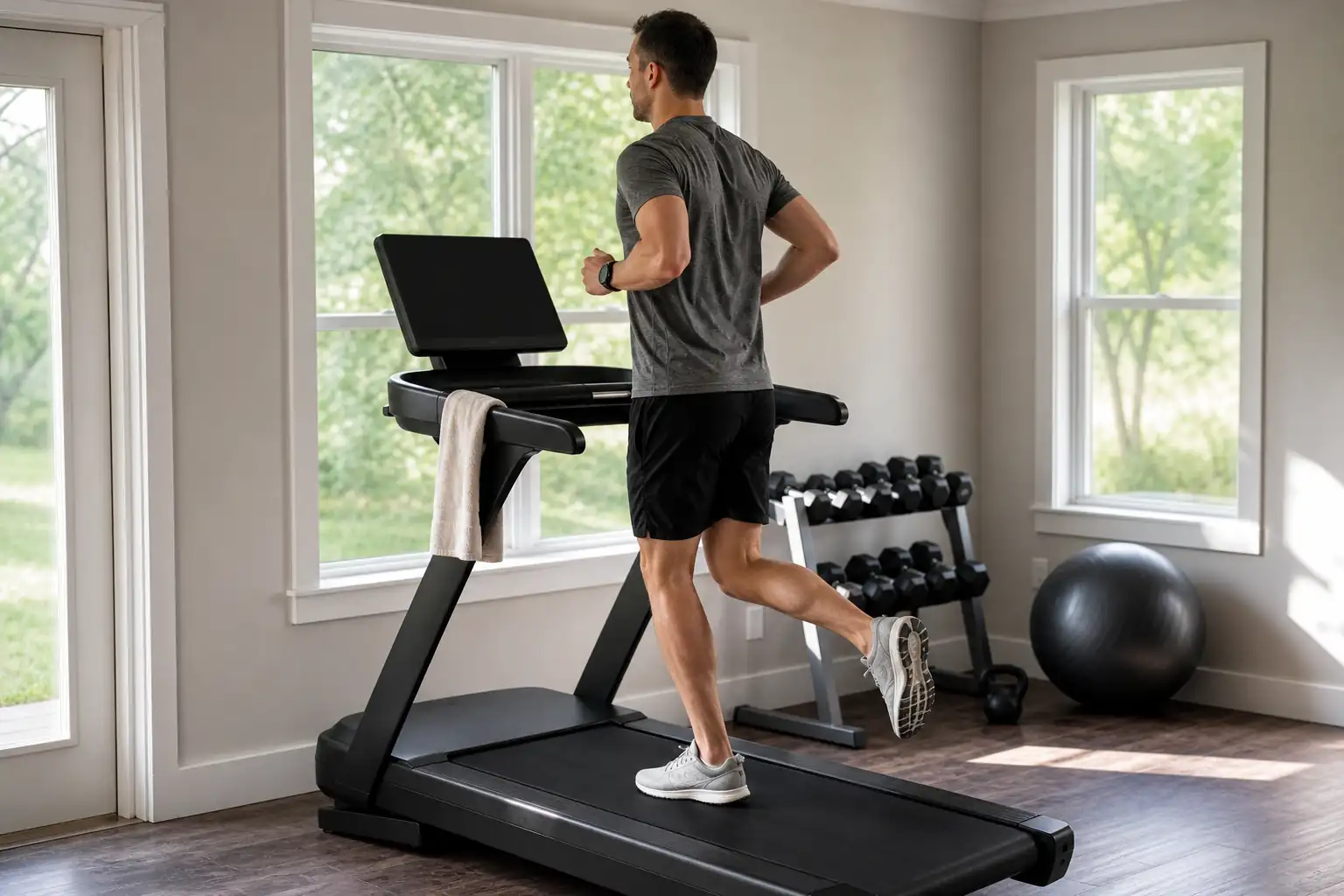
Treadmill calories burned depend on body weight, speed, incline and time. Using the ACSM metabolic equations, a 160 lb person burns an estimated 126 calories in 30 minutes walking at 3 mph, about 220 at a 6% incline and about 388 running at 6 mph. These are estimates; individuals vary.
Key takeaways
- Body weight, speed, incline and time set the estimate.
- Incline adds the most calories for walkers.
- Running burns more per minute and per mile than walking.
- Our tables use the ACSM equations and are estimates, not measurements.
- Consoles differ because of weight settings, formulas and handrail use.
- Use estimates to compare workouts and build consistent weekly minutes.
Treadmill calorie numbers are everywhere, from the console to fitness apps, and they rarely agree. The reason is that nobody measures your calories on a home treadmill. Every number is an estimate built from a formula, and the result depends on what the formula knows about you and your workout.
This guide gives you transparent estimates. We computed every value in the tables with the walking and running equations of the American College of Sports Medicine (ACSM), the same equations exercise scientists use in the lab, for five body weights and common speeds and inclines. Then we explain where these numbers come from, how accurate they are and why your console shows something else. If you are comparing machines for incline work, our best treadmill with incline guide is a good place to start.
How Many Calories Does a Treadmill Workout Burn?
Four things decide the estimate: body weight, speed, incline and time. Body weight matters because you move your own mass with every step. Speed matters because faster walking or running takes more energy per minute. Incline matters because you also lift your body upward. Time multiplies all of it.
To put that in numbers for a 160 lb person over 30 minutes: walking at 3 mph on a flat belt comes to about 126 calories, the same walk at a 6% incline to about 220 and running at 6 mph to about 388. A 220 lb person doing the same workouts comes in roughly 40% higher, because the estimates scale with body weight.
These figures are a starting point for planning, not a precise count. Your real number can be higher or lower depending on fitness, walking or running economy and how you use the handrails. For the bigger picture on activity amounts, the Physical Activity Guidelines for Americans recommend at least 150 minutes of moderate activity or 75 minutes of vigorous activity a week.
How We Calculated These Estimates
The ACSM metabolic equations estimate oxygen use from treadmill speed and grade. A 2020 validation study in the Journal of Clinical Medicine lists both: walking oxygen use = 3.5 + 0.1 × speed + 1.8 × speed × grade, and running oxygen use = 3.5 + 0.2 × speed + 0.9 × speed × grade, in mL of oxygen per kg per minute with speed in meters per minute and grade as a fraction. The 3.5 term is resting oxygen use, defined as 1 MET.
To turn oxygen into calories we multiplied by body weight and used the standard conversion of about 5 calories per liter of oxygen, the same assumption used in a 2025 analysis of the ACSM walking equation. We ran the calculations in Python for every cell of the tables, using 1 mph = 26.82 m/min and 1 lb = 0.4536 kg, and rounded to the nearest calorie.
The walking equation applies to walking speeds and the running equation to running. At speeds in between, such as a slow jog, use the row that matches what you are actually doing. Note that the results are gross calories, which include the energy you would burn sitting still.
- Step 1: convert speed from mph to meters per minute (multiply by 26.82).
- Step 2: apply the walking or running equation to get oxygen use per kg per minute.
- Step 3: multiply by body weight in kg and divide by 1,000 to get liters of oxygen per minute.
- Step 4: multiply by 5 to get calories per minute, then by the number of minutes.
Calories Burned Walking on a Treadmill
The table shows estimated calories for 30 minutes of walking on a flat belt. Double the numbers for an hour. The METs column shows the effort level, which is the same for every body weight; the Physical Activity Guidelines class 3.0 to under 6.0 METs as moderate intensity. In the equation, flat walking at 2.5 mph sits just under 3 METs, so adding a little speed or incline is what moves a walk into the moderate range.
Flat walking estimates rise slowly with speed, because the equation only adds a small amount per extra mile per hour. That is why walkers who want more work from the same session usually add incline rather than speed. Walking pads, which typically top out at walking speeds and often have no incline, fall in the first rows of this table; see our best walking pad guide for models.
| Speed, incline | METs | 130 lb | 160 lb | 190 lb | 220 lb | 250 lb |
|---|---|---|---|---|---|---|
| 2.0 mph, 0% | 2.5 | 78 | 97 | 115 | 133 | 151 |
| 2.5 mph, 0% | 2.9 | 90 | 111 | 132 | 153 | 174 |
| 3.0 mph, 0% | 3.3 | 102 | 126 | 149 | 173 | 196 |
| 3.5 mph, 0% | 3.7 | 114 | 140 | 167 | 193 | 219 |
Check Amazon for current pricing and availability.
Pro tip: For a weight between two columns, take the midpoint. The estimates scale in a straight line with body weight.
Calories Burned Incline Walking on a Treadmill
Incline has the biggest effect on walking calories. In the ACSM equation, the vertical term multiplies speed by grade, so each extra percent of incline adds a fixed amount at a given speed. At 3 mph, the estimate for a 160 lb person goes from 126 calories on a flat belt to 268 at 9% and 362 at 15% over 30 minutes.
Research supports using the walking equation on inclines: a study of slow walking at grades up to 27% found it appropriate at low speeds and higher grades. Two cautions apply. The estimates assume you are not holding the handrails, and steep grades put more load on calves, Achilles tendons and the lower back, so build up gradually. Steep settings at 12 to 15% are usually only available on treadmills with a strong motorized incline or on incline trainers, covered in our best incline trainer guide.
| Speed, incline | METs | 130 lb | 160 lb | 190 lb | 220 lb | 250 lb |
|---|---|---|---|---|---|---|
| 3.0 mph, 0% | 3.3 | 102 | 126 | 149 | 173 | 196 |
| 3.0 mph, 3% | 4.5 | 141 | 173 | 205 | 238 | 270 |
| 3.0 mph, 6% | 5.8 | 179 | 220 | 262 | 303 | 344 |
| 3.0 mph, 9% | 7.0 | 217 | 268 | 318 | 368 | 418 |
| 3.0 mph, 12% | 8.3 | 256 | 315 | 374 | 433 | 492 |
| 3.0 mph, 15% | 9.5 | 294 | 362 | 430 | 498 | 566 |
Best for Incline

Sole F89
FitScore 90/100
Our top incline pick: a 4 HP motor, 22 x 60-inch deck, 375 lb capacity and lifetime frame and motor coverage.
Ranked in our Best Treadmill With Incline guide
Check Price on AmazonBest Traditional Pick

Sole F65
FitScore 87.7/100
A 3 HP motor and wide 22 x 60-inch belt with a 350 lb capacity and the SOLE+ app.
Ranked in our Best Treadmill With Incline guide
Check Price on AmazonBest Value

XTERRA Sport Series TR75
FitScore 85.5/100
A 3 HP motor, 20 x 60-inch belt and 350 lb capacity with lifetime frame and motor coverage.
Ranked in our Best Treadmill With Incline guide
Check Price on AmazonCalories Burned Running on a Treadmill
Running costs more than walking at every speed in these tables, and it also costs more per mile. For a 160 lb person, the estimates work out to about 84 calories per mile walking at 3 mph and about 129 per mile running at 6 mph. Running speeds also fall in the vigorous range of 6 METs or more, which the guidelines count at roughly twice the value of moderate minutes.
A 2004 study in Medicine and Science in Sports and Exercise measured walkers and runners covering 1,600 m on a treadmill and found the ACSM running equation among the most suitable predictors of running energy use. Incline raises the running estimate as well, as the last rows show. For running at these speeds, a 22 x 60-inch deck and a strong motor make sessions more comfortable; see our best treadmill for running guide.
| Speed, incline | METs | 130 lb | 160 lb | 190 lb | 220 lb | 250 lb |
|---|---|---|---|---|---|---|
| 5.0 mph, 0% | 8.7 | 268 | 330 | 392 | 454 | 516 |
| 6.0 mph, 0% | 10.2 | 316 | 388 | 461 | 534 | 607 |
| 7.0 mph, 0% | 11.7 | 363 | 447 | 531 | 614 | 698 |
| 8.0 mph, 0% | 13.3 | 411 | 505 | 600 | 695 | 790 |
| 9.0 mph, 0% | 14.8 | 458 | 564 | 669 | 775 | 881 |
| 6.0 mph, 2% | 11.0 | 341 | 420 | 499 | 578 | 656 |
| 6.0 mph, 4% | 11.9 | 367 | 452 | 536 | 621 | 706 |
| 6.0 mph, 6% | 12.7 | 393 | 483 | 574 | 664 | 755 |
Best for Running

Horizon 7.4 AT
FitScore 89.9/100
A 3.5 HP motor and 22 x 60-inch deck with lifetime frame and motor coverage and 5-year parts.
Ranked in our Best Treadmill for Running guide
Check Price on AmazonBest Heavy-Duty

Sole TT8
FitScore 89.2/100
A non-folding frame with a 4 HP motor, 22 x 60-inch deck and 400 lb capacity for frequent runners.
Ranked in our Best Treadmill for Running guide
Check Price on AmazonBest Smart Value

NordicTrack Commercial 1250
FitScore 86.9/100
A 3.6 HP motor, 22 x 60-inch deck and 400 lb capacity; iFIT classes need a paid membership.
Ranked in our Best Treadmill for Running guide
Check Price on AmazonWhy Your Treadmill Console Shows a Different Number
Your console is estimating too, and it often has less information than the tables above. If you never entered your weight, the machine either uses a default weight or a generic formula, so a 130 lb and a 250 lb user see the same number. Check your manual or user profile settings to see whether you can enter your weight.
Handrails are the next big factor. Holding or leaning on the rails supports part of your body weight and lowers the real effort, but the console only knows speed and incline. The 2020 validation study notes that the ACSM equations overestimate when people rely heavily on handrail support. Gross versus net calories matter too: our tables and many consoles include resting energy, about 38 calories per 30 minutes for a 160 lb person, while some apps subtract it.
Finally, people differ. A study of 200 college students walking at about 3 mph on 2 to 6% grades concluded the ACSM walking equation was not a good predictor of their individual calorie use, and the E-MECHANIC analysis of adults with overweight or obesity found the equation overestimated more at harder workloads and after weeks of training, as people became more efficient. Heart rate based estimates on some consoles and wearables add their own error. Our best treadmill with heart rate monitor guide covers models that pair with chest straps.
- Enter your current weight in the console or app if it allows it.
- Walk without holding the rails once you are steady.
- Check whether a number is gross or net before comparing apps.
- Use the same source every time if you want to compare workouts.
How to Use Calorie Estimates Sensibly
The most useful thing a calorie estimate does is compare workouts. It shows clearly that adding incline or time does more than adding a little speed on a walk, and that running packs more work into fewer minutes. It is much less useful as a precise daily figure, so treat any single number with a margin of error.
For weight management, the CDC notes on its physical activity and weight page that more activity increases the calories your body uses, but that reaching and keeping a healthy weight takes both regular activity and healthy eating. Questions about how much to eat belong with a healthcare professional or registered dietitian, not with a treadmill console. Focus on building weekly minutes you can sustain, and pick a treadmill that makes those minutes easy; our best treadmill for home guide is a good overview.
Watch out: Do not treat calorie estimates as a license to push through pain or to restrict food. Talk to a healthcare professional before big changes to diet or exercise, especially with a chronic condition.
Calorie Estimate Checklist
- Find your body weight column, or take the midpoint between two columns.
- Pick the row that matches your speed and incline.
- Scale the 30-minute value to your session length.
- Use the walking table for walking and the running table for running.
- Remember the values include resting calories.
- Enter your weight in the console or app before comparing.
- Walk without leaning on the handrails.
- Compare workouts with one consistent source.
Common Mistakes to Avoid
- Treating console calories as an exact measurement.
- Comparing a gross number from one app with a net number from another.
- Leaving the console on its default weight.
- Holding the handrails on steep inclines and expecting the full estimate.
- Raising incline too quickly to chase a bigger number.
The Bottom Line
- Calories scale almost directly with body weight: a heavier person burns more at the same speed and incline.
- Incline adds the most for walkers: at 3 mph, a 6% grade raises the estimate by roughly three quarters versus a flat belt.
- Running costs more per mile than walking: about 129 vs 84 calories per mile for a 160 lb person in these estimates.
- Our figures are gross calories, which include the roughly 1 MET your body burns at rest.
- Console numbers differ because of the weight you entered, the formula used and handrail use.
Our Top Picks
 Best for InclineSole F89FitScore90/100Check on Amazon
- Best Traditional PickSole F65FitScore87.7/100Check on Amazon
- Best ValueXTERRA Sport Series TR75FitScore85.5/100Check on Amazon
- Best for RunningHorizon 7.4 ATFitScore89.9/100Check on Amazon
- Best Heavy-DutySole TT8FitScore89.2/100Check on Amazon
- Best Smart ValueNordicTrack Commercial 1250FitScore86.9/100Check on Amazon
Frequently Asked Questions
It depends on weight, speed and incline. A 160 lb person burns an estimated 126 calories walking at 3 mph, 220 at a 6% incline and 388 running at 6 mph, using the ACSM equations.
Yes. At 3 mph, each percent of incline adds energy cost; a 160 lb person goes from about 126 to 220 estimated calories in 30 minutes when the grade rises from 0 to 6%.
They are estimates. Accuracy depends on whether the console knows your weight, which formula it uses and whether you hold the handrails, so treat the number as approximate.
Running burns more per minute and per mile in the ACSM equations. Incline walking can close much of the gap per minute with less impact.
For a 160 lb person at 3 mph on a flat belt, the estimate is about 84 gross calories per mile. Heavier people burn more and lighter people less.
They use different inputs and formulas. Consoles often use a default weight and include resting calories, while watches mix heart rate and motion data, and some subtract resting calories.
Outdoor walking and running add factors such as wind, hills and uneven ground that the treadmill equations do not include. On a flat belt with no handrail use, the ACSM equations are a reasonable estimate.
Explore More Treadmill Guides
Best Treadmill With Incline (2026): Top 5 Picks
Best Incline Trainer (2026): 5 Steep-Incline Picks for Home
Best Treadmill for Running (2026): Top 5 Picks
Best Treadmill for Weight Loss (2026): 5 Cardio-Focused Picks

Best Walking Pad (2026): 5 Picks for Home and Under-Desk Walking
Treadmill Buying Guide (2026): How to Choose the Right Home Treadmill
This article contains affiliate links. If you click through and make a purchase, we may earn a small commission at no extra cost to you. As an Amazon Associate, we earn from qualifying purchases. We do not show prices because they change constantly: product details and availability can change at any time, so please check the current price and details directly on Amazon. Learn more. Amazon and the Amazon logo are trademarks of Amazon.com, Inc. or its affiliates.
