

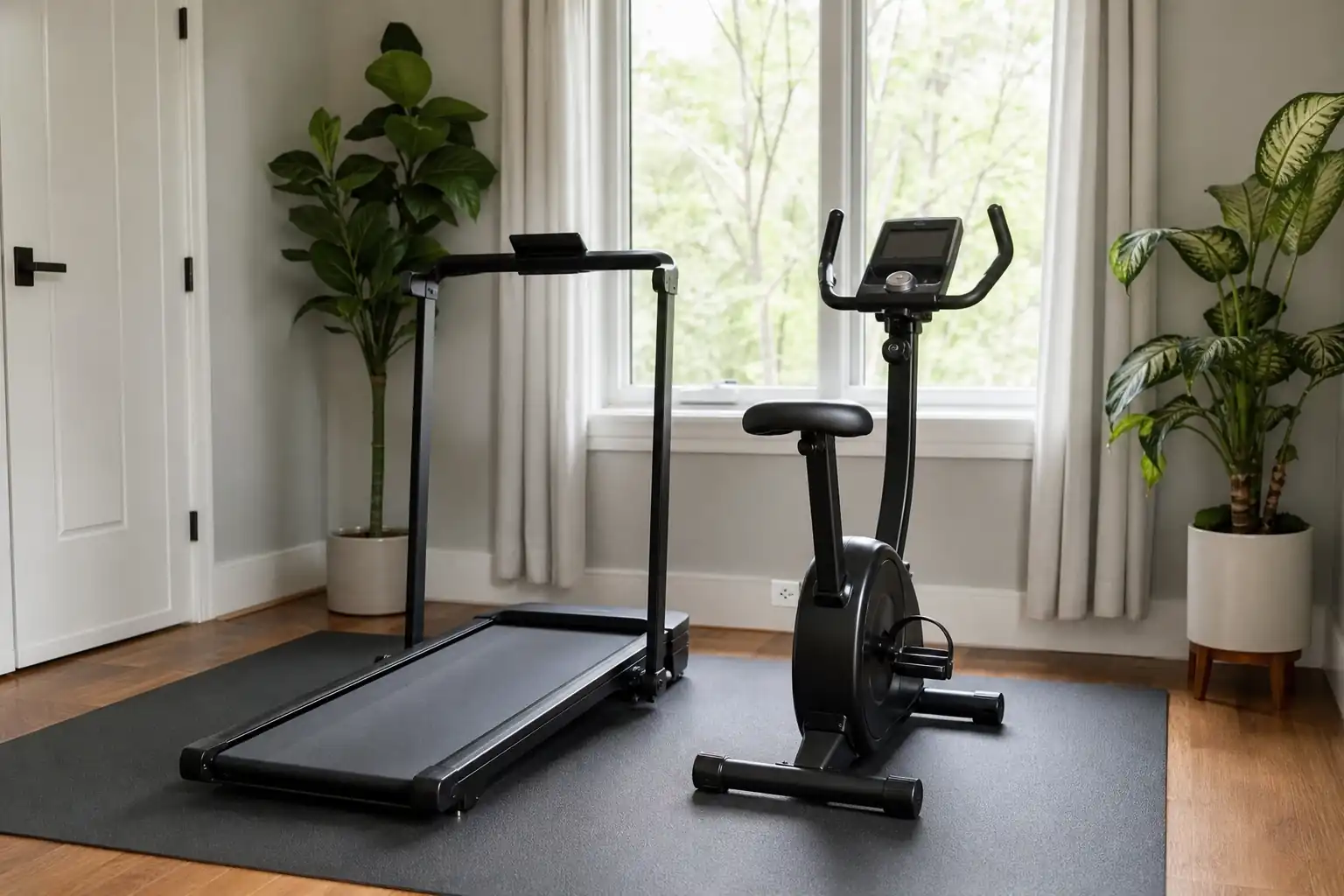
Short answer
Choose a treadmill if you want weight-bearing exercise, walking or running that carries over to daily life and races, and incline for harder workouts. Choose an exercise bike if you need low-impact cardio for sore joints, a quieter machine, a smaller footprint or a seated option for balance concerns. Both can meet CDC activity guidelines.
Key takeaways
- Treadmills are better for walking, running, bone loading and race training.
- Exercise bikes are better for low impact, quiet use, small rooms and balance concerns.
- Both machines cover moderate and vigorous intensity under CDC definitions.
- Cushioned decks and incline walking make treadmills friendlier for sore joints.
- The best machine is the one you will use several times a week.
Treadmills and exercise bikes are the two most common home cardio machines, and both can deliver a solid workout. The difference is in how they load your body. A treadmill has you on your feet, carrying your full weight with every step. An exercise bike supports you on a seat, so your legs work without the impact of landing.
This comparison covers calories and intensity, joint impact, bone health, muscles worked, space, noise and safety, with health points linked to sources from the CDC, the NIH and the Arthritis Foundation. FitGearHQ tests treadmills, so the product picks below are treadmills chosen for the buyers who are most often torn between the two, such as people with sore knees or small rooms. Start with our treadmill buying guide if you are new to treadmills.
Treadmill vs Exercise Bike at a Glance
The table sums up the main differences. Ranges for treadmills come from the models we rank; bike notes are general because exercise bikes vary widely between upright, recumbent and indoor cycling designs.
In short, the treadmill is the better tool for walking, running and bone loading, and the bike is the better tool for low impact, quiet use and small spaces. Our best treadmill for home guide is the place to start if the treadmill side wins.
| Criterion | Treadmill | Exercise bike |
|---|---|---|
| Main movement | Walking, jogging, running | Seated or standing pedaling |
| Impact | Weight-bearing; impact rises with running | Low impact; the seat supports your weight |
| Bone loading | Brisk walking and running are weight-bearing | Limited, because you sit |
| Intensity range | Moderate (brisk walking) to vigorous (running, steep incline) | Moderate (under 10 mph) to vigorous (over 10 mph) |
| Footprint (models we rank) | About 44 × 22 in for walking pads to about 77 × 37 in for full treadmills | Usually smaller than a full treadmill |
| Noise | Motor plus footfalls | Usually quieter, no footfalls |
| Power | Outlet needed (except manual models) | Varies; many bikes need little or no power |
| Best for | Walkers, runners, bone health, race training | Sore joints, quiet homes, balance concerns |
Check Amazon for current pricing and availability.
Calories and Intensity
Neither machine burns more calories by design. What matters is how hard and how long you work. The CDC classifies brisk walking at 2.5 mph or faster and cycling slower than 10 mph as moderate intensity, and jogging or running and cycling faster than 10 mph as vigorous. Both machines can therefore cover the same intensity range.
Treadmills make it easy to raise intensity without running. Adding incline turns a walk into a climb, and models such as the Horizon 7.0 AT reach 15% incline. Exercise bikes raise intensity through resistance and cadence. Many people find they can sustain a hard effort longer on a bike because there is no impact, while others find walking or running feels more natural.
For weekly targets, the CDC recommends 150 minutes of moderate-intensity or 75 minutes of vigorous-intensity activity, plus 2 days of muscle strengthening. The best choice for calorie burn is the one you will use most often. Our best treadmill for weight loss guide covers treadmill features that help with consistency.
Pro tip: Calorie numbers on consoles are estimates. Track minutes and effort over weeks instead of trusting one session readout.
Joint Impact and Knee Comfort
Exercise bikes are the lower-impact option. The Arthritis Foundation calls stationary biking an ideal low-impact exercise for people with arthritis and notes that regular riding can help lubricate joints and build the leg muscles that support them. If running or even long walks hurt your knees, hips or ankles, a bike is often the easier place to start.
A treadmill can still be joint-friendly if you walk rather than run and choose a cushioned deck. Treadmills with adjustable cushioning, such as the NordicTrack T Series 16 with SelectFlex, soften each landing compared with harder surfaces. Our treadmill cushioning guide explains how deck cushioning works.
If you have a joint condition, ask your doctor or physical therapist which activity suits you. Many people with sore knees use both: the bike on bad days and incline walking on good days.
Best for Bad Knees

NordicTrack T Series 16
FitScore 84.4/100
SelectFlex cushioning you can set from soft to firm, a 20 × 60-inch deck and 12% incline for low-speed climbing.
Ranked in our Best Treadmill for Bad Knees guide
Check Price on AmazonBest Wide Deck

Horizon 7.4 AT
FitScore 82.6/100
A 22 × 60-inch deck gives room to walk without watching your feet, with 15% incline and lifetime frame and motor coverage.
Ranked in our Best Treadmill for Bad Knees guide
Check Price on AmazonBest Value Knee Pick

XTERRA Sport Series – TR75
FitScore 77.7/100
A 20 × 60-inch deck, 350-lb rating and lifetime frame and motor warranty at an entry-to-mid-range level.
Ranked in our Best Treadmill for Bad Knees guide
Check Price on AmazonBone Health and Everyday Function
This is the treadmill’s clearest advantage. The NIH lists brisk walking and jogging or running among weight-bearing exercises that make bones work harder. Cycling is not on that list, and a bike seat supports much of your body weight while you pedal.
Walking on a treadmill also trains the same movement you use all day: carrying your weight, balancing on one leg at a time and pushing off. If your goal is to walk farther, hike or train for a race, a treadmill is the more specific tool. Our best treadmill for seniors guide covers models with full handrails for walkers who want that support.
Bikes mainly work the quadriceps, glutes, hamstrings and calves through a fixed pedal path, which many people find easier to control. Pairing either machine with strength training covers the CDC’s muscle-strengthening recommendation.
Space, Noise and Setup
Exercise bikes are usually smaller, lighter and quieter. There are no footfalls, which matters in apartments with neighbors below. Full treadmills such as the XTERRA TR75 (about 77 × 35 inches) need much more floor space, plus clearance behind the deck, and a grounded outlet.
Treadmills have closed much of the space gap. Walking pads and compact folding treadmills store flat or upright, and our best compact treadmill and best walking pad guides rank them by footprint and folded size. For noise, our best quiet treadmill for apartment picks favor models that keep motor and footfall noise down.
Whatever you choose, put a mat under it to protect the floor and reduce vibration. Treadmills also need regular belt care, covered in our treadmill maintenance guide.
Safety, Balance and Household Use
A bike is the safer choice for people with balance issues, since you stay seated. The Arthritis Foundation notes that recumbent bikes are more stable and comfortable and suit people with balance or mobility issues, while upright bikes can be uncomfortable for those with back, shoulder or wrist problems.
Treadmills carry a moving belt, so household safety matters more. In a 2021 warning, the CPSC advised treadmill owners to keep small children and pets away, keep objects away from the treadmill, unplug it when not in use and store the safety key out of reach of children. Always clip the safety key to your clothing and start the belt at a slow speed.
For walkers who want a treadmill but worry about balance, full handrails, a low deck and a slow minimum speed help. Compare models in our best treadmill with handle guide.
Watch out: Never leave a treadmill running unattended, and keep children and pets out of the room while it is in use.
Which Should You Choose?
Pick the machine that fits your body, your goals and your space, then use it consistently.
- Walker or runner training for events: treadmill. See our best treadmill for running picks.
- Bone health focus: treadmill, because walking and running are weight-bearing.
- Sore knees or arthritis: exercise bike, or a cushioned treadmill for walking; ask your doctor.
- Balance or mobility concerns: recumbent exercise bike, or a treadmill with full handrails.
- Apartment with neighbors below: exercise bike, or a quiet walking-focused treadmill.
- Small room: exercise bike, walking pad or compact folding treadmill.
- Incline walking for harder workouts without running: treadmill with power incline.
Best Compact

WELLFIT TM029 FOLD
FitScore 77.4/100
Folds to about 30 inches long, with a 20 × 50-inch belt, 15% automatic incline and a 500-lb rating.
Ranked in our Best Compact Treadmill guide
Check Price on AmazonBest Compact Incline

BORGUSI CTM5103
FitScore 78.2/100
15% automatic incline, 8.5 mph and a 3.0 HP motor on a folding frame that weighs about 103 lb.
Ranked in our Best Compact Treadmill With Incline guide
Check Price on AmazonSmallest Footprint

Trisomy D2
FitScore 70.9/100
A walking pad with a handle that folds to about 6.4 inches tall, with 15% incline and a 450-lb rating.
Ranked in our Most Compact Treadmill guide
Check Price on AmazonCommon Mistakes to Avoid
- Choosing by calorie claims; intensity and time drive calorie burn on both machines.
- Running on a treadmill through knee pain instead of switching to walking or a bike.
- Forgetting bone loading; a bike alone does little for weight-bearing goals.
- Buying a full treadmill for a small apartment without checking footprint and noise.
- Skipping safety steps on a treadmill in a home with children or pets.
The Bottom Line
- The CDC counts brisk walking (2.5 mph or faster) and cycling slower than 10 mph as moderate intensity, and jogging or cycling faster than 10 mph as vigorous.
- The NIH lists brisk walking and jogging or running as weight-bearing exercise for bone health.
- The Arthritis Foundation describes stationary biking as an ideal low-impact exercise for people with arthritis.
- Calorie burn depends mainly on intensity and time, so the machine you use consistently matters more than its type.
- Our top treadmill for bad knees scores 85.4 in its guide; it pairs adjustable cushioning with a 20 × 60-inch deck.
Our Top Picks
 Best for Bad KneesNordicTrack T Series 16FitScore84.4/100Check on Amazon
- Best Wide DeckHorizon 7.4 ATFitScore82.6/100Check on Amazon
- Best Value Knee PickXTERRA Sport Series – TR75FitScore77.7/100Check on Amazon
- Best CompactWELLFIT TM029 FOLDFitScore77.4/100Check on Amazon
- Best Compact InclineBORGUSI CTM5103FitScore78.2/100Check on Amazon
- Smallest FootprintTrisomy D2FitScore70.9/100Check on Amazon
Frequently Asked Questions
Neither is better by design. Calorie burn depends on intensity and time, and the CDC counts both brisk walking and moderate cycling as moderate-intensity activity, so pick the machine you will use most consistently.
Often, yes. The Arthritis Foundation describes stationary biking as an ideal low-impact exercise for people with arthritis. Walking on a cushioned treadmill can also work; ask your doctor which suits you.
Not in the same way. The NIH lists brisk walking and jogging as weight-bearing exercise for bone health, and a bike seat supports your weight while you pedal.
An exercise bike usually takes less space than a full treadmill. Walking pads and compact folding treadmills narrow the gap and can store under furniture or upright.
A recumbent bike is more stable for seniors with balance issues. A treadmill with full handrails and a slow start speed suits seniors who want to train walking.
Yes. Many people alternate, using the bike on recovery days or when joints are sore and the treadmill for walking, incline work or running.
Explore More Treadmill Comparisons
Best Treadmill for Bad Knees: 5 Picks for a Comfortable Home Workout
Best Treadmill for Weight Loss (2026): 5 Cardio-Focused Picks
Best Treadmill for Seniors: 5 Supportive Home Models Worth Buying in 2026
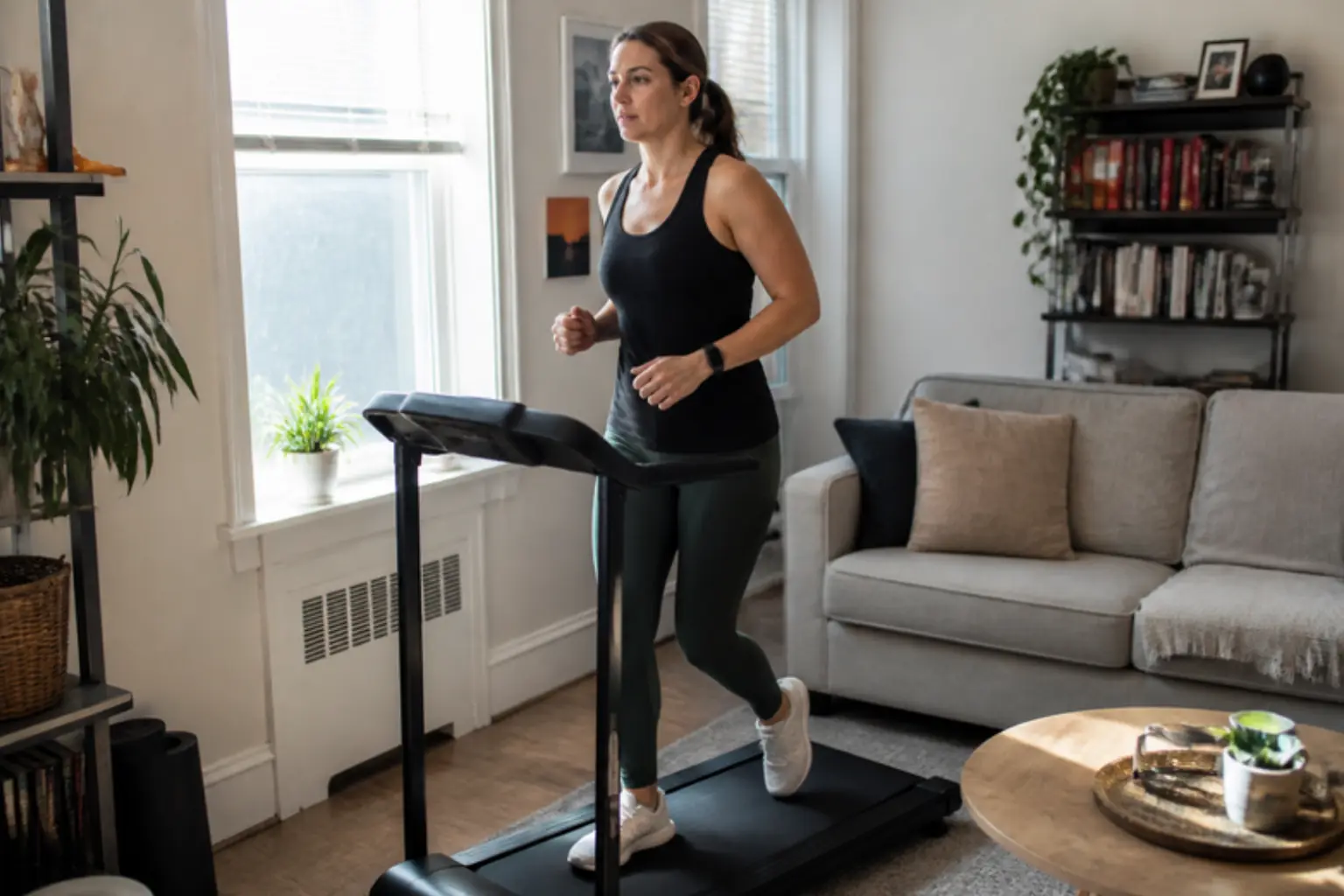
Best Compact Treadmill (2026): 5 Space-Saving Picks
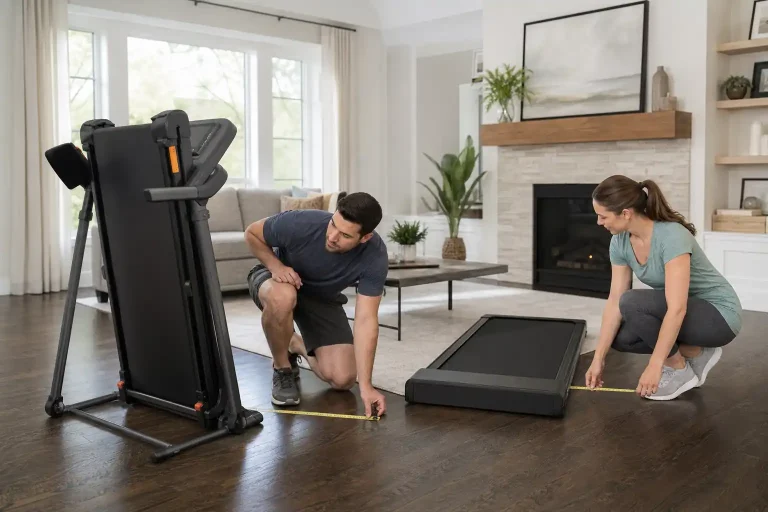
Treadmill Buying Guide (2026): How to Choose the Right Home Treadmill
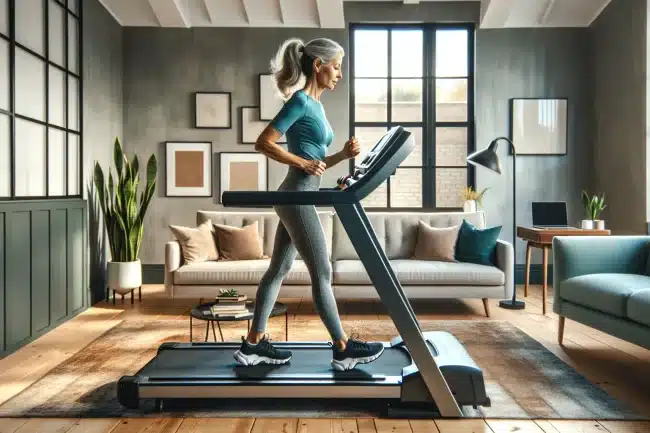
Best Cushioned Treadmill for Walking (2026): Top 5 Picks
This article contains affiliate links. If you click through and make a purchase, we may earn a small commission at no extra cost to you. As an Amazon Associate, we earn from qualifying purchases. We do not show prices because they change constantly: product details and availability can change at any time, so please check the current price and details directly on Amazon. Learn more. Amazon and the Amazon logo are trademarks of Amazon.com, Inc. or its affiliates.
