

Short answer
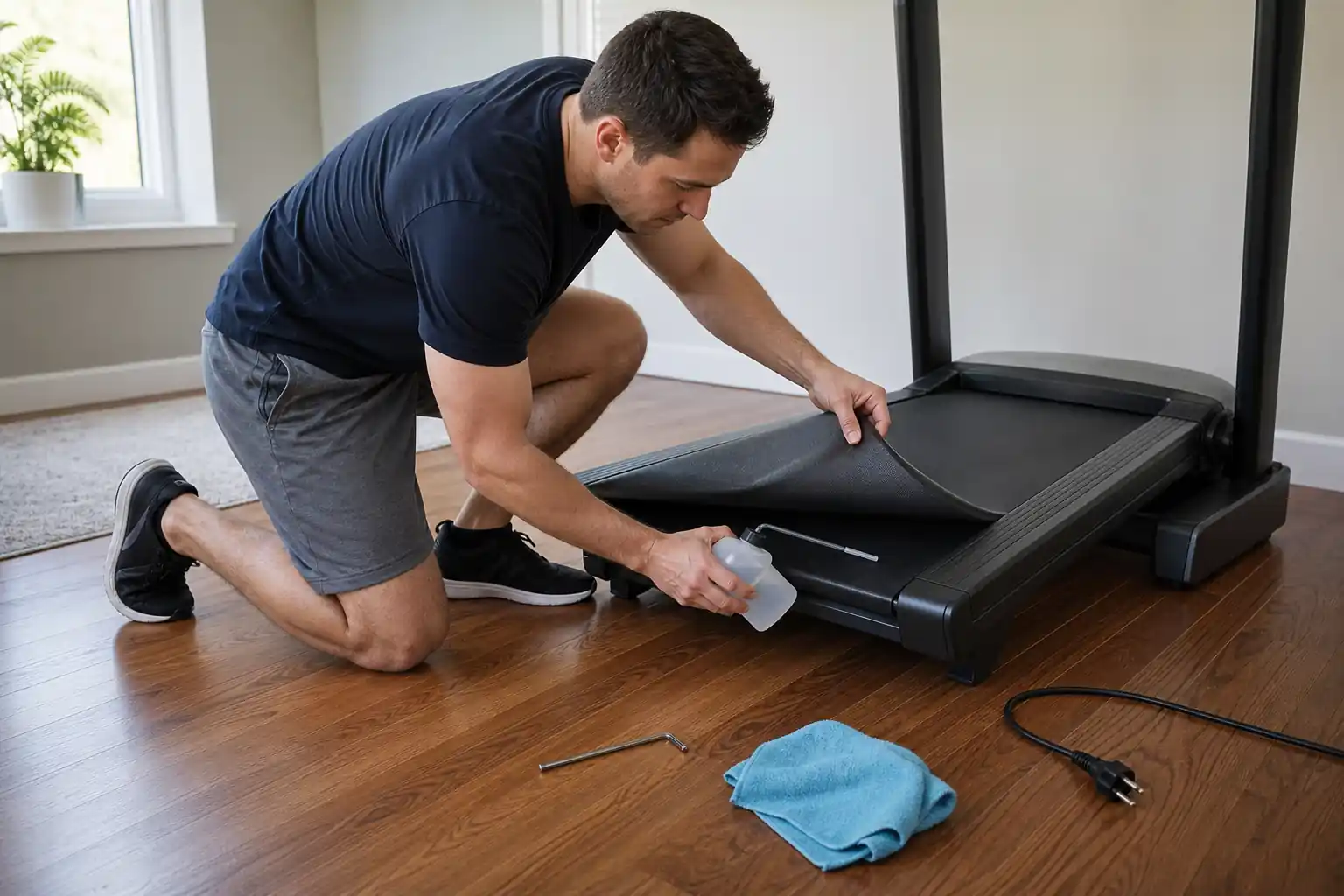
To lubricate a treadmill, unplug it, loosen the belt if your manual says to, lift each side of the belt and apply 100% silicone lubricant in a thin line along the center of the deck. Then walk slowly for a few minutes to spread it, wipe off excess and check belt tension and alignment.
Key takeaways
- Unplug and remove the safety key before every lubrication.
- Use 100% silicone treadmill lubricant or what your manual specifies.
- Apply a thin line to the deck under the belt, then walk slowly to spread it.
- Follow the interval in your owner manual and use the hand test in between.
- Check tension and alignment afterward, adjusting in quarter turns.
- Lubrication is one part of a full maintenance routine.
Lubrication is the treadmill maintenance task owners ask about most and the one they most often get wrong. The belt slides over the deck under your full body weight with every step, and a thin film of lubricant keeps that friction low. Skip it and the motor and control board work harder; overdo it or use the wrong product and the belt can slip, collect dirt or wear out early.
This guide covers what to use, how often, the exact steps and the checks to make afterward. It is one part of a bigger routine, so keep our full guide on how to maintain a treadmill handy for cleaning, motor care and calibration. Above all, your owner manual has the final word: when it says something different from this guide, follow the manual.
Why Treadmill Lubrication Matters
Every step presses the belt down onto the deck, and the motor has to drag the belt across that surface. When the deck is properly lubricated, the belt glides with little resistance. When it dries out, friction rises, the motor draws more current and heat builds in the motor and electronics. Over time that extra load can shorten the life of the belt, the deck, the motor and the control board.
Lubrication is also about feel. A dry deck can make the belt hesitate or jerk on each footstrike, especially for heavier users or at running speeds, and it can add a rubbing or squeaking noise. Owners of running treadmills and heavy-duty machines tend to notice it first because of the higher load; our best treadmill for heavy people guide focuses on frames and decks built for that use.
- Lower friction means less strain on the motor and control board.
- A lubricated belt runs smoother and quieter.
- Belts and decks wear more slowly when friction stays low.
- Too much lubricant causes problems too: slipping and dirt buildup.
What Lubricant to Use on a Treadmill
Most home treadmill manufacturers call for 100% silicone lubricant made for treadmills, and many sell their own. It usually comes in a squeeze bottle with a long applicator tube or in an aerosol can with a straw. The squeeze bottle gives the most control; the aerosol is quicker but easier to over-apply.
Avoid general-purpose products. WD-40, motor oil, household oils, petroleum-based sprays and furniture polish can break down the belt materials, attract dust or make the belt slip. Some silicone sprays sold for other uses contain solvents or other additives, so look for the words 100% silicone and treadmill on the label. A small number of treadmills use a different deck treatment, such as a wax-based product; if your manual names one, use only that.
| Product | Use it? | Notes |
|---|---|---|
| 100% silicone treadmill lubricant (bottle) | Yes | Most control; applicator tube reaches the center of the deck |
| 100% silicone treadmill lubricant (aerosol) | Yes | Fast; use short bursts to avoid overspray |
| Manufacturer-branded lubricant | Yes | The safest choice for warranty and compatibility |
| Wax-based deck treatment | Only if your manual specifies it | Used on some decks; follow the manual exactly |
| WD-40, motor oil, household oil | No | Can damage the belt and deck and attract dirt |
| General silicone spray with solvents | No | Additives may harm belt materials |
Check Amazon for current pricing and availability.
Pro tip: Buy the lubricant your manufacturer sells or recommends when you can. Warranty terms may refer to maintenance done as described in the manual.
How Often to Lubricate a Treadmill
There is no single interval for every treadmill. Manufacturers set it based on the deck and belt they use, and they express it in months, hours of use or miles. Some decks come pre-waxed or are described as low-maintenance and need lubricant rarely, while others need it every few months with regular use. Find the maintenance section of your owner manual and write the interval on a label stuck to the frame.
Use matters as much as the calendar. Heavier users, running and daily sessions all raise friction, so the deck dries out faster than on a machine used for occasional walks. Between scheduled intervals, use the hand test: unplug the treadmill, lift the edge of the belt at the middle of the deck and slide your fingers along the deck surface. A slightly slick feel is normal; a dry, grabby feel means it is time.
| What you notice | Possible cause | What to do |
|---|---|---|
| Deck feels dry under the belt | Lubricant has worn off | Lubricate per the manual |
| Belt hesitates or jerks on each step | High friction or a loose belt | Check lubrication, then tension |
| Rubbing or squeaking under the belt | Dry deck or belt rubbing the frame | Check lubrication and centering |
| Motor sounds strained or the machine trips its breaker | High friction or an electrical fault | Unplug and check the deck; contact the manufacturer if it continues |
| Belt slips right after lubricating | Too much lubricant or low tension | Wipe excess and adjust tension per the manual |
Before You Start: Safety and Tools
Electrical safety comes first. Turn the treadmill off, remove the safety key and unplug the cord from the wall outlet, not just the power switch. You will have your hands near the belt and rollers, and a belt that starts by accident can trap fingers or a rag. If you just finished a workout, give the motor a few minutes to cool.
Keep children and pets out of the room while you work. The U.S. Consumer Product Safety Commission documented children, pets and objects pulled under a treadmill and advised owners of that model to unplug it when not in use and store the safety key out of reach. It is also worth searching the CPSC recalls database for your model before routine maintenance, since a recall repair should come first.
- Lubricant specified in your manual, usually 100% silicone.
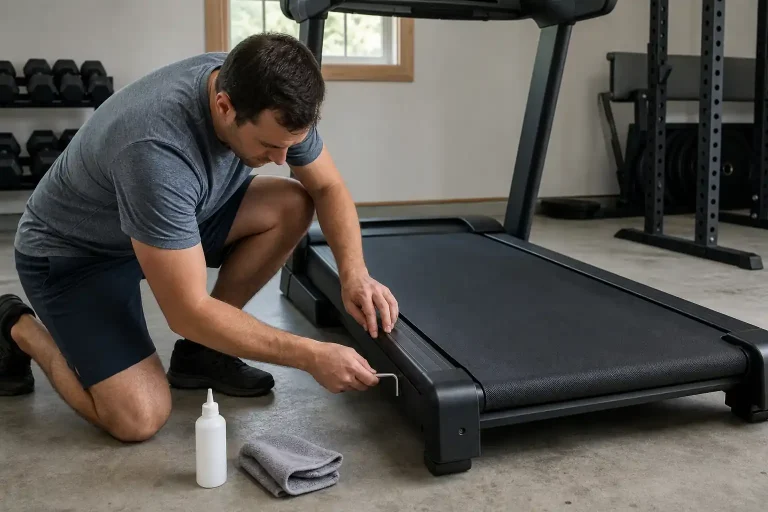
- The hex key (Allen wrench) supplied with the treadmill for the rear roller bolts.
- A clean, lint-free cloth or microfiber towel.
- A vacuum to clean around the deck before you start.
- Your owner manual, open to the maintenance section.
Watch out: If you see a damaged power cord, smell burning or the treadmill trips a breaker repeatedly, stop and contact the manufacturer. Those are not lubrication problems.
How to Lubricate a Treadmill Step by Step
These steps fit most home treadmills with a standard belt and deck. Your manual may add or change a step, such as loosening the belt first or applying in a specific pattern, so read its version before you begin. The whole job usually takes 10 to 15 minutes.
- 1. Unplug and clean. Remove the safety key, unplug at the wall and vacuum around and under the treadmill so dust does not stick to fresh lubricant.
- 2. Wipe the deck edges. Run a dry cloth under the belt edges to remove old residue and dust.
- 3. Loosen the belt if required. If your manual says so, turn both rear roller bolts counterclockwise the same number of turns and count them.
- 4. Lift one side of the belt. At the middle of the deck, lift the belt edge enough to reach the center of the deck surface.
- 5. Apply a thin line. Apply the amount your manual gives in a thin line along the center of the deck, from front to back. Repeat on the other side.
- 6. Restore tension. If you loosened the belt, turn both bolts back clockwise the same number of turns.
- 7. Spread the lubricant. Plug in, insert the safety key, stand on the side rails, start the belt at a low speed and walk on it for 3 to 5 minutes.
- 8. Wipe and log. Wipe any lubricant that reaches the belt edges, rails or floor, then note the date in your maintenance log.
Pro tip: More is not better. Excess silicone migrates to the rollers and floor and can make the belt slip. If you are unsure, use the smaller amount and recheck with the hand test after a week.
Checking Belt Tension and Alignment After Lubricating
Fresh lubricant lowers friction, which can reveal a belt that was a little loose all along. Walk at a moderate speed and plant your feet firmly. If the belt slips or hesitates under your step, unplug the treadmill and tighten both rear roller bolts clockwise by a quarter turn each, then test again. Stop as soon as the slip disappears; an overtightened belt strains the motor and rollers. Many manuals also give a lift test, such as how far the belt should lift at the middle of the deck.
Next, check alignment. Run the belt at a slow walking speed with nobody on it and watch whether it stays centered between the side rails. If it drifts toward one side, unplug the treadmill and turn the bolt on that side clockwise by a quarter turn on most models, or the other bolt counterclockwise; check your manual for the direction it specifies. Run it again for a minute and repeat until it tracks straight. Make sure the treadmill sits level first, since an uneven floor can cause drift.
- Adjust in quarter turns and test between each adjustment.
- Turn both bolts equally for tension; turn one bolt for alignment.
- Keep hands, cloths and hair away from the rollers whenever the belt is running.
- If the belt keeps drifting or slipping after adjustment, contact the manufacturer.
Walking Pads, Low-Maintenance Decks and When to Call for Service
Walking pads need lubrication too, but their low decks often leave little room to lift the belt. Some come with a small bottle of silicone and instructions to apply it from the side of the deck. Follow those instructions exactly, and vacuum around the pad often, because their motors sit close to the floor and pick up dust. Our best walking pad guide covers models that are easier to maintain.
Some treadmills are sold with pre-waxed or low-maintenance decks that need little added lubricant. Adding silicone to a deck that was not designed for it can do more harm than good, so check before you apply anything. If lubrication and adjustment do not fix slipping, jerking or a strained motor, the belt or deck may be worn. Contact the manufacturer with your model and serial number; check whether your parts warranty covers the repair.
If you are shopping, a solid deck, a strong motor and long frame and motor coverage make maintenance easier to live with. These picks from our best durable treadmill guide stand out for build and warranty.
Most Durable

Horizon 7.4 AT
FitScore 89.7/100
A 3.5 HP motor and 22 x 60-inch deck with lifetime frame and motor coverage, 5-year parts and 2-year labor.
Ranked in our Best Durable Treadmill guide
Check Price on AmazonBest Performance

Sole F89
FitScore 87.7/100
A 4 HP motor and 22 x 60-inch deck with lifetime frame and motor coverage and 3-year parts.
Ranked in our Best Durable Treadmill guide
Check Price on AmazonBest Value

XTERRA Sport Series TR75
FitScore 82/100
A 3 HP motor, 20 x 60-inch belt and 350 lb capacity with lifetime frame and motor coverage and 2-year parts.
Ranked in our Best Durable Treadmill guide
Check Price on AmazonTreadmill Lubrication Checklist
- Read the lubrication section of your owner manual.
- Confirm the lubricant is 100% silicone or the product your manual names.
- Remove the safety key and unplug at the wall.
- Vacuum around the treadmill and wipe under the belt edges.
- Apply a thin line along the center of the deck on both sides.
- Walk slowly for 3 to 5 minutes to spread the lubricant.
- Wipe off any excess from the belt edges, rails and floor.
- Test for slipping and adjust tension in quarter turns if needed.
- Check that the belt stays centered.
- Log the date and set a reminder for the next interval.
Common Mistakes to Avoid
- Using WD-40, household oil or a general silicone spray with solvents.
- Applying lubricant to the top of the belt instead of the deck.
- Using too much and causing the belt to slip.
- Working on the treadmill while it is still plugged in.
- Adding lubricant to a pre-waxed deck without checking the manual.
- Making large turns on the roller bolts instead of quarter turns.
The Bottom Line
- Unplug the treadmill at the wall and remove the safety key before you touch the belt or deck.
- Use 100% silicone treadmill lubricant or the product your manufacturer specifies; never WD-40 or household oil.
- Apply lubricant to the deck under the belt, not on top of the belt.
- Your owner manual sets the interval; some decks are pre-waxed and need little or no added lubricant.
- After lubricating, check that the belt is centered and does not slip.
Our Top Picks
 Most DurableHorizon 7.4 ATFitScore89.7/100Check on Amazon
- Best PerformanceSole F89FitScore87.7/100Check on Amazon
- Best ValueXTERRA Sport Series TR75FitScore82/100Check on Amazon
Frequently Asked Questions
Use 100% silicone treadmill lubricant or the product your manufacturer specifies. Avoid WD-40, household oils and petroleum-based sprays.
Follow your owner manual, which may give the interval in months, hours or miles. Heavier use wears lubricant faster, so use the hand test between intervals.
No. WD-40 is not a treadmill lubricant and can damage the belt and deck or attract dirt. Use 100% silicone or the product your manual names.
On the deck surface under the belt, in a thin line along the center on each side. Do not apply it to the top of the belt or to the motor.
Unplug it, lift the belt edge and feel the deck. If it feels dry rather than slightly slick, or the belt jerks and squeaks, it is likely time.
Yes. Too much lubricant can make the belt slip on the rollers and attract dust. Wipe off excess and use the amount your manual gives.
Most do. Some walking pads ship with silicone and instructions to apply it from the side of the deck; follow the manual for your model.
Explore More Treadmill Guides
How to Maintain a Treadmill (2026): The Complete Home Care Guide

Best Durable Treadmill (2026): 5 Heavy-Duty Home Picks

Best Quiet Treadmill (2026): 5 Home-Friendly Picks

Best Walking Pad (2026): 5 Picks for Home and Under-Desk Walking

Best Treadmill for Home (2026): Top Picks Ranked for Faster, Smarter Buying
Treadmill Buying Guide (2026): How to Choose the Right Home Treadmill
This article contains affiliate links. If you click through and make a purchase, we may earn a small commission at no extra cost to you. As an Amazon Associate, we earn from qualifying purchases. We do not show prices because they change constantly: product details and availability can change at any time, so please check the current price and details directly on Amazon. Learn more. Amazon and the Amazon logo are trademarks of Amazon.com, Inc. or its affiliates.
