

Short answer
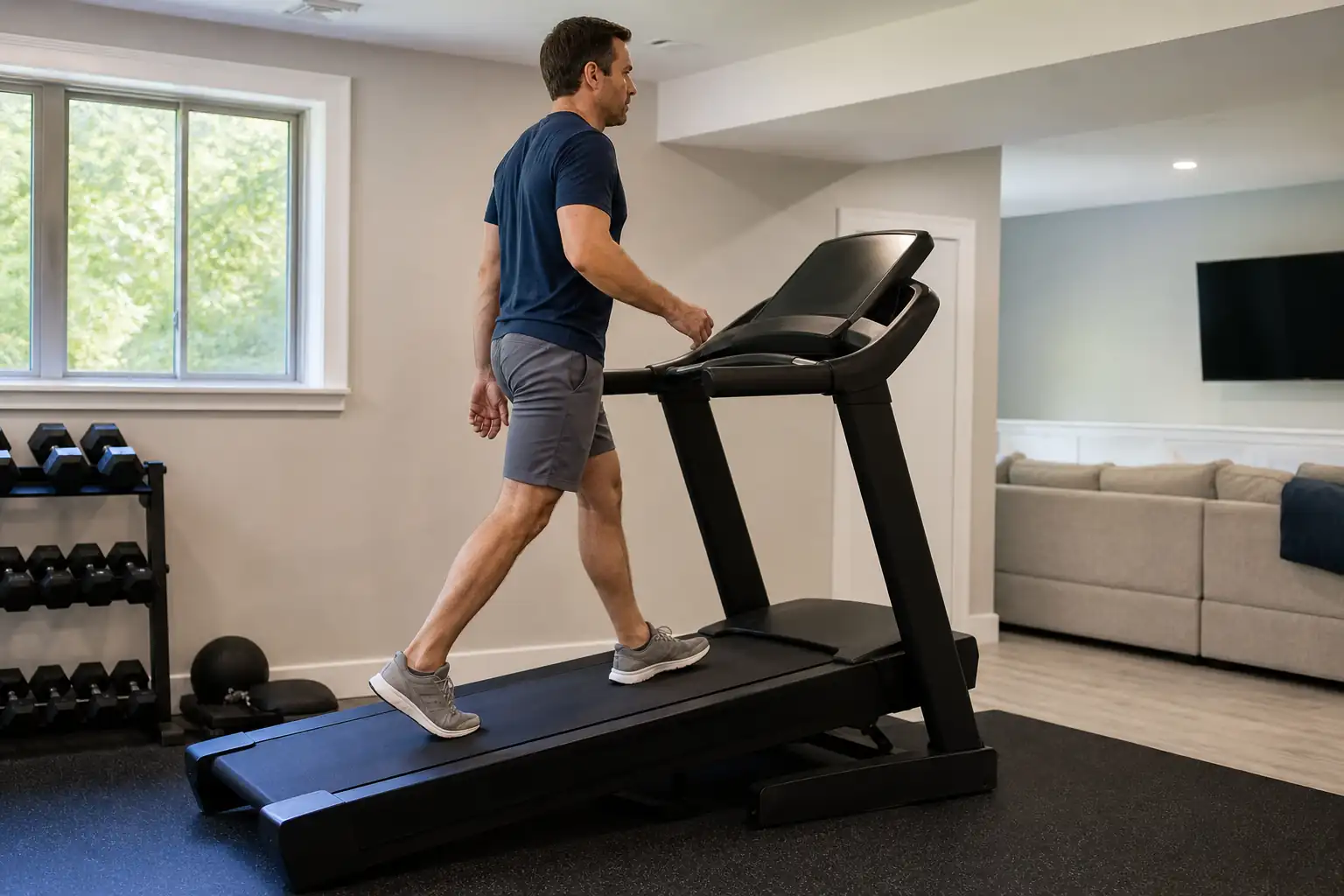
A good treadmill incline depends on your goal. Use 1% for runs that feel like outdoor running, 2 to 4% for beginner walks, 5 to 8% for fitness walking and hill repeats, and 9 to 12% for hard incline walks such as 12-3-30. Build up gradually and keep your hands off the rails.
Key takeaways
- Use 1% incline for runs that feel like outdoor running.
- 3 to 8% is a good working range for most walkers.
- 9 to 12% is a hard incline walk; 12-3-30 is the best-known example.
- Each 1% at 3 mph adds about 0.4 METs by the ACSM equation.
- Incline can lower some knee loading but adds work for calves and Achilles.
- Hands off the rails, safety key on and build up gradually.
Incline is the easiest way to make a treadmill workout harder without going faster. A few percent turns a stroll into exercise, and a steep grade can make walking as demanding as jogging. The catch is that more is not always better: steep incline loads the calves and Achilles, and hanging on the handrails cancels much of the benefit.
This guide explains what a good incline is for each goal, how much each step raises intensity, how incline affects your joints and the safety rules that matter on a steep deck. If you are shopping, our best treadmill with incline and best incline trainer guides rank the machines.
Treadmill Incline Levels by Goal
Treadmill incline is shown as a percent grade: the rise in height for every 100 units of distance. A 10% grade rises 10 feet over 100 feet, which is much steeper than most sidewalks. The table maps common incline ranges to how they feel and what they are good for, with the estimated intensity of walking at 3 mph on each.
The MET column uses the American College of Sports Medicine walking equation, which has been shown to remain reasonably accurate at higher grades. One MET is your resting energy use, so 6 METs means about six times rest. The numbers are estimates and assume you are not holding the rails.
| Incline | How it feels | Good for | Est. METs at 3 mph (example grade) |
|---|---|---|---|
| 0–1% | Flat; 1% roughly matches outdoor running effort | Warm-ups, easy walks, steady runs | 3.3 (at 0%) |
| 2–4% | Gentle hill you notice after a few minutes | Beginners, longer walks, easy hills | 4.5 (at 3%) |
| 5–8% | Moderate hill; breathing clearly harder | Fitness walking, hill repeats for runners | 5.8 (at 6%) |
| 9–12% | Steep; calves and glutes work hard | Incline walking workouts such as 12-3-30 | 8.3 (at 12%) |
| 13–15% | Very steep; the top of most home treadmills | Experienced incline walkers | 9.5 (at 15%) |
| Over 15% | Mountain-like; incline trainers only | Hiking prep and advanced walkers | 11.6 (at 20%) |
Check Amazon for current pricing and availability.
How Much Harder Does Incline Make a Workout?
Much harder, and fast. By the ACSM walking equation, each extra 1% of grade at 3 mph adds about 0.4 METs, so 10% more than doubles the cost of a flat walk. At running speeds the equation adds less per percent than for walking, but a few percent still makes a big difference over a 30-minute run.
Use effort, not just numbers, to set your incline. The CDC talk test is a practical guide: at moderate intensity you can talk but not sing, and at vigorous intensity you cannot say more than a few words without pausing. Choose the grade that puts you where you want to be, then hold it.
| Speed | Incline | Estimated METs |
|---|---|---|
| 3.0 mph walk | 0% | 3.3 |
| 3.0 mph walk | 5% | 5.4 |
| 3.0 mph walk | 10% | 7.4 |
| 3.0 mph walk | 15% | 9.5 |
| 3.5 mph walk | 5% | 6.1 |
| 3.5 mph walk | 10% | 8.5 |
| 6.0 mph run | 0% | 10.2 |
| 6.0 mph run | 1% | 10.6 |
| 6.0 mph run | 4% | 11.9 |
| 6.0 mph run | 8% | 13.5 |
A Good Incline for Walking and Weight Loss
For most walkers, 3 to 8% at a brisk pace is a good working range. It raises effort well above flat walking while letting you keep an upright posture and a natural stride. Beginners can start at 1 to 3%, add 1% a week and stop when the talk test says moderate or vigorous.
The best-known steep routine is 12-3-30: 12% incline, 3 mph, 30 minutes. In the first peer-reviewed study of it, active adults burned about 308 calories in 30 minutes, while running burned the same amount in about 24 minutes. The authors note the sample was small and young, and that holding the rails could change the intensity. Our 12-3-30 treadmill workout guide includes a four-week build-up.
For weight loss, the best incline is one you can repeat most days. A moderate grade for 45 minutes often adds up to more than a steep grade you can hold for 10. See our how to lose weight on a treadmill guide for weekly plans.
- Beginner: 1–3% at 2.5–3.0 mph for 20–30 minutes.
- Intermediate: 5–8% at 3.0–3.5 mph for 30–45 minutes.
- Advanced: 10–12% at 3.0 mph for 30 minutes, or 2-minute blocks alternating 8% and 12%.
- Steep hiking prep: 15% and up at 2.0–3.0 mph on an incline trainer.
A Good Incline for Running
For everyday runs, 1% is the standard choice. A classic study found that a 1% grade best matched the energy cost of outdoor running at speeds of about 6.5 to 11.2 mph, because a treadmill has no air resistance. At easy jogging speeds the difference is small, so 0 to 1% is fine.
For hill work, 4 to 8% is a good range for repeats of one to three minutes, with easy flat recovery between them. Uphill running raises step frequency, energy cost and muscle work, especially at the hip, so it builds strength and fitness at slower speeds. Keep steep running for short efforts and build volume gradually. Our treadmill HIIT workouts include hill intervals, and the treadmill vs running outside guide covers the 1% question in depth.
Best for Incline

Sole F89
FitScore 90/100
Our top incline pick: 15% incline and 6% decline on a 22 × 60-inch deck with a 4 HP motor and 375-lb capacity. Read our review.
Ranked in our Best Treadmill With Incline guide
Check Price on AmazonBest Heavy-Duty

Sole TT8
FitScore 88.7/100
A non-folding 4 HP deck with 15% incline, 6% decline and a 400-lb capacity for frequent hill sessions. Read our review.
Ranked in our Best Treadmill With Incline guide
Check Price on AmazonBest Traditional Pick

Sole F65
FitScore 87.7/100
15% incline on a wide 22 × 60-inch belt with a 3 HP motor and 350-lb capacity. Read our review.
Ranked in our Best Treadmill With Incline guide
Check Price on AmazonIncline and Your Joints
Incline walking is often suggested as a lower-impact alternative to running, and there is some research behind it. In a small study of 12 healthy older men walking at 3 mph, grades of 10% or more lowered the peak knee abduction moment, a marker of inner-knee loading, compared with level walking. The authors note the study was small, all male and did not include people with knee arthritis. The Arthritis Foundation also notes that a slight upward incline can reduce joint impact.
Incline shifts work rather than removing it. Steep walking asks more of your calves, Achilles tendons, hips and lower back, so build up over weeks, not days. If you feel pain in your calves, heels or back that lingers after a session, lower the grade. Our best treadmill for bad knees guide covers cushioned decks for joint-sensitive users.
Incline Safety: Hands Off the Rails
Hanging on the handrails is the most common incline mistake. It takes weight off your legs, so the workout becomes easier than the display suggests, and it pulls you into a hunched posture. The Arthritis Foundation warns that gripping the rails to keep up with the treadmill can cause injuries. Use the rails for balance when you step on or change settings, then let go. If you cannot walk without holding on, lower the incline or the speed.
Steep incline is hard work. If you have a heart condition, high blood pressure, diabetes or lung disease, or have been inactive, talk with your doctor before starting incline workouts. Pregnant women should check with their ob-gyn; ACOG lists warning signs to stop exercising. Stop and call 911 if you notice chest discomfort, pain spreading to the arm, neck or jaw, or unusual shortness of breath, which the American Heart Association lists as warning signs of a heart attack.
- Clip the safety key to your clothing on every session.
- Warm up on a flat or 1–2% deck for 3 to 5 minutes.
- Walk tall with shorter steps; do not lean into the console.
- Lower incline gradually at the end before stopping the belt.
- Check your ceiling height: incline raises the deck where you stand.
Watch out: Do not step off the back of a treadmill at high incline. Lower the grade and speed first, then step to the side rails.
Choosing a Treadmill for Incline Workouts
Most full-size home treadmills in our guides reach 10 to 15% incline, which covers every workout above, including 12-3-30. If you want room to progress past 12%, choose a 15% model. For steeper hiking-style walks, incline trainers go to 20% or more, and a few compact models reach 25% or higher at walking speeds.
Two other specs matter. A motorized incline that changes quickly makes intervals practical, and handlebar controls let you adjust without reaching for the console. A deck of at least 50 to 55 inches gives a comfortable stride on a steep grade. Our best incline trainer and best compact treadmill with incline guides compare the steep options.
Best Incline Trainer

ECHANFIT CTM5518
FitScore 81.7/100
Up to 20% incline and 12 mph on a 20 × 50-inch belt with a 500-lb listed capacity, so 12-3-30 becomes a starting point.
Ranked in our Best Incline Trainer guide
Check Price on AmazonBest Space-Saving Pick

VITALWALK TM10GY
FitScore 74.2/100
Up to 25% incline on an 18 × 49-inch belt in a folding frame about 54 inches long.
Ranked in our Best Incline Trainer guide
Check Price on AmazonSteepest Compact

TREAFLOW 7210
FitScore 70.7/100
Up to 25% incline and 10 mph on a 17.7 × 47.2-inch belt, with a compact folding frame.
Ranked in our Best Incline Trainer guide
Check Price on AmazonIncline Checklist
- Decide your goal: outdoor-like running, fitness walking, weight loss or hiking prep.
- Use 1% for steady runs and 0–1% for easy jogs.
- Start walkers at 1–3% and add about 1% a week.
- Set incline by the talk test, not a number from social media.
- Keep your hands off the rails except for balance.
- Build up to steep routines like 12-3-30 over several weeks.
- Check ceiling height at your highest planned incline.
- Choose a 15% treadmill if you want room to progress past 12%.
Common Mistakes to Avoid
- Jumping straight to 12% or 15% on the first session.
- Holding the rails or the console on a steep grade.
- Leaning far forward instead of walking tall with shorter steps.
- Running steep hills for long blocks before building a base.
- Ignoring calf or Achilles pain that lingers after sessions.
- Stepping off the back while the deck is still inclined.
The Bottom Line
- A classic study found a 1% treadmill grade best matched the energy cost of outdoor running at about 6.5 to 11.2 mph.
- By the ACSM walking equation, walking at 3 mph on a 12% grade costs about 8.3 METs, versus about 3.3 METs on a flat belt.
- The first peer-reviewed study of 12-3-30 measured about 308 calories in 30 minutes in active adults, as an average estimate.
- In a small study of older men, grades of 10% or more lowered a marker of inner-knee loading compared with level walking.
- Most home treadmills in our guides reach 10 to 15%; incline trainers go to 20% or more.
Our Top Picks
 Best for InclineSole F89FitScore90/100Check on Amazon
- Best Heavy-DutySole TT8FitScore88.7/100Check on Amazon
- Best Traditional PickSole F65FitScore87.7/100Check on Amazon
- Best Incline TrainerECHANFIT CTM5518FitScore81.7/100Check on Amazon
- Best Space-Saving PickVITALWALK TM10GYFitScore74.2/100Check on Amazon
- Steepest CompactTREAFLOW 7210FitScore70.7/100Check on Amazon
Frequently Asked Questions
For most people, 3 to 8% at a brisk pace is a good working range. Beginners can start at 1 to 3% and add about 1% a week.
Use a moderate incline you can sustain for 30 to 60 minutes, such as 5 to 10% at a brisk walk. Total weekly activity and diet matter more than any single grade.
Yes, for experienced walkers. It is the grade used in 12-3-30, which is a hard workout, so build up to it over a few weeks.
Yes, if you want effort that matches flat outdoor running. A classic study found 1% matched outdoor energy cost at moderate running speeds.
It can raise effort to a similar level with less impact. In the 12-3-30 study, running burned the same calories in about 24 minutes that the incline walk burned in 30.
Not usually. One small study found grades of 10% or more lowered a marker of inner-knee loading in older men, but steep walking adds load on calves and Achilles.
Most home treadmills reach 10 to 15%. Incline trainers go to 20% or more, and some compact models list 25% or higher.
Explore More Treadmill Guides
Best Treadmill With Incline (2026): Top 5 Picks
Best Incline Trainer (2026): 5 Steep-Incline Picks for Home
12-3-30 Treadmill Workout (2026): How to Start, Progress and Stay Safe
Best Treadmill With Automatic Incline (2026): 5 Motorized Picks
Treadmill Calories Burned (2026): Estimates by Weight, Speed and Incline
Best Treadmill for Walking: 5 Standout Home Picks for 2026
This article contains affiliate links. If you click through and make a purchase, we may earn a small commission at no extra cost to you. As an Amazon Associate, we earn from qualifying purchases. We do not show prices because they change constantly: product details and availability can change at any time, so please check the current price and details directly on Amazon. Learn more. Amazon and the Amazon logo are trademarks of Amazon.com, Inc. or its affiliates.
