

Short answer
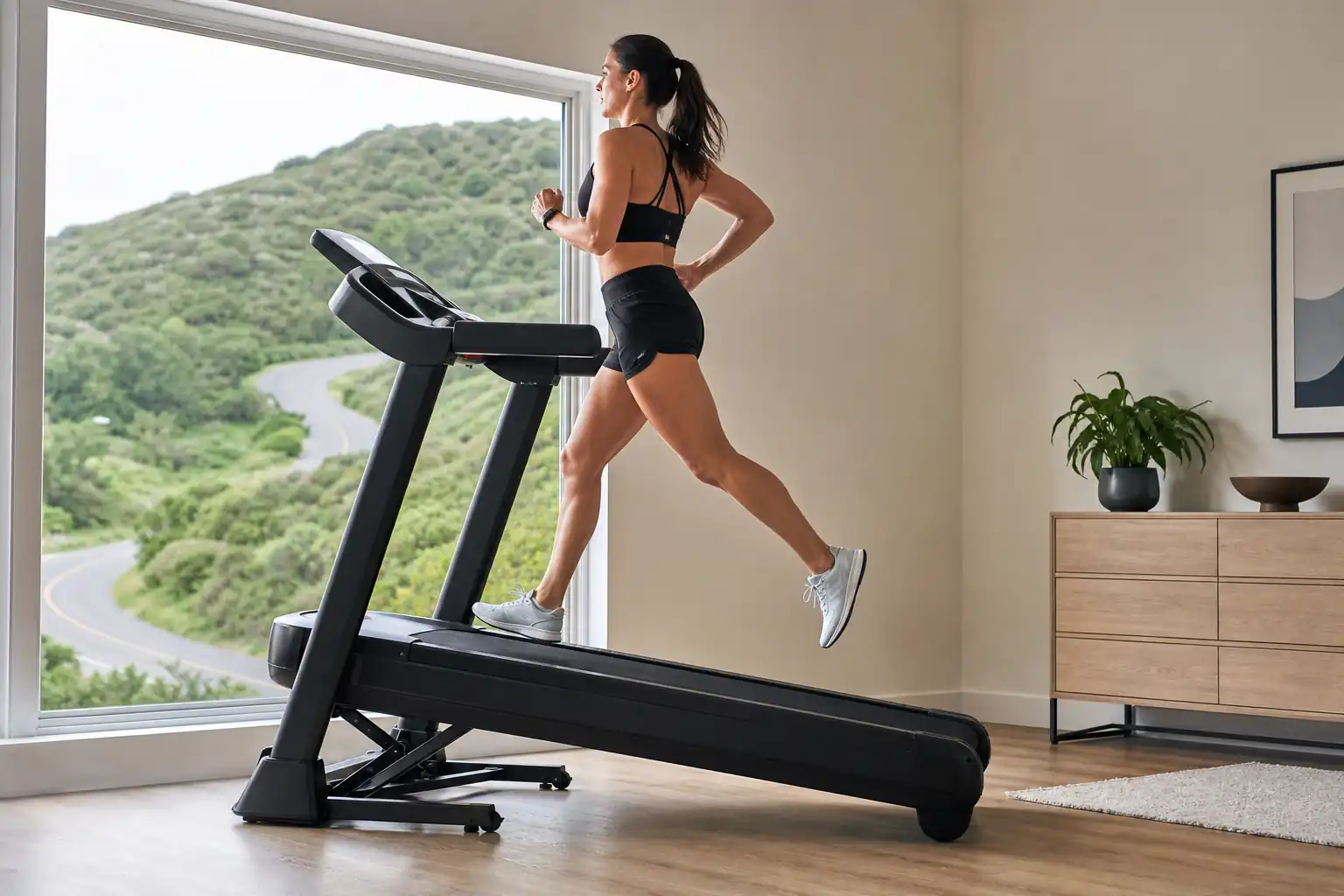
A 1% treadmill incline roughly offsets the missing air resistance of outdoor running at moderate speeds, so it makes flat treadmill runs feel closer to road runs. Treadmill hills train climbing well, but they cannot copy real descents, turns and changing grades. Use incline for controlled hill work and bad weather; run outside for race-specific terrain.
Key takeaways
- 1% incline roughly offsets missing air resistance at moderate speeds.
- Outdoor running may still cost slightly more, especially at faster speeds.
- Treadmill incline trains climbing well and makes hill work repeatable.
- Real descents load the quads more, and most treadmills cannot copy them.
- Running mechanics are largely similar on a belt and on the road.
- Mix treadmill hill sessions with outdoor runs for race specificity.
Runners ask two different questions about treadmill incline. The first is whether 1% makes treadmill running equal to running outside on flat ground. The second is whether treadmill hills can replace real hills. The answers are “roughly, at moderate speeds” and “partly, for climbing but not for descending.”
This guide explains what the research says about the 1% rule, how a treadmill hill differs from an outdoor one, what treadmills cannot do for downhill running, and when incline is the better choice. For the broader comparison of pace, joints and weather, see our treadmill vs running outside guide.
Treadmill Incline vs Outdoor Running at a Glance
Treadmill incline and outdoor terrain differ on more than steepness. The table compares them on the points that change how a workout feels and what it trains.
| Criteria | Treadmill incline | Outdoor running |
|---|---|---|
| Air resistance | None; 1% incline roughly compensates | Present; more noticeable at speed and in wind |
| Grade control | Exact, steady grade you choose | Changes constantly with the route |
| Climbs | Repeatable and easy to measure | Real hills of varying length and steepness |
| Descents | None, or up to 3–6% decline on a few models | Real downhills, often steeper than treadmill decline |
| Surface | Uniform, shock-absorbing deck | Asphalt, concrete, trail, track |
| Turns and footing | None | Corners, curbs, roots and uneven ground |
| Weather and air quality | Not a factor | Heat, cold, ice, smoke and ozone |
Check Amazon for current pricing and availability.
The 1% Incline Rule: What the Research Says
The 1% rule comes from a 1996 study of nine trained runners. It found that a 1% treadmill grade most accurately reflected the energy cost of outdoor running at speeds from about 6.5 to 11.2 mph, over runs of about 5 minutes. Indoors there is no air to push through, so the same belt speed costs a little less, and 1% adds that work back.
Later studies refine the rule rather than overturn it. High-level distance runners showed better running economy on a track than on a treadmill at 1%, and a 2026 study of endurance athletes found that overground running still had a higher energy cost than treadmill running at 1% grade. The original study did not test slower speeds, and at easy jogging paces air resistance matters less.
In practice: set 1% for steady runs when you want outdoor-like effort, use 0 to 1% for easy jogs, and judge hard sessions by effort or heart rate. Our treadmill pace chart converts belt speeds to outdoor paces.
Pro tip: The 1% rule is about flat running, not hills. If your outdoor route is rolling, add short blocks of 2 to 4% to your treadmill run instead of holding 1% the whole way.
Treadmill Hills vs Real Hills
For climbing, treadmill incline works well. A review of graded running found that uphill running raises step frequency and muscle work, and that energy cost rises linearly with grade. Those demands are the same whether the slope is a road or a deck, so treadmill hill repeats build the strength and fitness that outdoor climbs require.
The difference is variety. Outdoor hills change grade every few steps, come with turns and uneven footing, and are followed by a descent. A treadmill holds one exact grade until you change it. That precision is useful for repeatable workouts, but it does not train the pacing and footing skills of a hilly race. One study of trail and road runners found that an outdoor uphill test at 16% produced higher running cost and lactate than a 1% treadmill test, while peak oxygen uptake was similar, a reminder that steep outdoor climbs place their own demands on the body.
Treadmill grade also has limits. Most home treadmills in our guides top out at 10 to 15%, while trails can be steeper. Incline trainers reach 20% or more, but mostly at walking speeds; see our best incline trainer guide.
Downhill Running: What Treadmills Cannot Fully Copy
Downhill running is the biggest gap. Running downhill makes your quadriceps brake each step, and research shows that downhill running increases markers of muscle damage and reduces maximal force afterward. That is why the first hilly race can leave your quads sore for days even when the climbs felt fine. Runners preparing for courses with long descents need some downhill practice.
Most treadmills have no decline at all. A few go below 0%: the Sole TT8 and Sole F89 reach 6% decline, and the NordicTrack Commercial 1250 and 2450 reach 3%. That is enough for gentle downhill practice, not steep mountain descents. If decline matters to you, choose one of these models and add outdoor downhill runs gradually as race day approaches.
Best for Hills and Descents

Sole TT8
FitScore 93.8/100
A non-folding 4 HP deck with 15% incline, 6% decline and a 22 × 60-inch belt rated to 400 lb. Read our review.
Ranked in our Best Treadmill for Marathon Training guide
Check Price on AmazonBest Folding Decline

Sole F89
FitScore 94.6/100
A folding 22 × 60-inch deck with a 4 HP motor, 15% incline, 6% decline and lifetime frame and motor coverage. Read our review.
Ranked in our Best Treadmill for Marathon Training guide
Check Price on AmazonBest for Virtual Routes

NordicTrack Commercial 2450
FitScore 92/100
A -3% to 12% range and up to 14 mph; with an iFIT membership, workouts can change speed and grade for you. Read our review.
Ranked in our Best Treadmill for Marathon Training guide
Check Price on AmazonForm, Surface and Joints on an Inclined Belt
Your running form changes little between belt and road. A systematic review of 33 studies concluded that running mechanics are largely comparable on a motorized treadmill and overground, with small differences such as a flatter foot at landing on the treadmill. On an incline, the same changes happen as on a real hill: shorter steps, quicker turnover and a more forward-leaning body from the ankles.
The surface is softer indoors. In tests of 77 treadmills, treadmills showed the highest shock absorption of the surfaces measured. For walkers, incline can also shift load away from the knee: in a small study of older men, grades of 10% or more lowered a marker of inner-knee loading. Neither finding proves a treadmill prevents injury, so build hill volume gradually. Our best cushioned treadmill guide compares decks.
When to Use Treadmill Incline Instead of Running Outside
Incline is the better tool when you need control. Hill repeats at an exact grade and pace are easy to repeat week to week and to measure progress. It is also the safer choice in bad conditions: in heat, the CDC advises athletes to schedule workouts for cooler times of day and drink more water than usual, and on high-ozone days it suggests exercising indoors or choosing a lighter activity. If your area is flat, the treadmill may be the only hill you have.
Run outside when the race demands it: long descents, technical trails, sharp turns or a course where pacing by feel matters. A sensible mix keeps both. Our best treadmill for marathon training guide ranks machines built for long indoor sessions.
- Use incline: repeatable hill intervals, bad weather or poor air, flat home terrain, low-impact incline walking.
- Run outside: downhill practice, trail footing, race-pace long runs, courses with turns.
- Mix both: treadmill climbs during the week, outdoor hilly long run on the weekend.
Treadmill Hill Workouts That Mimic the Outdoors
Use the sessions below to bring outdoor hill training indoors. They are examples for healthy runners with a base of regular running; reduce the grade or the number of repeats if you are new to hills. Warm up for 10 minutes at 1% first and cool down the same way. Keep your hands off the rails, which take weight off your legs and change the workout.
| Workout | Main set | What it trains |
|---|---|---|
| Outdoor-equivalent run | 30–60 min at 1%, conversational pace | Flat road running |
| Rolling route | Alternate 3 min at 1% and 2 min at 3–4%, 30–45 min | Rolling courses, pacing over grade changes |
| Short hill repeats | 6–10 × 60–90 s at 6–8%, walk or jog 2 min at 1% | Climbing power and form |
| Long climb | 2–3 × 8 min at 4–5%, 3 min easy between | Sustained climbs in road or trail races |
| Decline practice (decline models only) | 4–6 × 2 min at -2% to -3%, easy flat recovery | Gentle downhill tolerance |
| Steep power hike | 20–30 min at 12–15%, 2.5–3.5 mph walk | Steep trail climbs, low impact |
Best for Hill Intervals

Horizon 7.4 AT
FitScore 89.9/100
QuickDial incline and speed dials make grade changes fast, with 0–15% on a 22 × 60-inch deck and a 3.5 CHP motor. Read our review.
Ranked in our Best Treadmill for Running guide
Check Price on AmazonBest Smart Value

NordicTrack Commercial 1250
FitScore 86.9/100
A -3% to 12% range on a 22 × 60-inch deck with a 3.6 HP motor; iFIT route workouts need a paid membership. Read our review.
Ranked in our Best Treadmill for Running guide
Check Price on AmazonBest Traditional Incline

Sole F65
FitScore 87.7/100
15% incline on a wide 22 × 60-inch belt with a 3 HP motor, for steady climbs and power hikes. Read our review.
Ranked in our Best Treadmill With Incline guide
Check Price on AmazonChecklist for Incline Training
- Set 1% for steady runs meant to mimic flat outdoor running.
- Use 0–1% for very easy jogs.
- Add 2–4% blocks to mimic rolling routes.
- Use 6–8% for short hill repeats once you have a running base.
- Choose a decline model if your race has long descents.
- Add outdoor downhill runs gradually before a hilly race.
- Judge hard hill sessions by effort or heart rate.
- Keep your hands off the rails and clip the safety key.
Common Mistakes to Avoid
- Assuming 1% incline equals outdoor hills; it only offsets air resistance on the flat.
- Training only uphill and skipping downhill practice before a hilly race.
- Holding the handrails during steep intervals.
- Running long steep blocks before building a base.
- Expecting treadmill paces on incline to match outdoor hill paces exactly.
- Running outside in extreme heat or poor air instead of moving indoors.
The Bottom Line
- A 1996 study found a 1% treadmill grade best matched the energy cost of outdoor running at about 6.5 to 11.2 mph, over runs of about 5 minutes.
- Newer studies suggest outdoor running can still cost slightly more than treadmill running at 1%, especially for fast runners.
- Uphill running raises step frequency and muscle work; energy cost rises in a straight line with grade.
- Downhill running increases markers of muscle damage, and most treadmills have no decline at all.
- Running mechanics are largely comparable on a motorized treadmill and overground, according to a systematic review of 33 studies.
Our Top Picks
 Best for Hills and DescentsSole TT8FitScore93.8/100Check on Amazon
- Best Folding DeclineSole F89FitScore94.6/100Check on Amazon
- Best for Virtual RoutesNordicTrack Commercial 2450FitScore92/100Check on Amazon
- Best for Hill IntervalsHorizon 7.4 ATFitScore89.9/100Check on Amazon
- Best Smart ValueNordicTrack Commercial 1250FitScore86.9/100Check on Amazon
- Best Traditional InclineSole F65FitScore87.7/100Check on Amazon
Frequently Asked Questions
A 1% incline is the standard answer. A classic study found it best matched the energy cost of outdoor running at about 6.5 to 11.2 mph.
The climbing work is similar, since energy cost rises with grade either way. Outdoor hills add changing grades, uneven footing and descents that a treadmill does not.
Not necessarily. Air resistance matters less at easy speeds, so 0 to 1% is fine. Use 1% when you want effort closer to flat outdoor running.
They prepare you for the climbs. Add outdoor downhill running or a decline treadmill, because descents load the quads in ways uphill work does not.
Among the models in our guides, the Sole TT8 and Sole F89 reach 6% decline, and the NordicTrack Commercial 1250 and 2450 reach 3%.
It is lower impact and can be just as demanding, but it trains different things. Mix both if you run races.
The grade never lets up, there is no downhill to recover on and indoor air is warm. Run treadmill hills by effort, not by outdoor pace.
Explore More Treadmill Guides and Comparisons
Treadmill vs Running Outside (2026): Pace, 1% Incline, Joints and Weather
Best Treadmill With Incline (2026): Top 5 Picks
Best Treadmill for Running (2026): Top 5 Picks
Best Treadmill for Marathon Training (2026): Top 5 Picks
Best Incline Trainer (2026): 5 Steep-Incline Picks for Home
Treadmill Pace Chart (2026): MPH to Min/Mile and Min/Km
This article contains affiliate links. If you click through and make a purchase, we may earn a small commission at no extra cost to you. As an Amazon Associate, we earn from qualifying purchases. We do not show prices because they change constantly: product details and availability can change at any time, so please check the current price and details directly on Amazon. Learn more. Amazon and the Amazon logo are trademarks of Amazon.com, Inc. or its affiliates.
