Body Fat Calculator
1Your measurements
2Skinfolds (optional, with a caliper)
Right side of the body, in millimeters, average of two readings. The 3-site badge marks the folds the 3-site method needs for your sex; all seven give the 7-site result.
Your body fat
–
Body fat by method
ACE body fat categories
Next step: lose fat and keep muscle with a small calorie deficit; the TDEE calculator sets your daily target.
Open the TDEE calculatorFor general information only, not medical advice. These formulas estimate population averages and can be off for an individual; talk to your doctor or a registered dietitian before changing your diet or training, especially with a health condition, during pregnancy or for anyone under 18.
Free tool · Updated November 3, 2026
Five ways to estimate your body fat
A tape measure gives you three estimates in a minute; a skinfold caliper adds the two Jackson-Pollock methods. The calculator runs them side by side, picks the most precise one you entered, and places you in the American Council on Exercise categories.
Short answer
A body fat percentage calculator turns a few measurements into an estimate of how much of your weight is fat. With a tape only, a 5 ft 9 in man with a 15.5 in neck and a 36 in waist comes out at about 21% by the U.S. Navy method and 26% by relative fat mass; a skinfold caliper adds the more precise Jackson-Pollock methods. Enter your measurements below to see every method side by side.
Key takeaways
- Skinfold methods with a caliper are the most precise home estimates; tape methods come close for tracking.
- Every method has an error of a few percentage points against lab methods such as DEXA.
- Use the same method, the same time of day and the same person measuring to track change.
- Women carry more essential fat than men, so every category starts higher for women.
A body fat calculator answers the question the scale cannot: how much of your weight is fat and how much is everything else. Lab methods such as DEXA scans and underwater weighing do that precisely, but they cost time and money. Field methods use a tape measure or a skinfold caliper and a published equation.
Each equation was built on a different group of people and has its own blind spots, so this calculator runs five of them on the same measurements. Where they agree, you can trust the estimate; where they spread, the spread is your real uncertainty. For the tape method in depth, see our navy body fat calculator.
How to Measure for Each Method
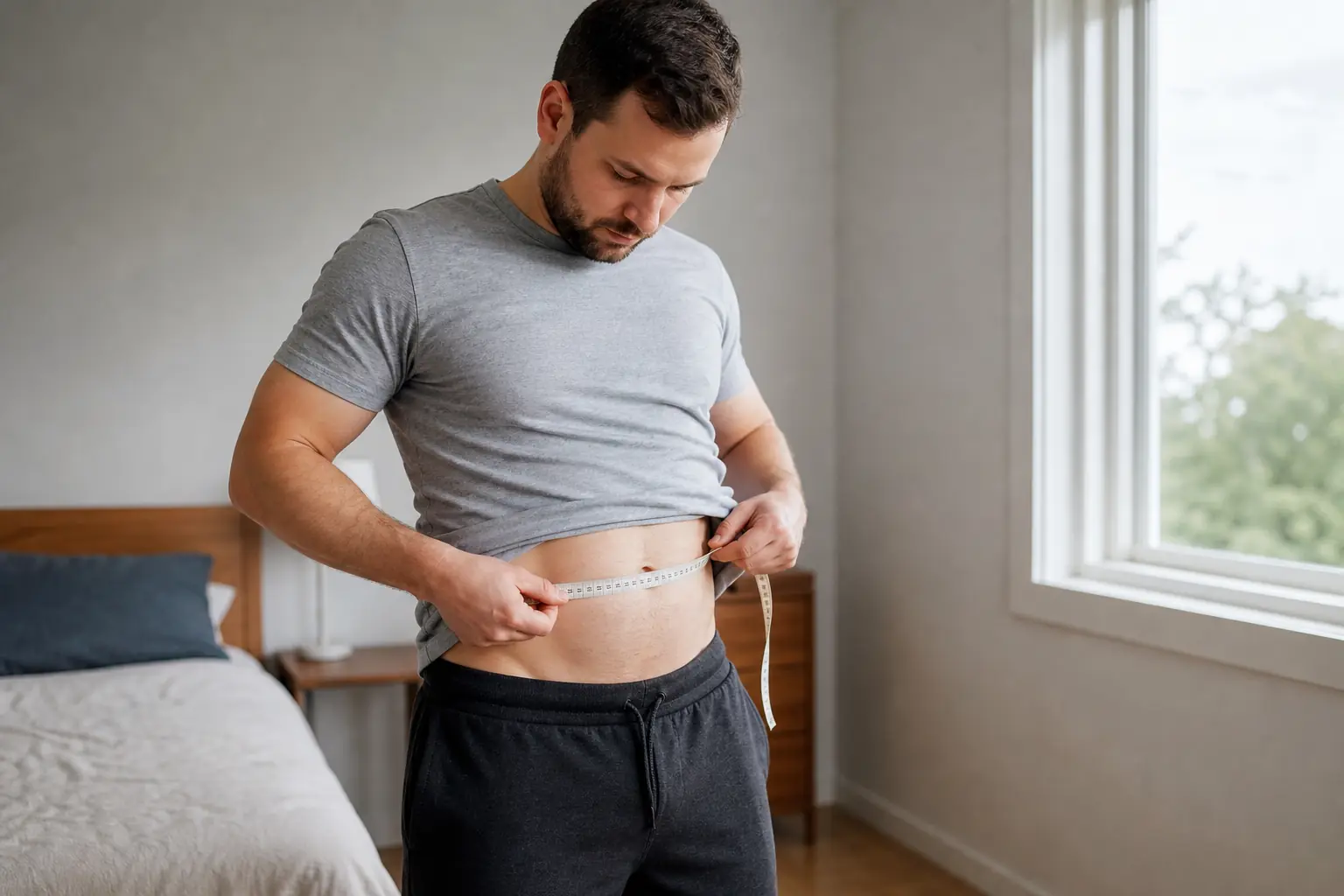
- Tape (Navy and RFM): neck just below the larynx, tape sloping slightly down to the front; waist at the navel for men and at the narrowest point for women, at the end of a normal breath out; hips around the widest part of the buttocks.
- Skinfolds: pinch a double fold of skin and fat between thumb and finger, pull it away from the muscle, place the caliper 1 cm below your fingers and read after 2 seconds. Use the right side of the body.
- 3-site folds: chest, abdomen and thigh for men; triceps, suprailiac and thigh for women.
- 7-site folds: chest, midaxillary, triceps, subscapular, abdomen, suprailiac and thigh, for both sexes.
- Repeat: take each measurement two or three times and use the average; skinfolds are easier to take with a helper.
Body Fat Percentage Formulas Explained
The skinfold equations of Jackson and Pollock (1978, men) and Jackson, Pollock and Ward (1980, women) predict body density from the sum of skinfolds and age. The Siri equation (1961) then converts density to body fat: 495 / density – 450.
Relative fat mass, published by Woolcott and Bergman in Scientific Reports (2018), needs only height and waist and was checked against DEXA scans in more than 10,000 U.S. adults. The U.S. Navy equations come from Hodgdon and Beckett at the Naval Health Research Center (1984); the BMI-based formula is from Deurenberg and colleagues (1991).
| Method | Men | Women |
|---|---|---|
| Jackson-Pollock 3-site (body density) | 1.10938 – 0.0008267 S + 0.0000016 S² – 0.0002574 age (S = chest + abdomen + thigh, mm) | 1.0994921 – 0.0009929 S + 0.0000023 S² – 0.0001392 age (S = triceps + suprailiac + thigh) |
| Jackson-Pollock 7-site (body density) | 1.112 – 0.00043499 S + 0.00000055 S² – 0.00028826 age | 1.097 – 0.00046971 S + 0.00000056 S² – 0.00012828 age |
| Siri (density to % fat) | 495 / density – 450 | same |
| Relative fat mass (RFM) | 64 – 20 x height / waist | 76 – 20 x height / waist |
| U.S. Navy (inches) | 86.010 x log10(waist – neck) – 70.041 x log10(height) + 36.76 | 163.205 x log10(waist + hips – neck) – 97.684 x log10(height) – 78.387 |
| Deurenberg (BMI) | 1.2 x BMI + 0.23 x age – 16.2 | 1.2 x BMI + 0.23 x age – 5.4 |
Which Method Should You Trust?
When you enter skinfolds, the calculator takes the 7-site result as the main estimate, then the 3-site result; with a tape only, it takes the Navy method. The average of all methods is shown next to it. The error figures below are typical values against lab methods for careful measurements.
| Method | You needNeed | Typical error vs labError | Best for |
|---|---|---|---|
| Jackson-Pollock 7-site | Caliper, a trained helper | about 3 to 4 points | Most accurate home method |
| Jackson-Pollock 3-site | Caliper | about 3 to 4 points | Quick tracking with a caliper |
| U.S. Navy | Soft tape | about 3 to 4 points | Tracking without a caliper |
| Relative fat mass | Soft tape (waist only) | about 4 to 5 points | The fastest check |
| BMI-based | Scale only | 5 points or more | A rough first guess |
Body Fat Percentage Chart for Men and Women
The ranges below are the categories used by the American Council on Exercise. Women carry more essential fat than men, so every category starts higher, and healthy ranges rise somewhat with age.
| Category | Men | Women |
|---|---|---|
| Essential fat | 2 to 5% | 10 to 13% |
| Athletes | 6 to 13% | 14 to 20% |
| Fitness | 14 to 17% | 21 to 24% |
| Average | 18 to 24% | 25 to 31% |
| Obese | 25% and above | 32% and above |
How to Lower Your Body Fat
- Set a small deficit. The TDEE calculator gives a daily calorie target that loses fat without losing much muscle.
- Walk every day, on an incline. Incline walking burns far more than flat walking at the same speed; see the treadmill calorie calculator and the 12-3-30 workout.
- Keep some strength training. It helps keep lean mass while the scale goes down, so more of the loss is fat.
- Check your weight too. The BMI calculator gives your healthy weight range; a home treadmill makes daily walking easy, see our best treadmills for weight loss.
Share, Embed or Cite This Calculator
You are welcome to link to this body fat calculator. The result link keeps your inputs; the embed code adds the calculator to your page with a visible credit link.
Share this calculator
Send it to a friend, a training partner or your followers. These buttons share the calculator itself, not your results.
Use this calculator like an app
Put Body Fat Calculator on your phone’s home screen: it opens full screen in one tap, like a native app, with no download from a store.
- iPhone (Safari)Tap Share , then Add to Home Screen, then Add.
- Android (Chrome)Tap the menu ⋮, then Add to home screen or Install app.
- ComputerBookmark the page, or in Chrome and Edge use the install icon in the address bar.
Embed the interactive calculator
For websites and blogs. Paste this code where you want the calculator: your visitors use it right on your page. It resizes itself and shows a credit link to FitGearHQ.
Add a link card
For blogs, newsletters and pages that do not allow scripts: a clean card with a picture and one link.
Cite this calculator
- TitleBody Fat Calculator
- PublisherFitGearHQ
- URLhttps://fitgearhq.com/body-fat-calculator/
- Updated
More Free Fitness Tools
See them all on Fitness Calculators, Treadmill Tools or every free fitness tool.
Checklist Before You Measure
4 checks
Tap a number to check off that step.
- 01
Use a soft, non-stretch tapeSnug on the skin without compressing it.
- 02
Measure at the same time of dayMorning, before eating and before training, gives the most repeatable numbers.
- 03
Take each measurement twiceAverage the readings; re-take a third if two differ by more than 2 mm or a quarter inch.
- 04
Compare like with likeTrack one method over weeks rather than mixing methods.
Common Mistakes to Avoid
Mistake 1Measuring after a workout
Instead: Exercise moves water into the skin and muscles and changes skinfolds.
Mistake 2Pinching muscle with the fold
Instead: Pull the fold away from the muscle before you place the caliper.
Mistake 3Pulling the stomach in
Instead: Measure the waist relaxed, at the end of a normal breath out.
Mistake 4Expecting lab precision
Instead: Field methods are estimates; a few points of error is normal.
The Bottom Line
- Five methods: Jackson-Pollock 7-site and 3-site (Siri), RFM, U.S. Navy and Deurenberg (BMI).
- ACE categories for men and women, with fat mass and lean mass.
- US and metric units; the link keeps your measurements.
- For adults; not a medical test.
Frequently Asked Questions
By the ACE categories, 14 to 24% for men and 21 to 31% for women covers the fitness and average ranges. Athletes are often 6 to 13% (men) and 14 to 20% (women).
The Jackson-Pollock 7-site skinfold method, done carefully by a trained person, is usually the closest to lab methods. With a tape only, the U.S. Navy method is a good choice.
Use the tape methods: the U.S. Navy method needs your neck, waist and (for women) hips, and relative fat mass needs only your height and waist.
An equation from height and waist: 64 – 20 x height / waist for men, 76 – 20 x height / waist for women. It was validated against DEXA scans in U.S. adults.
Each equation was built on a different group and measures something slightly different. The spread between methods is a fair picture of the uncertainty.
Fat mass is your weight times your body fat percentage; lean mass is the rest (muscle, bone, organs and water).
Every two to four weeks, with the same method, at the same time of day.
Explore Treadmills for Fat Loss
Best Treadmill for Weight Loss (2026): 5 Cardio-Focused Picks
Best Incline Treadmill (2026): Top 5 Treadmills With Incline
Best Treadmill for HIIT and Interval Training (2026): 5 Picks
Best Treadmill for Home (2026): Top Picks Ranked for Faster, Smarter Buying
Best Incline Trainer (2026): 5 High-Incline Treadmills Compared