

Short answer
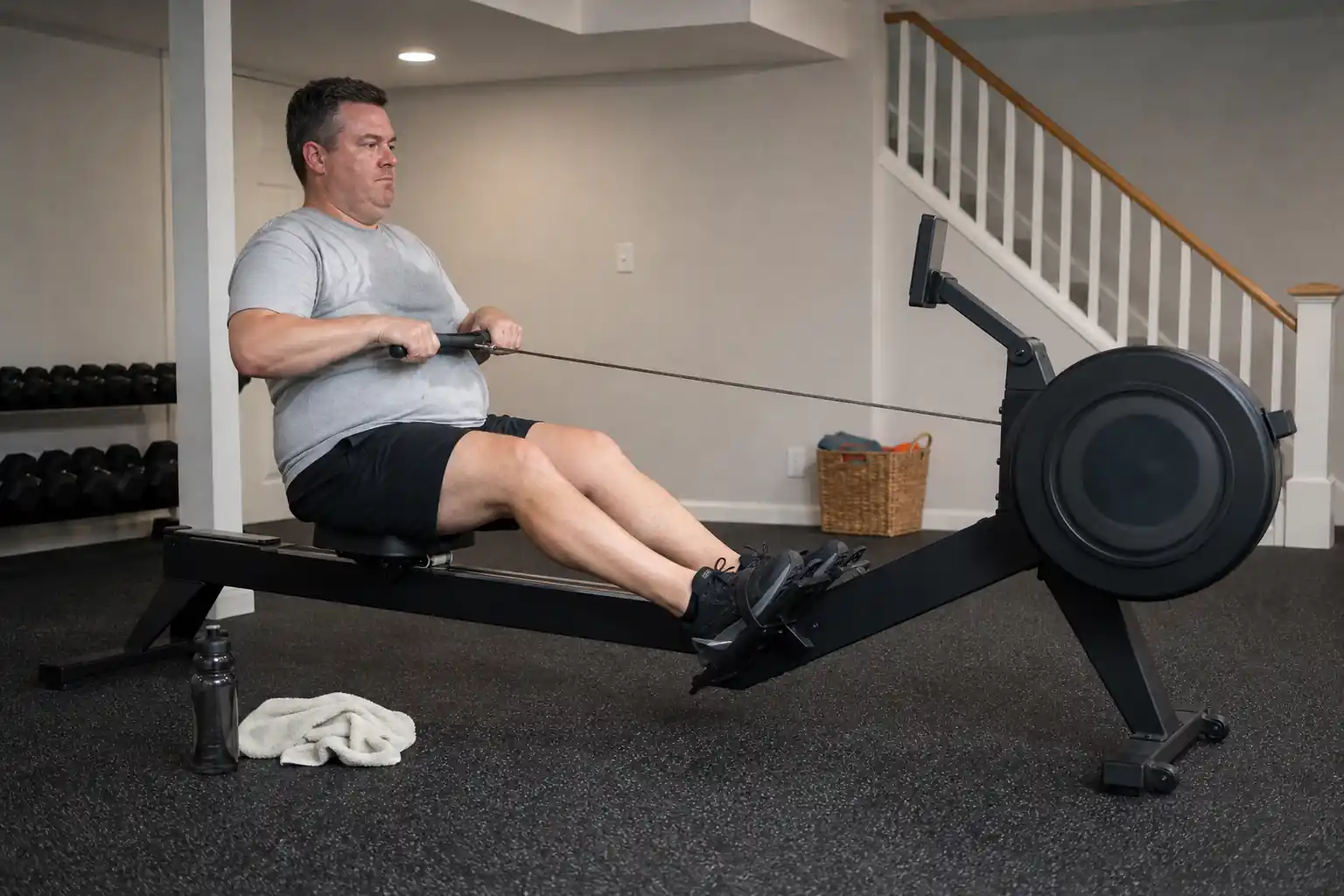
A rowing machine for weight loss works as the activity half of a plan: build up to at least 150 minutes a week of moderate rowing, then more if you can, and pair it with eating habits you can keep. Harvard Health estimates that 30 minutes of moderate stationary rowing burns about 252 calories for a 155-lb person. The CDC notes that many people need more than 150 minutes a week to maintain weight, and that reaching a healthy weight takes both activity and healthy eating.
Key takeaways
- Rowing supports weight loss as the activity half of a plan that includes eating habits.
- Build toward at least 150 minutes a week; many people need more.
- Spot reduction does not work: overall fat loss changes belly fat over time.
- Fitness usually improves before the scale moves.
- Add two strength sessions a week and track several progress markers.
A rowing machine is a strong tool for weight loss because it uses a lot of muscle at once, works at any pace and is easy on the joints. It is not a shortcut. The people who see results row often, build up gradually, add strength work and change how they eat in ways they can keep. That takes months, not weeks.
This guide sticks to what public health sources and studies support. It covers how many calories rowing uses, how many minutes a week to aim for, a 12-week plan, and the questions people search most: belly fat, abs, back fat and before-and-after photos. It does not set calorie or diet targets; those belong with your doctor or a registered dietitian. If you still need a machine, our best rowing machine guide ranks the top home rowers.
Using a Rowing Machine for Weight Loss: Does It Work?
Yes, as part of a plan. Rowing raises the energy your body uses, and regular activity helps you keep weight off after you lose it. The CDC is clear on its physical activity and weight page: getting to and staying at a healthy weight requires both regular physical activity and healthy eating patterns. The same page notes that you will need a high amount of physical activity to lose weight unless you also adjust your diet.
Rowing has three practical strengths for this goal. It uses the legs, hips, back and arms, so the effort per minute is high for the speed. It is seated and has no landing impact, which suits people who find running hard on the knees. And it is easy to do at home, which helps with the part that matters most: doing it often.
How Many Calories Does a Rowing Machine Burn?
Calorie use depends mostly on your body weight and how hard you row. Harvard Health publishes estimates for 30 minutes of activity at three body weights. For a 155-lb person, moderate stationary rowing comes to about 252 calories in 30 minutes and vigorous rowing to about 369. Brisk walking at 3.5 mph comes to about 133.
These are estimates from formulas, not measurements of you. Fitness, technique and how steady your effort is all change the real number. Rowing machine monitors also estimate calories, and different models use different formulas, so use them to compare your own sessions over time, not as exact figures. Our rowing machine calories burned calculator estimates calories from your weight, time and pace.
| Activity | 155-lb person | 185-lb person |
|---|---|---|
| Rowing, stationary: moderate | 252 | 294 |
| Rowing, stationary: vigorous | 369 | 440 |
| Walking, 3.5 mph | 133 | 159 |
Check Amazon for current pricing and availability.
Pro tip: Do not “eat back” the calories on the monitor. They are estimates, and a calorie target is a question for your doctor or a registered dietitian.
How Much Should You Row to Lose Weight?
Start with the baseline. Adults need at least 150 minutes a week of moderate activity, or 75 minutes of vigorous activity, plus muscle-strengthening work on 2 or more days. For weight, that is often not enough. The CDC notes that you may need more than 150 minutes a week to maintain your weight, and that the amount varies greatly from person to person.
In rowing terms, 150 minutes is five 30-minute steady rows. Twice that is about 45 minutes on six or seven days. Nobody needs to start there. The plan below builds up over 12 weeks, and every session counts.
For effort, use the talk test. At moderate intensity you can talk but not sing. At vigorous intensity you can only say a few words before pausing for breath. Heart rate works too; our heart rate zone calculator sets zones from your age and resting heart rate.
| Goal | Weekly minutes | Example rowing week |
|---|---|---|
| Health baseline | 150 moderate or 75 vigorous | 5 × 30 min steady, or 3 × 25 min with intervals |
| Maintaining weight (many people) | More than 150 moderate | 5 × 40 min, or 3 steady + 2 interval sessions |
| Larger weight goals | Often well above 150 | 6 × 45 min mixed, built up over months |
| Strength (all goals) | 2 or more days | Two 20 to 30 min sessions with weights or body weight |
A 12-Week Rowing Plan for Weight Loss
This plan is for beginners and people returning after a break. It builds time first, then adds short harder pieces. Warm up with 5 minutes of easy rowing and cool down with 3 to 5 minutes. Repeat any block you are not ready to leave. If you are new to the stroke, read how to use a rowing machine properly first.
- Change one thing at a time: time, intensity or number of sessions.
- Add two strength sessions a week from week 3, on non-interval days.
- Mix in walking for extra activity with a different movement.
| Weeks | Sessions | Each session | Approx. weekly minutes |
|---|---|---|---|
| 1–2 | 3–4 | 10–15 min easy, 18–20 strokes per minute | 40–60 |
| 3–4 | 4 | 20 min steady, can talk but not sing | 80 |
| 5–6 | 5 | 25–30 min steady | 125–150 |
| 7–8 | 5 | 30 min; on 2 days add 6 × (1 min harder + 2 min easy) | 150 |
| 9–10 | 5–6 | 35 min; on 2 days add 5 × (2 min harder + 2 min easy) | 175–210 |
| 11–12 | 5–6 | 40–45 min; one longer steady row of 50–60 min if it feels good | 200–270 |
Watch out: Sudden jumps in training load raise the risk of back and joint pain. Stop and seek care for chest pain, dizziness, or unusual shortness of breath.
Steady Rowing or Intervals?
Both work. Steady rowing at a moderate effort is easy to recover from, so you can do it often and build weekly minutes. Intervals, short pieces at a hard effort with easy rowing between, use more energy per minute and are useful when time is short. Vigorous minutes count roughly double toward activity targets.
Intervals are also harder on form. Fatigue makes the lower back round at the catch, so keep hard pieces short while you learn. A mix of three or four steady sessions and one or two interval sessions a week suits most people.
| Steady rowing | Intervals | |
|---|---|---|
| Effort | Moderate: can talk, cannot sing | Hard pieces: a few words only |
| Session length | 20–60 min | 15–30 min including rest |
| How often | 3–5 times a week | 1–2 times a week |
| Strength | Builds weekly minutes with little soreness | More work per minute |
| Risk | Low | Form slips when tired; build up slowly |
Rowing Machine for Belly Fat: What Is Realistic
You cannot pick where your body loses fat. Exercising one area does not burn the fat over it. A 2011 trial in the Journal of Strength and Conditioning Research looked at whether abdominal exercises reduce belly fat: 24 sedentary adults did seven ab exercises five days a week for six weeks while keeping their diet steady. Their ab endurance improved, but belly fat, body fat percentage and waist size did not change compared with the control group.
Rowing does not target belly fat either. What it can do is help you use more energy across the whole body, week after week. If your overall body fat goes down through activity and eating habits, belly fat usually goes down with it over time. Where you lose fat first, and how fast, varies from person to person.
A tape measure is a better guide than the mirror. Measure your waist at the same spot, at the same time of day, every two to four weeks.
Watch out: Be wary of any program that promises to “melt” belly fat or give fast, targeted results. No exercise does that.
Rowing Machine for Abs, Back Fat and Love Handles
Rowing works the abdominal muscles. They brace the trunk on every drive and pull your body forward on the recovery. Over time that builds core endurance. Whether you can see your abs is a different question: that depends on the fat over them, which follows overall body fat, not on how hard you train the core.
The same rule applies to back fat and love handles. Rowing trains the back muscles and the obliques, but it does not burn the fat over them more than fat anywhere else. Overall activity, strength training and eating habits change body composition; spot work does not.
For a stronger midsection, add a few core exercises to your strength days, such as planks, side planks and dead bugs. They will not burn belly fat, but they support the posture rowing asks for.
Rowing Machine Before and After: What Changes First
Before-and-after photos online are hard to judge. Lighting, posture, clothing and time of day change how a body looks. Diet changes, other exercise and the time between photos are rarely stated. Use them for motivation if they help, not as a promise of what will happen to you.
What changes first is usually fitness, not weight. The same pace feels easier, your heart rate is lower at a given split and you recover faster. In a 2023 trial of indoor rowing in women in their mid-60s (International Journal of Environmental Research and Public Health), 10 weeks of three 30-minute sessions raised aerobic capacity clearly, while average body mass did not change. Training alone improved fitness; it did not by itself move the scale.
That is why a mix of measures works better than one number. Track the ones below, and look at the trend over months.
| Marker | How to track it | How often |
|---|---|---|
| Weekly rowing minutes | Log every session | Weekly |
| Pace at the same effort | 500 m split at a steady, talking pace | Every 2–4 weeks |
| Fixed-distance test | Time for 2,000 m or 20 minutes for distance | Every 4–6 weeks |
| Waist measurement | Same spot, same time of day | Every 2–4 weeks |
| Body weight | Weekly average, not single days | Weekly |
Strength Training, Eating and Safety
Strength training belongs in the plan. Federal guidelines recommend muscle-strengthening work on 2 or more days a week for all major muscle groups. Rowing trains muscles for endurance; strength work trains them against heavier loads, and it covers pushing muscles such as the chest and triceps that rowing leaves out.
For eating, talk to your healthcare professional, who may refer you to a registered dietitian. If food, weight or exercise starts to feel compulsive or distressing, tell your doctor; support is available.
Check with a healthcare professional before starting if you have a heart condition, high blood pressure, diabetes, joint or back problems, or are pregnant. At home, keep children and pets away from the rail and handle, and hook the handle back in its holder after each session.
Pick a Rower for Weight-Loss Training
For weight loss, the best rower is the one you will use often. Two features help: a monitor that shows heart rate or pace so you can keep the right effort, and a frame rated well above your weight. Our best rowing machine for heavy people guide ranks rowers rated 300 lb and up, and the best magnetic rowing machine guide covers the quietest options for daily use. Each FitScore below comes from the guide named on the card; how we score explains the method.
Best for heavy users

Concept2 RowErg
FitScore 83.8/100
The top pick in our best rowing machine for heavy people guide. The listing gives a 500 lb capacity, and the monitor shows split, watts and heart rate, so you can hold the right effort. It is 96 inches long in use and separates in two for storage.
Ranked in our Best Rowing Machine for Heavy People guide
Check Price on AmazonBest heart rate pick

Sunny Health & Fitness Smart Magnetic Rowing Machine SF-RW523021
FitScore 79.9/100
Ranked first in our best magnetic rowing machine guide. Sixteen quiet magnetic levels, and a monitor that shows heart rate, stroke rate and 500 m split for zone-based sessions. It takes users up to 300 lb and stands upright.
Ranked in our Best Magnetic Rowing Machine guide
Check Price on AmazonBest water rower

YOSUDA Foldable Water Rowing Machine
FitScore 79.1/100
Ranked in our heavy people guide with a 400 lb capacity. The water tank gives a smooth pull that builds as you push harder, and it folds. The monitor shows time, distance, strokes and calories, without heart rate.
Ranked in our Best Rowing Machine for Heavy People guide
Check Price on AmazonRowing for Weight Loss Checklist
7 checks
Tap a number to check off that step.
- 01
Set a weekly minutes goal, starting where you are and building toward 150 or more.
- 02
Use the talk test or heart rate zones to keep steady days moderate.
- 03
Add one or two interval sessions a week once 30 minutes feels easy.
- 04
Schedule two strength sessions a week.
- 05
Track minutes, splits and waist size, not just the scale.
- 06
Talk to a healthcare professional about eating and any health conditions.
- 07
Learn proper form before adding intensity.
Common Mistakes to Avoid
Mistake 1Expecting rowing to burn belly fat specifically.
Mistake 2Treating monitor calorie counts as exact and eating them back.
Mistake 3Starting with long, hard sessions and quitting after a sore week.
Mistake 4Judging progress by daily weigh-ins or other people’s before-and-after photos.
Mistake 5Skipping strength training.
Mistake 6Rowing with the arms and back instead of the legs, which tires you before your legs do much work.
The Bottom Line
- Harvard Health estimates 252 calories for 30 minutes of moderate rowing and 369 for vigorous rowing at 155 lb.
- The CDC says reaching and keeping a healthy weight requires both regular activity and healthy eating.
- Many people need more than 150 minutes of activity a week to maintain their weight.
- You cannot choose where you lose fat: a 6-week trial of daily ab exercises did not reduce belly fat.
- Track minutes, splits and waist measurements, not just daily weigh-ins.
Our Top Picks
 Best for heavy usersConcept2 RowErgFitScore83.8/100Check on Amazon
- Best heart rate pickSunny Health & Fitness Smart Magnetic Rowing Machine SF-RW523021FitScore79.9/100Check on Amazon
- Best water rowerYOSUDA Foldable Water Rowing MachineFitScore79.1/100Check on Amazon
Frequently Asked Questions
Exercise alone can help, but the CDC says reaching and keeping a healthy weight requires both regular activity and healthy eating, and that losing weight takes a high amount of activity unless you also adjust your diet. A healthcare professional or registered dietitian can help with the eating side.
Build up to at least 150 minutes a week of moderate rowing, such as 30 minutes five days a week. The CDC notes many people need more than 150 minutes a week to maintain weight. Start shorter, about 10 to 15 minutes per session, and add time each week.
Both use a lot of energy. Harvard Health lists about 360 calories for 30 minutes of running at 6 mph for a 155-lb person, against 252 for moderate and 369 for vigorous rowing. Rowing is low impact and works the upper body too. The better choice is the one you can do consistently without pain.
Not directly. No exercise burns fat from one area. In a 6-week trial, daily ab exercises did not reduce belly fat. Rowing helps you use more energy across the body; if overall body fat falls through activity and eating habits, belly fat usually falls too, at a pace that varies by person.
Harvard Health estimates about 252 calories for 30 minutes of moderate stationary rowing and 369 for vigorous rowing for a 155-lb person, and 294 and 440 for a 185-lb person. Real values vary with fitness and technique.
Fitness often improves within a few weeks: the same pace feels easier and your heart rate drops. Changes in weight and body shape take longer and depend on eating habits too. Track weekly minutes, pace and waist size over several months.
Explore More Rowing Machine Guides
Best Rowing Machine (2026): 5 Top Picks for Home, Ranked
Benefits of a Rowing Machine: 9 Reasons to Row, and the Limits (2026)
Best Rowing Machine for Heavy People (2026): 5 Picks Rated 300 lb+
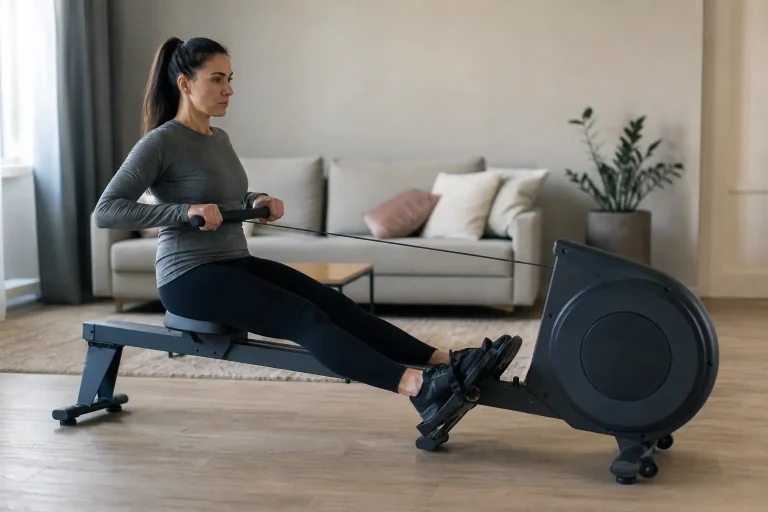
Best Magnetic Rowing Machine (2026): 5 Quiet Picks Ranked
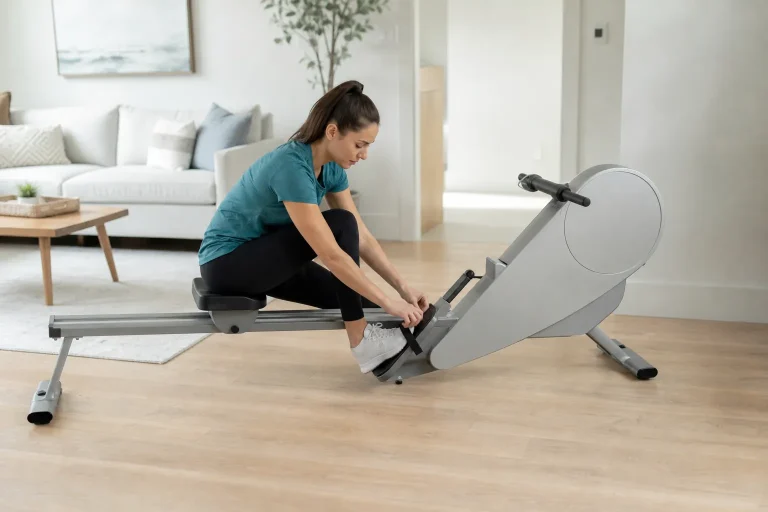
How to Use a Rowing Machine Properly: Form, Technique and Settings (2026)
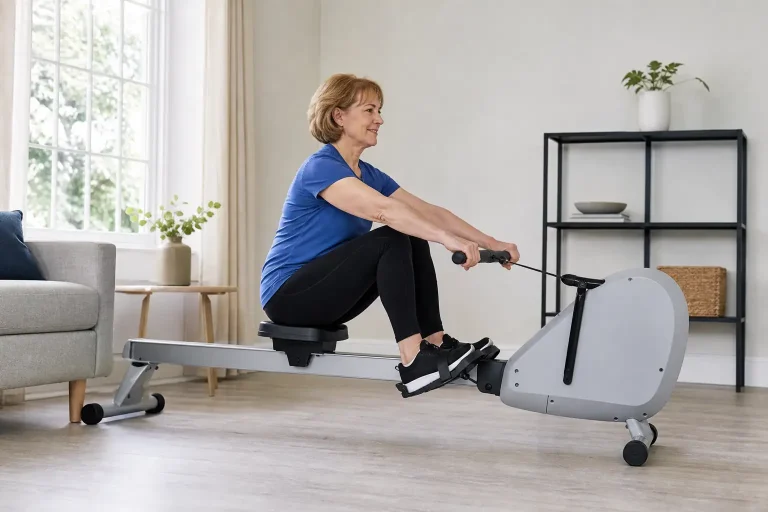
Best Rowing Machine for Beginners (2026): 5 Easy-to-Start Picks
This article contains affiliate links. If you click through and make a purchase, we may earn a small commission at no extra cost to you. As an Amazon Associate, we earn from qualifying purchases. We do not show prices because they change constantly: product details and availability can change at any time, so please check the current price and details directly on Amazon. Learn more. Amazon and the Amazon logo are trademarks of Amazon.com, Inc. or its affiliates.
