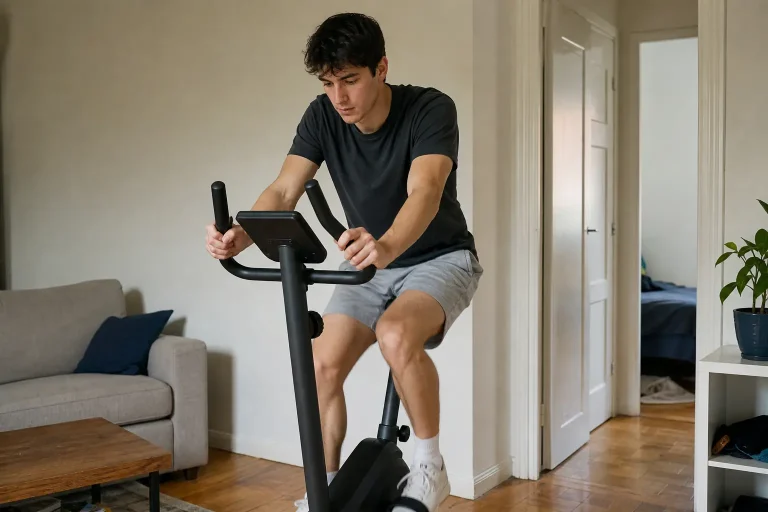
Exercise Bike Calorie Calculator
1Your ride
Calories burned
–
Calories by method
Estimates for healthy adults, not medical advice. Real energy use varies with fitness and body composition, and bike consoles estimate watts differently.
Free tool · Updated November 5, 2026
Calories from your watts or effort, your weight and your time
The calorie number on a bike console often ignores your weight. This calculator uses your weight with two published methods, and works even when your bike shows no watts.
Short answer
Calories burned on an exercise bike depend on your power, weight and time. At 100 watts for 30 minutes, a 180 lb rider burns about 245 kcal by the MET method of the 2024 Adult Compendium and about 251 kcal by the ACSM cycling equation. Enter your own numbers below for both estimates.
Key takeaways
- Power in watts drives the burn more than time alone.
- Weight matters: a heavier rider burns more at the same effort.
- No watts on the console? The effort setting uses typical watts for that feel.
- Both methods are estimates; compare your rides with the same method.
Most exercise bike consoles show calories, but many use a fixed body weight or a rough guess from speed. This exercise bike calorie calculator starts from what you can read on almost any bike, average watts, or from how hard the ride felt, and uses your own weight.
It runs two independent estimates: the MET values measured for stationary cycling in the 2024 Adult Compendium of Physical Activities, and the leg cycling equation from the American College of Sports Medicine. Seeing both gives a fair range rather than one false-precise number.
How the Two Methods Work
Method 1, METs. A MET is the energy you use sitting still, defined as 1 kcal per kilogram per hour. The 2024 Adult Compendium of Physical Activities lists measured values for stationary cycling by power, from 3.5 METs at 25 to 30 W to 16.3 METs above 325 W, plus 9.0 METs for a spin class. Calories = METs x weight in kg x hours.
Method 2, the ACSM equation. The American College of Sports Medicine estimates oxygen use on a cycle ergometer as 1.8 x work rate (kg.m per minute) / body weight + 7 mL per kg per minute, where 1 watt is about 6.12 kg.m per minute. Each liter of oxygen is close to 5 kcal.
Where they differ: the ACSM equation moves smoothly with every watt, the MET method in steps, so near a band edge the gap can be large. The Compendium values are for adults aged 19 to 59. The CDC guide to measuring activity intensity explains how METs relate to moderate and vigorous effort.
| Code | Activity | METs |
|---|---|---|
| 01210 | Bicycling, stationary, 25 to 30 W, very light | 3.5 |
| 01214 | Bicycling, stationary, about 50 W, light | 4 |
| 01216 | Bicycling, stationary, about 60 W, light to moderate | 5 |
| 01218 | Bicycling, stationary, 70 to 80 W | 5.8 |
| 01220 | Bicycling, stationary, 90 to 100 W, moderate to vigorous | 6 |
| 01224 | Bicycling, stationary, 101 to 125 W | 6.8 |
| 01228 | Bicycling, stationary, 126 to 150 W | 8 |
| 01232 | Bicycling, stationary, 151 to 199 W | 10.3 |
| 01236 | Bicycling, stationary, 200 to 229 W, vigorous | 10.8 |
| 01240 | Bicycling, stationary, 230 to 250 W, very vigorous | 12.5 |
| 01244 | Bicycling, stationary, 270 to 305 W, very vigorous | 13.8 |
| 01248 | Bicycling, stationary, over 325 W, very vigorous | 16.3 |
| 01200 | Bicycling, stationary, general | 6.8 |
| 01270 | Bicycling, stationary, RPM/spin bike class | 9 |
Calories Burned on an Exercise Bike in 30 Minutes
The two tables below give the calories for a 30-minute ride at five power levels and five body weights. Double them for an hour. Pick the row closest to your average watts.
| Average watts (METs)Watts | 130 lb130 | 160 lb160 | 190 lb190 | 220 lb220 | 250 lb250 |
|---|---|---|---|---|---|
| 50 W (4 METs) | 118 | 145 | 172 | 200 | 227 |
| 75 W (5.8 METs) | 171 | 210 | 250 | 289 | 329 |
| 100 W (6 METs) | 177 | 218 | 259 | 299 | 340 |
| 150 W (8 METs) | 236 | 290 | 345 | 399 | 454 |
| 200 W (10.8 METs) | 318 | 392 | 465 | 539 | 612 |
| Average wattsWatts | 130 lb130 | 160 lb160 | 190 lb190 | 220 lb220 | 250 lb250 |
|---|---|---|---|---|---|
| 50 W | 145 | 159 | 173 | 187 | 202 |
| 75 W | 186 | 200 | 214 | 229 | 243 |
| 100 W | 227 | 241 | 256 | 270 | 284 |
| 150 W | 310 | 324 | 338 | 353 | 367 |
| 200 W | 392 | 407 | 421 | 435 | 450 |
When Your Bike Shows No Watts
Many budget, folding and recumbent bikes show speed, distance and a resistance level but no watts, and speed on a stationary bike is only a display value. The effort setting uses a typical power for each feel: light about 75 W, moderate about 110 W, hard about 165 W and very hard about 220 W.
These are averages for recreational riders; a trained cyclist produces more power at the same feel. If your bike has a power reading or pairs with an app that shows watts, enter the watts instead.
How to Burn More Calories on an Exercise Bike
Power is the lever: raising resistance or cadence until you hold more watts adds more calories per minute than riding longer at an easy pace, as long as you recover well.
- Stay in the right zone. Use the heart rate zone calculator to keep long rides easy and intervals hard.
- Plan the goal. The TDEE calculator shows how a ride fits your daily energy needs.
- Train for weight loss. See how to lose weight on an exercise bike.
- Choose the right bike. See our best exercise bike rankings by type, scored with FitScore.
Share, Embed or Cite This Calculator
Trainers and clubs are welcome to link to or embed this exercise bike calorie calculator; the result link keeps the numbers entered.
Share this calculator
Send it to a friend, a training partner or your followers. These buttons share the calculator itself, not your results.
Embed the interactive calculator
For websites and blogs. Paste this code where you want the calculator: your visitors use it right on your page. It resizes itself and shows a credit link to FitGearHQ.
Add a link card
For blogs, newsletters and pages that do not allow scripts: a clean card with a picture and one link.
Cite this calculator
- TitleExercise Bike Calorie Calculator
- PublisherFitGearHQ
- URLhttps://fitgearhq.com/exercise-bike-calories-calculator/
- Updated
More Free Fitness Tools
See them all on Exercise Bike Tools or Fitness Calculators, compare exercise bikes or browse every free fitness tool.
Checklist for an Accurate Calorie Estimate
4 checks
Tap a number to check off that step.
- 01
Use the ride averageRead average watts from the summary screen, not a sprint peak.
- 02
Weigh yourself firstBody weight changes the result in both methods.
- 03
Enter the full timeInclude warm-up and cool-down if you pedaled through them.
- 04
Compare like with likeTrack your rides with one method so the trend is fair.
Common Mistakes to Avoid
Mistake 1Trusting the console number as-is
Instead: Many consoles ignore your weight or estimate from speed.
Mistake 2Counting peak watts
Instead: Calories follow average power over the ride.
Mistake 3Adding the two methods together
Instead: They estimate the same thing; read them as a range.
Mistake 4Reading speed as effort
Instead: Speed on a stationary bike is a display value, not your power.
The Bottom Line
- MET method: kcal = METs x weight in kg x hours, 3.5 to 16.3 METs by watts.
- ACSM equation: oxygen use from watts and weight, 5 kcal per liter of oxygen.
- Works with watts or a simple effort level for bikes without a power reading.
- Free, no sign-up; the link keeps your inputs.
Frequently Asked Questions
It depends on power and weight. A 180 lb rider at 100 watts burns about 245 kcal by the MET method; at 150 watts, about 327 kcal.
It is a rough estimate. Many consoles use a fixed weight or calculate from speed. Entering your average watts and weight, as this calculator does, gives a better estimate.
Multiply the MET value for your power by your weight in kg and the hours ridden, or use the ACSM equation: oxygen use = 1.8 x watts x 6.12 / weight in kg + 7 mL/kg/min, about 5 kcal per liter.
At the same watts, the energy cost is similar. Recumbent riders often hold lower power, so they burn fewer calories per hour in practice, not because of the seat itself.
In the 2024 Adult Compendium, stationary cycling ranges from 3.5 METs at 25 to 30 watts to 16.3 METs above 325 watts; general stationary cycling is 6.8 METs and a spin class 9.0 METs.
Yes. In both methods the calories scale with body weight at a given effort.
Explore More Exercise Bike Guides
Best Exercise Bike for Home (2026): 5 Picks Ranked by FitScore
Best Spin Bike for Home (2026): 5 Indoor Cycling Bikes Ranked
Best Recumbent Bike (2026): 5 Picks for Comfortable Home Cardio
Best Exercise Bike for Weight Loss (2026): 5 Picks for Daily Calorie Burn
Best Upright Exercise Bike (2026): 5 Picks Ranked by FitScore