

Short answer
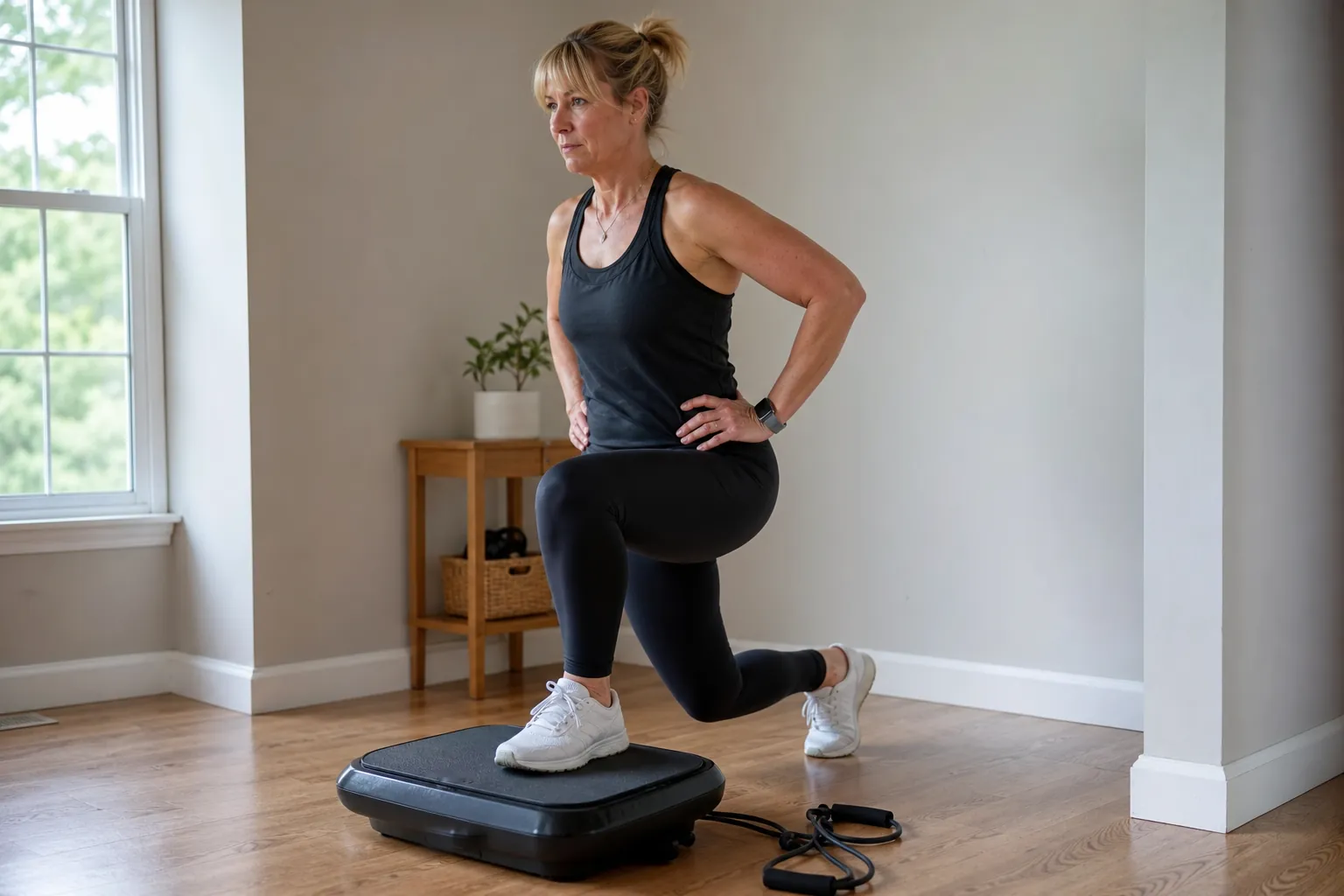
The best vibration plate exercises are lower-body moves done with soft, bent knees: the half squat, the wide squat, the split squat, the calf raise and the one-leg squat, plus band rows and presses for the upper body. In lab tests, squatting on a vibrating plate raised leg muscle activity by 40% to more than 300% over the same squat without vibration, and a slight knee bend of about 26 to 30 degrees sent the least vibration to the head. Start with 30 to 60 second holds and build to 10 to 15 minutes, three times a week.
Key takeaways
- Squats in a slight knee bend are the base of every vibration plate routine.
- Vibration raised leg muscle activity by 40% to more than 300% over the same squat in one study.
- A knee bend of about 26 to 30 degrees sent the least vibration to the head.
- Use bands for the upper body and keep your legs in a half squat while you pull.
- Build from 3 minutes to 10 to 15 minutes, three times a week.
Standing on a vibration plate feels like something is happening, but the research results come from exercise on the plate, not from standing still. The vibration makes your muscles contract reflexively many times a second, and that adds to whatever position you hold or move through.
This guide gives 10 vibration plate exercises that match what studies tested, how deep to bend, how long to hold and which setting to start on, then a simple 4-week plan. If you do not own a plate yet, our best vibration plate for beginners guide ranks the easiest ones to start on.
How to Set Up Before Any Vibration Plate Exercise
A few rules apply to every move. They come from lab measurements of how vibration travels through the body.
- Soft knees, always. A 2007 study in Medicine & Science in Sports & Exercise measured head acceleration during squats on two plates at 30 Hz. It was lowest with the knees bent about 26 to 30 degrees and rose when people stood straighter. Locked knees let the vibration travel up to your head.
- Feet flat and centered. On an oscillating plate, a wider stance means more side-to-side travel and a stronger feel; a narrow stance is gentler.
- Barefoot or thin soles. Most home plates have a grippy mat; thick running shoes absorb part of the movement.
- Start low. Use the lowest speed level for your first sessions and raise it only when a set feels easy.
- Short bouts. Studies used holds of about 30 to 60 seconds with rests in between, not 10 minutes in one go.
10 Vibration Plate Exercises, Ranked by How Much They Load the Legs
The order runs from the easiest to the most demanding. Hold each static position for the time given, or do slow repetitions for the same time.
| Exercise | Position | Time per set | Main muscles |
|---|---|---|---|
| 1. Half squat hold | Feet hip-width, knees bent about 30 degrees, hips back | 30-60 s | Thighs, glutes |
| 2. Calf raise | Knees soft, rise onto the balls of the feet and lower slowly | 30-45 s | Calves |
| 3. Wide squat | Feet wider than hips, toes out, sit down to a comfortable depth | 30-45 s | Inner thighs, glutes |
| 4. Deep squat hold | Thighs close to parallel, chest up | 20-30 s | Thighs, glutes |
| 5. Split squat | Front foot on the plate, back foot on the floor, lower the back knee | 30 s per side | Front thigh, glutes |
| 6. One-leg squat | One foot centered, hold the handlebar or a wall, small knee bend | 15-30 s per side | Thigh, glutes, balance |
| 7. Band row | Half squat, bands under the plate, pull elbows back | 30-45 s | Upper back, arms |
| 8. Band shoulder press | Half squat, press the band handles overhead | 30 s | Shoulders, arms |
| 9. Band biceps curl | Half squat, elbows at the sides | 30 s | Arms |
| 10. Plank, forearms on the plate | Forearms on the plate, feet on the floor, body straight | 20-30 s, lowest speed | Core, shoulders |
Check Amazon for current pricing and availability.
Squats: The Core Vibration Plate Exercise
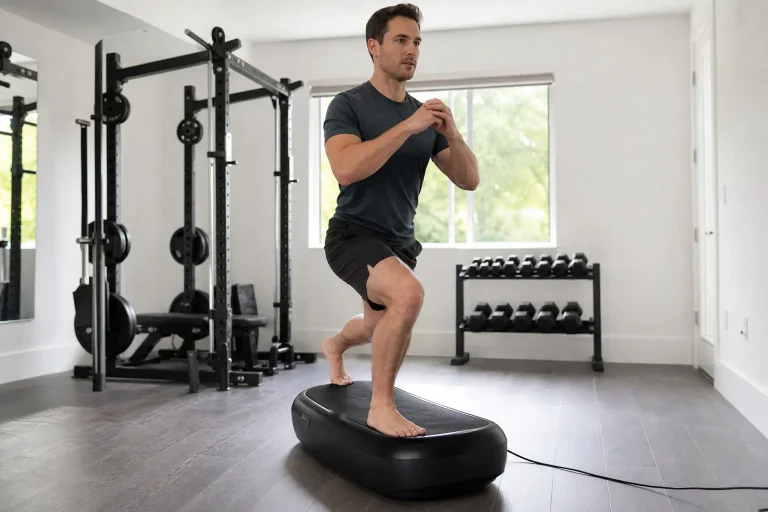
Every study we cite used squats. A 2006 study in the Journal of Strength and Conditioning Research recorded the thigh and calf muscles of 15 men holding a high squat, a low squat and a one-leg squat on a plate at 35 Hz. With vibration, muscle activity rose by 40% to 361% compared with the same squat without it, and the one-leg squat produced the biggest jump. Even so, activity stayed between 13% and 82% of each muscle’s maximal effort, so it is moderate work, not a heavy lift.
Use that in practice: the half squat is your base position, the deep squat and split squat make it harder, and the one-leg squat is the most demanding. Change the position before you raise the speed.
The plate also helps your knees in one way: the slightly bent position that loads the thighs is also the one that damps the most vibration before it reaches your head.
Pro tip: If you feel the vibration buzzing in your head, bend your knees a little more or lower the level. That is vibration reaching your head.
Upper-Body Vibration Plate Exercises With Bands
Most home plates come with two resistance bands that clip to the sides: 34 of the 44 plates in our database include them. Stand in a half squat so your legs keep working while your arms pull or press.
Keep the bands short enough to feel tension at the start of each move, and stop if a clip slips. The band moves add work for the arms and back, but the vibration itself reaches the arms much less than the legs, so treat them as light band training.
Placing your hands on the plate, as in a plank or push-up, sends the vibration straight to the arms and shoulders. Use the lowest level and short holds, and skip it if your wrists or shoulders complain.
A 4-Week Vibration Plate Plan for Beginners
This plan follows the pattern of the studies, three sessions a week of short holds, and builds slowly. Rest 30 to 60 seconds between sets. A 2018 review of 18 studies of adults with obesity found programs of squats and calf raises three times a week for 6 to 12 weeks, so think of this as the first month of a longer habit.
| Week | Exercises | Sets and time | Total on the plate |
|---|---|---|---|
| 1 | Half squat hold, calf raise | 3 sets of 30 s each, lowest level | About 3 min |
| 2 | Half squat, calf raise, wide squat | 3 sets of 40 s each, low level | About 6 min |
| 3 | Add split squat and band row | 2-3 sets of 45 s, low to medium level | About 8-10 min |
| 4 | Add deep squat hold and band press | 2-3 sets of 45-60 s, medium level | About 10-15 min |
Vibration Plate Exercises for Older Adults
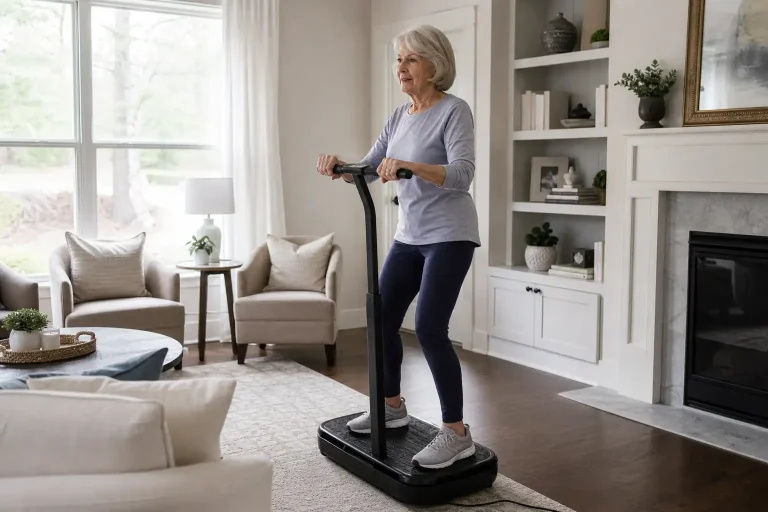
Older adults should start with the half squat and calf raise while holding a handlebar, and add the wide squat later. Balance studies in older adults were mostly supervised and used a handlebar for support. Ask your doctor before you start, especially with a heart, joint or balance condition.
Our best vibration plate for seniors guide only ranks plates with a handlebar; 7 of the 44 plates in our database have one, so check this before you buy.
Plates That Suit These Exercises
For this routine you need room for a wide stance, bands that clip on and a level range that starts gently. These three come from our ranked guides.
Best first plate

Merach MR-2490H1 4D
FitScore 72.3/100
The 28.1 inch deck fits a wide squat, it has 7 presets, 120 speed levels to start low and a display, and bands are included. It is rated for 450 lb. Ranked #1 in our best vibration plate for beginners guide, FitScore 72.3 for that intent.
Check Price on AmazonMost setting range

Merach CV55 4D
FitScore 77/100
A stated 5 to 45 Hz range with both oscillating and linear motion lets you move from gentle holds to the higher frequencies used in studies. Bands included; owners like the number of settings, and noise reports are split. Ranked #1 in our best vibration plate for weight loss guide, FitScore 77 for that intent.
Check Price on AmazonWidest platform

Lifepro Rumblex Plus 4D
FitScore 69.9/100
A 29.5 by 18 inch deck gives the most room for split squats and wide squats of the three, with bands, wheels and a 500 lb rating. Owners mention a heavy, solid build. Ranked #3 in our best vibration plate for weight loss guide, FitScore 69.9 for that intent.
Check Price on AmazonBefore Each Vibration Plate Session
7 checks
Tap a number to check off that step.
- 01
Plate on a hard, level floor, away from furniture.
- 02
Barefoot or thin-soled shoes.
- 03
Knees slightly bent in every standing move.
- 04
Lowest level for the first few sessions.
- 05
Holds of 30 to 60 seconds with rest in between.
- 06
Bands clipped and checked before you pull.
- 07
Water nearby, and stop if you feel dizzy or unwell.
Common Mistakes to Avoid
Mistake 1Standing with locked knees.
Mistake 2Jumping straight to the highest level.
Mistake 3Doing one long 10-minute set instead of short holds.
Mistake 4Putting your head or face near the plate in floor moves.
Mistake 5Expecting the plate to burn belly fat from one area.
The Bottom Line
- Squats on a plate at 35 Hz raised leg muscle activity by 40% to 361% over the same squat without vibration in a 2006 study.
- The one-leg squat produced the largest increase of the three squats tested.
- Head acceleration was lowest with the knees bent about 26 to 30 degrees, in a 2007 study.
- Programs in studies of adults with obesity used squats and calf raises three times a week for 6 to 12 weeks.
- 34 of the 44 plates in our database include resistance bands for upper-body moves.
Our Top Picks
 Best first plateMerach MR-2490H1 4DFitScore72.3/100Check on Amazon
- Most setting rangeMerach CV55 4DFitScore77/100Check on Amazon
- Widest platformLifepro Rumblex Plus 4DFitScore69.9/100Check on Amazon
Frequently Asked Questions
Squats (half, wide and deep), split squats, one-leg squats and calf raises are the core moves. With the bands most plates include you can add rows, shoulder presses and curls while holding a half squat. A forearm plank works at the lowest level.
Studies used holds of about 30 to 60 seconds with rest between sets. Beginners can start with 3 sets of 30 seconds and build to 10 to 15 minutes in total over a few weeks.
Yes. In a 2007 study, head acceleration was lowest with the knees bent about 26 to 30 degrees, and it rose when people stood straighter. Never lock your knees on the plate.
Most study programs used three sessions a week. Short daily sessions are common on product manuals, but leave at least a day between hard leg sessions and follow your own recovery.
A forearm plank and band moves in a half squat work the core, but no study shows a plate reduces belly fat. Fat loss comes from overall energy balance.
The half squat hold: feet hip-width, knees bent about 30 degrees, 30 seconds at the lowest level. It is the base of every other move.
Explore More Vibration Plate Guides
Best Vibration Plate for Beginners (2026): 5 Easy-to-Start Picks
Best Vibration Plate (2026): 5 Top Picks for Home, Ranked
Best Vibration Plate for Weight Loss (2026): 5 Picks to Train On
Best Vibration Plate for Seniors (2026): 5 Picks With Handlebars
Best 4D Vibration Plate (2026): 5 Multi-Motion Picks, Ranked
Best Compact Vibration Plate (2026): 5 Light, Easy-to-Store Picks
This article contains affiliate links. If you click through and make a purchase, we may earn a small commission at no extra cost to you. As an Amazon Associate, we earn from qualifying purchases. We do not show prices because they change constantly: product details and availability can change at any time, so please check the current price and details directly on Amazon. Learn more. Amazon and the Amazon logo are trademarks of Amazon.com, Inc. or its affiliates.
