

Rowing HIIT at a glance
Short hard efforts, easy recovery, one or two sessions a week.
The numbers behind the sessions on this page.
Short answer
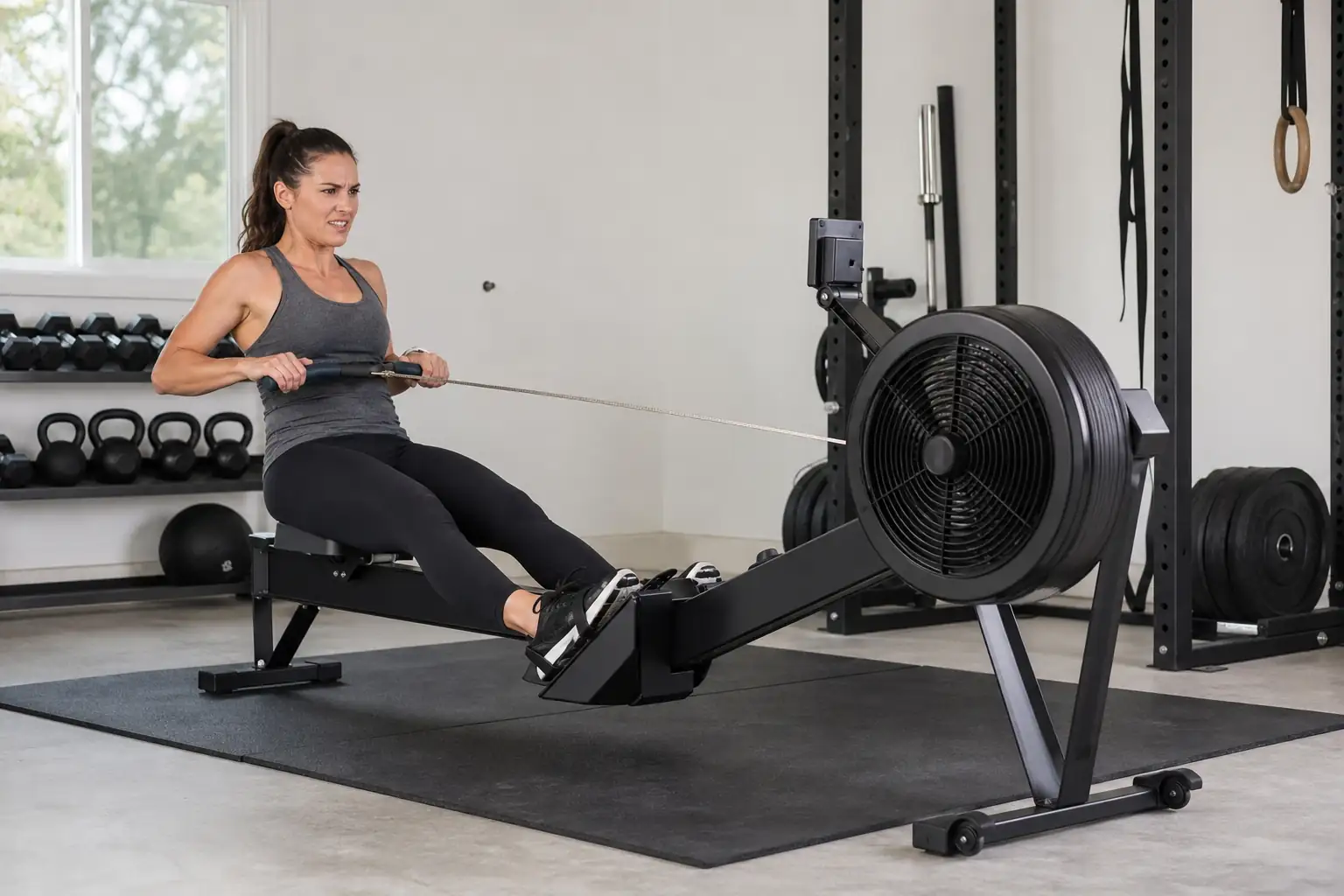
A good rowing machine HIIT workout is 6 rounds of 1 minute hard and 75 seconds easy after a warm-up, about 24 minutes in all.
Key takeaways
- Six 1-minute efforts with 75 seconds of recovery is the best-documented rowing HIIT session.
- Hard means a 7 to 8 on a 0 to 10 scale, and a split you can hold for every round.
- Add one round or a faster split each week, never both, and keep one easy day between sessions.
New to intervals? Start with 30 seconds hard and 90 seconds easy, and see our rowing machine workout library for steady rows.
What Is a Rowing Machine HIIT Workout?
High-intensity interval training, or HIIT, alternates short hard efforts with easy recovery. On a rower it is simple to control: the monitor shows the time and your 500 m split, you can ease off at once without stepping away, and one session needs only 12 to 40 minutes.
The best-documented format is short and repeatable. In a 2025 study of 22 healthy, active adults, six 1-minute rowing efforts with 75 seconds of recovery at 85% of peak power were compared with a body-weight circuit on the same timing. Both sessions reached 92% to 96% of maximum heart rate, so a rowing HIIT session delivers real intensity in about 24 minutes.
HIIT does not replace easy rowing. It is the hard part of a week, one or two sessions, and the rest of your rowing stays steady. A session is only as good as its last round: if the split fades badly, the early rounds were too hard.
How Hard Should Rowing Intervals Feel?
Use two checks together. The first is feel: on the CDC scale of 0 to 10, a vigorous effort is a 7 or 8, where you can say only a few words without pausing for breath. Intervals of 30 seconds to 4 minutes sit there; 20-second sprints go higher, at 9 to 10.
The second is your split. Row a hard 1-minute piece and note the 500 m split: that is your hard split. Longer intervals are rowed at a slightly slower split than 30-second and 1-minute ones, so the 2-minute and 4-minute sessions need a bit of margin. Start the first round at your hard split, not faster, so the last round matches it.
Heart rate is a late check, because it climbs through each interval and peaks in the recovery. An estimate of maximum heart rate is 208 minus 0.7 times your age: for a 40-year-old that is 180 beats per minute, so 92% to 96% is about 166 to 173. Treat that as what the study found, not a number to chase; our heart rate zone calculator gives your own zones.
| Workout | Effort (0 to 10) | Stroke rate in the work interval | How to pace it |
|---|---|---|---|
| Beginner 30/90 | 6 to 7 | 24 to 26 per minute | Strong, even strokes; you could say a short phrase at the end of each interval |
| Express 30/30 | 8 | 26 to 30 per minute | The same split on all 6 rounds |
| 30/30 | 8 | 26 to 30 per minute | Hold one split; stop the set if it fades by more than a few seconds |
| 1-minute repeats | 8 | 26 to 30 per minute | Start at the split you can hold for the full minute, no faster |
| 2-minute repeats | 7 to 8 | 24 to 28 per minute | A touch slower than the 1-minute split |
| 4 x 4 | 7 to 8 | 24 to 28 per minute | Comfortably hard: a split you could hold for a little longer than 4 minutes |
| 20/10 sprints | 9 to 10 | 30 to 34 per minute | All out for 20 seconds; the rest is only 10 seconds, so keep the legs driving |
Check Amazon for current pricing and availability.
Pro tip: Resistance is not intensity. On an air rower the damper changes how each stroke feels; how hard you push sets the interval. Keep the damper at a middle setting and make the stroke harder with your legs.
7 Rowing Machine HIIT Workouts
Pick the session by the time you have and how you feel. The two short sessions suit a busy day, the 1-minute repeats are the classic, and the 4 x 4 is the longest. Each includes its own warm-up and a 5-minute easy cool-down.
Beginner 30/90 gives a full minute and a half of easy rowing after each 30-second effort, so form stays clean. 30/30 and its 12-minute express version keep rest short and teach you to hold a split while tired. The 1 and 2-minute repeats train steady power; the 4 x 4 is the one to build toward. 20/10 sprints are for experienced rowers only, and only after weeks of 30/30.
| Workout | Warm-up | Work interval | Recovery | Rounds | Total time* |
|---|---|---|---|---|---|
| Beginner 30/90 | 5 min easy | 30 sec comfortably hard | 90 sec easy | 6 | 22 min |
| Express 30/30 | 3 min easy | 30 sec hard | 30 sec easy | 6 | 12 min |
| 30/30 | 5 min easy | 30 sec hard | 30 sec easy | 10 | 20 min |
| 1-minute repeats | 5 min easy | 1 min hard | 75 sec easy | 6 | 24 min |
| 2-minute repeats | 5 min easy | 2 min hard | 2 min easy | 6 | 34 min |
| 4 x 4 | 8 min easy, building | 4 min hard | 3 min easy | 4 | 41 min |
| 20/10 sprints | 8 min easy, building | 20 sec very hard | 10 sec rest | 8 | 17 min |
Pro tip: *Total time includes the warm-up and a 5-minute easy cool-down after the last round (3 minutes for the express session).
A 4-Week Rowing HIIT Progression
Two interval sessions a week, with at least one easy day between them, is enough to progress. One rule works for any HIIT block: when a workout repeats, row it at a faster pace; when it adds intervals, hold the same pace. Change one of the two per week, never both.
Fill the other days with steady rows from the workout library, and take the fourth week lighter: the same rounds as week 1 at a faster split is a clear sign that the block worked. If you skip a week, repeat the last week you finished rather than jumping ahead.
| Week | Session A | Session B | Time A / B* |
|---|---|---|---|
| 1 | 6 x 1 min hard, 75 sec easy | 8 x 30 sec hard, 30 sec easy | 24 min / 18 min |
| 2 | 7 x 1 min hard, 75 sec easy | 10 x 30 sec hard, 30 sec easy | 26 min / 20 min |
| 3 | 8 x 1 min hard, 75 sec easy | 12 x 30 sec hard, 30 sec easy | 28 min / 22 min |
| 4 (lighter week) | 6 x 1 min hard, 75 sec easy, at a faster split than week 1 | 8 x 30 sec hard, 30 sec easy, at a faster split than week 1 | 24 min / 18 min |
Pro tip: *Time includes a 5-minute warm-up and a 5-minute easy cool-down.
Warm-Up, Recovery and How Often to Do HIIT
Warm up for 5 to 10 minutes: row easy, then build to a moderate effort and add two or three short, harder bursts near the end.
Row the recovery, do not stop: easy strokes at a low rate keep the legs moving and let your breathing settle before the next round. In the 10-second rest of the 20/10 sprints you only reset your grip and breathe.
One or two interval sessions a week is the usual dose, never on back-to-back days. Rowing hard is demanding on the legs, back and grip, and form fades with fatigue; if your strokes turn short and rushed, finish the set and cool down.
Watch out: Check with your doctor before hard intervals if you have heart, lung or metabolic disease, or symptoms such as chest pain or dizziness when active. Stop rowing at once if you feel chest pain, faintness or unusual shortness of breath.
Rowers That Suit Interval Training
Intervals ask three things of a rower: resistance that answers instantly when you push harder, a monitor you can read mid-effort, and a frame that stays put through a sprint. The three picks below suit that job; their FitScores come from the guide named on each card: our best air rowing machine ranking for the first two, and our best magnetic rowing machine ranking for the quiet Sunny.
Best for sprint intervals

Concept2 RowErg
FitScore 87.1/100
Air resistance rises the harder you pull, so a 20-second sprint meets as much resistance as you can produce and an easy recovery stroke meets almost none. The PM5 monitor shows 500 m split, watts, stroke rate and heart rate, and the frame is rated for 500 lb. The limits are size and noise: it needs 96 inches of floor length and the fan is loud.
Ranked in our Best Air Rowing Machine guide
Check Price on AmazonBest for guided intervals

Aviron Strong Series
FitScore 81.1/100
A 22-inch touchscreen runs guided sessions and shows time, distance, strokes, calories and heart rate, so a 30/30 set can follow on-screen rounds. Resistance is air plus magnetic, the frame is alloy steel, it stands upright and it is rated for users up to 507 lb. Membership is optional but recommended for the interactive content.
Ranked in our Best Air Rowing Machine guide
Check Price on AmazonQuiet intervals

Sunny Health & Fitness SF-RW523021
FitScore 79.1/100
Magnetic resistance is silent, which matters when 30/30 rounds run next to a sleeping household. It lists 16 resistance levels and a monitor with 500 m split, stroke rate and heart rate, a 50-inch rail and a 300 lb rating, and it stands upright after a session. The top level is fixed, so strong rowers may find 20/10 sprints light.
Ranked in our Best Magnetic Rowing Machine guide
Check Price on AmazonBefore Your Next Rowing HIIT Session
7 checks
Tap a number to check off that step.
- 01
Know your hard split from a 1-minute test piece.
- 02
Set the foot straps across the widest part of your foot.
- 03
Pick a middle damper or resistance level.
- 04
Warm up for 5 to 10 minutes, with two or three short bursts at the end.
- 05
Choose the session by the time you have, and plan the easy cool-down.
- 06
Keep a day between two interval sessions.
- 07
Keep water and a towel within reach.
Common Mistakes to Avoid
Mistake 1Starting the first round faster than you can hold, then fading.
Mistake 2Raising the damper or level to the top instead of pushing harder.
Mistake 3Rushing the stroke rate with short, choppy strokes.
Mistake 4Pulling with the arms before the legs have pushed.
Mistake 5Skipping the warm-up, or stopping completely in the recovery.
Mistake 6Adding more rounds and a faster split in the same week.
The Bottom Line
- In a 2025 study, six 1-minute rowing efforts with 75 seconds of recovery reached 92% to 96% of maximum heart rate.
- Hard intervals feel like a 7 to 8 on a 0 to 10 effort scale: you can say only a few words.
- The seven sessions here take 12 to 41 minutes, warm-up and cool-down included.
- Stroke rate in intervals usually sits between 24 and 34 strokes per minute.
- To progress, add one round or row a faster split, not both in the same week.
Our Top Picks
 Best for sprint intervalsConcept2 RowErgFitScore87.1/100Check on Amazon
- Best for guided intervalsAviron Strong SeriesFitScore81.1/100Check on Amazon
- Quiet intervalsSunny Health & Fitness SF-RW523021FitScore79.1/100Check on Amazon
Frequently Asked Questions
Try 6 rounds of 1 minute hard and 75 seconds easy after a 5-minute warm-up, about 24 minutes in total. In a 2025 study, this format pushed heart rate to 92% to 96% of maximum. New rowers can start with 6 rounds of 30 seconds hard and 90 seconds easy.
Most sessions take 12 to 41 minutes with warm-up and cool-down. The 1-minute repeats take about 24 minutes, and an express 30/30 set fits into 12.
One or two interval sessions a week, with at least a day between them. Fill the other days with easy or steady rows.
Row a hard 1-minute piece and note the 500 m split. Start every round at that split, a little slower for 2-minute pieces and for 4 x 4. If the split fades by more than a few seconds over the rounds, you started too fast.
Intervals usually sit between 24 and 34 strokes per minute, with the fastest rates in sprints. Keep each stroke long and let the legs do the work.
Yes, with a gentler format: 30 seconds comfortably hard and 90 seconds easy, repeated 6 times, after a 5-minute warm-up. Learn the sequence of legs, back and arms first, and check with your doctor if you have a health condition.
HIIT is the hard day. Steady rows, pyramids and the 15 to 30-minute plans are in our rowing machine workout library, which also covers how long to row each week.
Explore More Rowing Machine Guides
Rowing Machine Workout Library (2026): Steady, HIIT, Pyramid and 15 to 30-Minute Sessions
Rowing Machine Workout for Beginners (2026): A 4-Week Plan
Best Air Rowing Machine (2026): 5 Picks for Hard Training
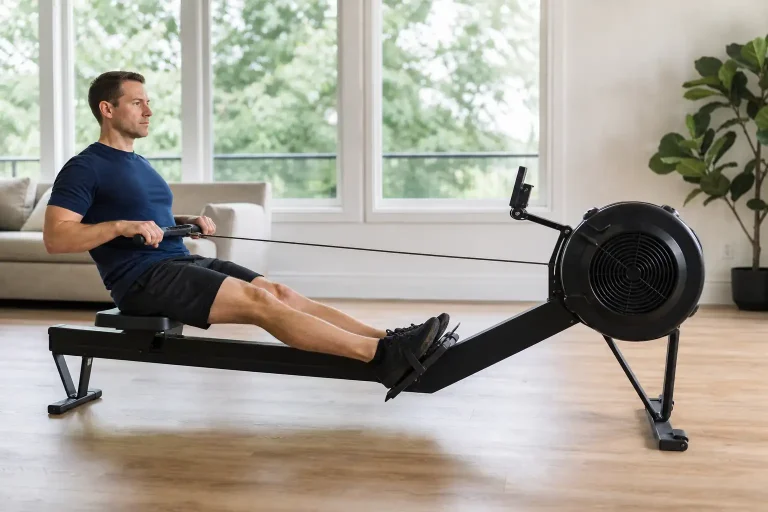
Best Rowing Machine (2026): 5 Top Picks for Home, Ranked
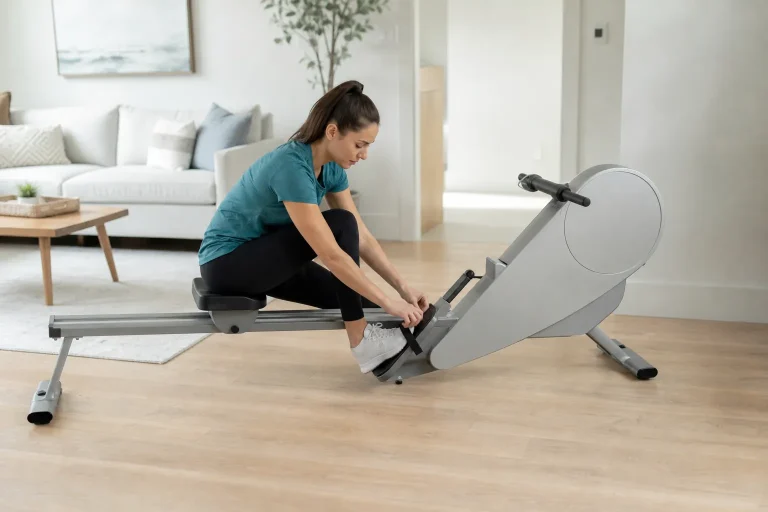
How to Use a Rowing Machine Properly: Form, Technique and Settings (2026)
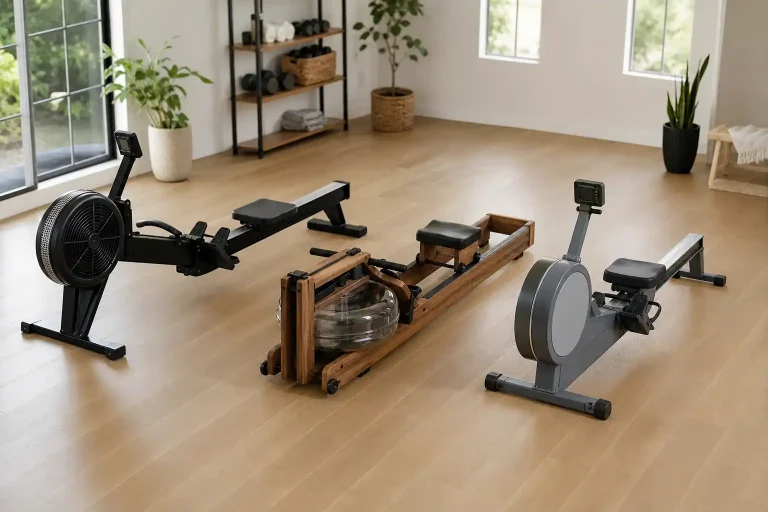
Types of Rowing Machines (2026): Air, Magnetic, Water, Hydraulic and Hybrid Explained
This article contains affiliate links. If you click through and make a purchase, we may earn a small commission at no extra cost to you. As an Amazon Associate, we earn from qualifying purchases. We do not show prices because they change constantly: product details and availability can change at any time, so please check the current price and details directly on Amazon. Learn more. Amazon and the Amazon logo are trademarks of Amazon.com, Inc. or its affiliates.
