

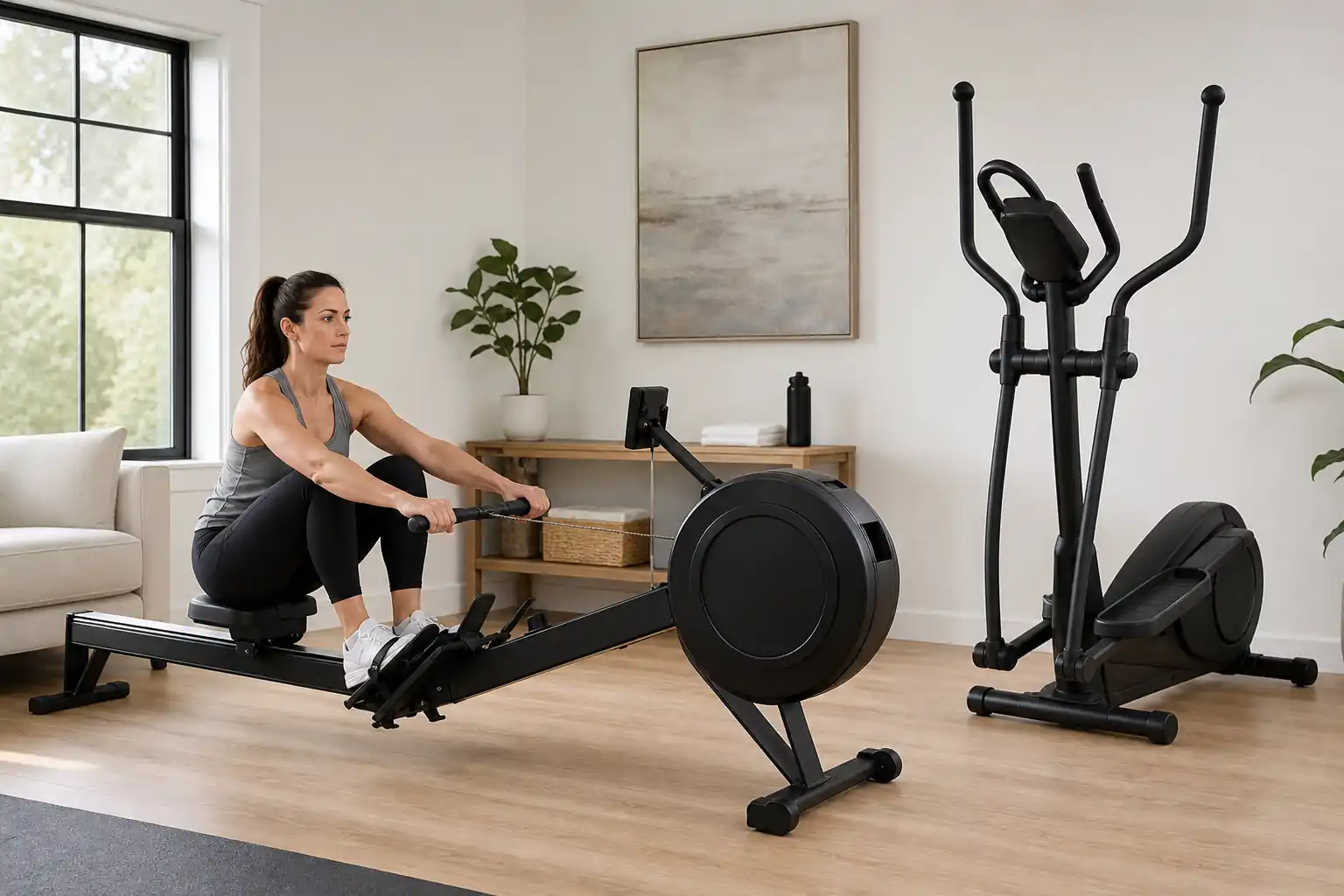
Short answer
In the rowing machine vs elliptical trainer choice, pick a rower if you want a seated, full-body stroke that trains your legs, back and arms together and stores upright or folds. Pick an elliptical if you want to stay on your feet, need a motion with almost no learning curve, or your lower back dislikes bending forward. Peak aerobic fitness and calorie burn land in the same range, so the one you will use most is the better buy.
Key takeaways
- Peak aerobic demand is similar on rowers and ellipticals; effort sets the calorie burn.
- A rower adds a real upper-back and arm pull; an elliptical keeps you upright.
- The elliptical is easier to learn; the rower rewards good technique.
- Rowers store more easily; magnetic rowers are the quietest option.
- Back pain with forward bending points to the elliptical.
Rowers and ellipticals are the two cardio machines people pick when they want a hard session without the pounding of running. Both use the arms and legs. Both let you go easy or very hard. The difference is posture: on a rower you sit and push back with your legs, then pull with your back and arms; on an elliptical you stand and stride in an oval, pushing and pulling the handles.
This comparison looks at calories, muscles, joint load, noise, footprint and the learning curve, then gives a verdict for each type of buyer. Health and energy figures link to peer-reviewed research, Harvard Health and Cleveland Clinic. The rower examples come from our best rowing machine rankings, scored from Amazon US listing specs.
Rowing Machine vs Elliptical Trainer at a Glance
The two machines overlap more than they differ. Each gives a whole-body cardio session, and each can be set from an easy warm-up to a hard interval. The real gaps are posture, technique, length on the floor and how the load reaches your back and knees.
Use the table as a first filter. The sections after it explain each row, with the sources behind the numbers.
| Criterion | Rowing machine | Elliptical trainer |
|---|---|---|
| Position | Seated, legs drive from a foot plate | Standing, feet on two moving pedals |
| Main muscles | Legs, glutes, back, core, arms in one stroke | Legs and glutes; arms and shoulders via moving handles |
| Peak aerobic demand | Similar to the elliptical in a 2021 study | Similar to the rower in the same study |
| Calories, 30 min at 185 lb (Harvard Health) | About 294 moderate, 440 vigorous | About 378 general effort |
| Impact | No landing; your weight rests on the seat | No landing; your weight rests on your feet |
| Low back | Forward lean at the catch; form matters | Upright trunk |
| Learning curve | Short, but the stroke order must be learned | Almost none |
| Noise | Magnetic is near silent; water swishes; air fans get loud | Usually quiet; depends on the flywheel and rails |
| Footprint | 62 to 96 in long in our data; often folds or stands up | Varies by model; many do not fold |
| Best for | Full-body strength-endurance, small rooms, intervals | Upright low-impact cardio, sore backs, simple use |
Check Amazon for current pricing and availability.
Calories and Fitness: Which Burns More?
Neither machine burns more calories by design. Effort and time decide the total. In a study of healthy men who did peak tests on three machines, peak oxygen uptake was similar on a treadmill, an elliptical and a rowing ergometer. In plain terms, a fit person can reach the same top aerobic effort on either one.
For everyday numbers, Harvard Health lists 30-minute estimates by body weight. At 185 lb, it gives about 294 calories for moderate stationary rowing, about 440 for vigorous rowing and about 378 for general elliptical work. Those labels are not matched: “general” elliptical sits between moderate and vigorous rowing. The fair reading is that both machines cover the same range, and a hard rower session can top an easy elliptical session, or the reverse.
Your console number is an estimate too. Rower monitors and elliptical consoles both turn your effort into calories with a formula, and brands use different ones. Compare your own sessions over weeks on one machine, not one brand’s readout with another’s.
| Activity | Estimated calories |
|---|---|
| Stationary rowing, moderate | About 294 |
| Elliptical trainer, general | About 378 |
| Stationary rowing, vigorous | About 440 |
| Running, 5 mph (for reference) | About 336 |
Pro tip: To compare effort fairly, use the talk test or heart rate. Our heart rate zone calculator gives you zones to hold on either machine.
Muscles Worked: Full Stroke vs Full Stride
A rowing stroke runs in a fixed order: legs, then body, then arms. Cleveland Clinic notes that the legs do much of the work, especially at higher resistance, while the upper back, abs, obliques, lower back, glutes and hamstrings all join in, and a strong core supports the lower back on every pull. That pulling motion is the part an elliptical cannot copy: your upper back and arms work against the load, not just swing.
An elliptical works the legs through a standing stride. Models with moving handles add a push and pull for the arms and shoulders, but the handles follow the legs rather than drive the machine, so the upper body does less of the work than on a rower. You also hold your own posture upright, which trains balance in a way a seat does not.
Muscle work is not strength training on either machine. Both are cardio first. Add two days of strength work a week if a rower or an elliptical is your only exercise.
- Rower: quads, glutes, hamstrings, calves, lats, upper back, rear shoulders, biceps, forearms, abs and lower back.
- Elliptical: the legs and hips through the stride; arms and shoulders when you push and pull the moving handles.
- Both: heart and lungs at the effort you choose.
Joints, Low Back and Comfort
Neither machine has a landing phase, so both are gentler on the knees and hips than running. The load path differs. On an elliptical your feet carry your weight the whole time, like walking without the heel strike. On a rower the seat carries your weight and the legs press against a foot plate.
The rower asks more of the low back. At the catch you lean forward with your knees bent, and the drive starts with your back braced. Cleveland Clinic warns that poor form can lead to upper and lower back trouble and that pulling toward the chin instead of the chest strains the shoulders. If forward bending or sitting low aggravates your back, start on an elliptical, or ask a physical therapist before you row.
Getting on and off matters too. Rower seats sit low: the listings in our guides that state a seat height give 9 to 17.7 inches, and the Concept2 RowErg lists 14 inches. If standing up from a low seat is hard for you, the elliptical’s step-on design is easier. If balance is the issue, the rower’s low seat removes the fear of falling.
Watch out: If you have back, hip or knee pain, ask your doctor or a physical therapist which machine and settings fit your condition before you start.
Space, Noise and the Learning Curve
A rower is long and narrow. The rowers ranked in our guides measure 62 inches (Dripex magnetic) to 96 inches (Concept2 RowErg) in use, and 16 to 27 inches wide. Most fold, stand upright on their end or split in two, so the floor is free between sessions. An elliptical is shorter but taller and heavier, and many models stay where you set them up. Measure your room for length on a rower and for ceiling height on an elliptical, since you stand on raised pedals.
Noise depends on the rower type. Magnetic rowers are close to silent and get the top rating on our noise scale. Water rowers make a steady swish. Air rowers spin a fan that gets loud as you push. Ellipticals are usually quiet, with some hum from the flywheel and rails. If you live in an apartment and want a rower, read our best magnetic rowing machine guide.
Technique is the rower’s main barrier. A poor stroke wastes effort and loads the back. Learn the order (legs, body, arms on the drive; arms, body, legs on the return) at a slow stroke rate before you add power. An elliptical needs no lesson. Our best rowing machine for beginners guide ranks models that keep the first weeks simple.
Rowing Machine Examples by Type
If the rower wins your comparison, choose the resistance type next. These three examples come from our Best guides. Each FitScore is the score the rower earns in the guide named in its card, because the FitScore changes with the buying intent.
Air example

Concept2 RowErg
FitScore 83.9/100
FitScore 83.9 in our best rowing machine guide, where it ranks 1st. A fan flywheel with a continuous damper and a PM5 monitor that shows 500 m split, watts and heart rate. Its listing states a 500 lb limit and a 5-year frame warranty. It is 96 inches long and splits in two rather than folding, and the fan is the loudest system here. Owners on Amazon praise its solid build.
Ranked in our Best Rowing Machine guide
Check Price on AmazonMagnetic example

Sunny Health & Fitness SF-RW523021
FitScore 78.7/100
FitScore 78.7 in our best magnetic rowing machine guide, where it ranks 1st. Sixteen magnetic levels, a 50-inch rail, a 500 m split on the monitor and the free SunnyFit app. It stands upright on a 79.3 x 19.7-inch footprint. The limits: a 300 lb user rating and a 6-month parts warranty on the listing.
Ranked in our Best Magnetic Rowing Machine guide
Check Price on AmazonWater example

YOSUDA Water Rower
FitScore 80.9/100
FitScore 80.9 in our best water rowing machine guide, where it ranks 1st. A water tank, a solid beech frame, a 400 lb limit and users up to 6 ft 6 in on the listing. It folds and is 73.6 inches long. The monitor shows time, distance, strokes and calories, with no split. Owners like its smooth seat glide and the sound of the water.
Ranked in our Best Water Rowing Machine guide
Check Price on AmazonWhich Should You Choose?
Start from your body and your goal, then your room. Most buyers fit one of these profiles.
- You want one machine that trains your back and arms as well as your legs: a rowing machine. The pull is the part an elliptical cannot match.
- Your lower back dislikes bending forward or sitting low: an elliptical, with an upright trunk and a step-on design.
- You have little floor space and want the room back after a session: a rower that folds or stands upright; see our best folding rowing machine picks.
- You want to start today with no technique to learn: an elliptical. A rower needs a few short sessions to learn the stroke order.
- You like intervals and measurable targets: a rower with split and watts, such as the Concept2 RowErg.
- You share walls and row early or late: a magnetic rower, the quietest system in our scoring.
Checklist Before You Choose
7 checks
Tap a number to check off that step.
- 01
Decide whether you want the upper-back and arm pull of rowing.
- 02
Check how your lower back feels in a seated forward lean.
- 03
Measure floor length for a rower: 62 to 96 inches plus room at each end.
- 04
Measure ceiling height for an elliptical, since you stand on raised pedals.
- 05
Pick a rower type by noise: magnetic, water or air.
- 06
Compare the max user weight with your weight, with a margin.
- 07
Check whether the monitor shows split or watts if you train to targets.
Common Mistakes to Avoid
Mistake 1Comparing one brand’s calorie readout with another’s.
Mistake 2Rowing with the arms first and the legs last.
Mistake 3Buying an air rower for a shared apartment without thinking about fan noise.
Mistake 4Assuming an elliptical works the back and arms as much as a rower.
Mistake 5Skipping strength training because both machines feel full-body.
Mistake 6Forgetting the length a rower needs at full extension.
The Bottom Line
- In a 2021 study, peak oxygen uptake was similar on a treadmill, an elliptical and a rowing ergometer.
- Harvard Health estimates about 294 calories for 30 minutes of moderate stationary rowing and 378 for general elliptical work at 185 lb.
- A rower is seated: the legs drive, the back swings and the arms finish the pull on every stroke.
- An elliptical keeps you upright with your feet on the pedals, so balance and posture feel like walking.
- The rowers ranked in our guides run 62 to 96 inches long, and most fold, stand upright or split in two.
Our Top Picks
 Air exampleConcept2 RowErgFitScore83.9/100Check on Amazon
- Magnetic exampleSunny Health & Fitness SF-RW523021FitScore78.7/100Check on Amazon
- Water exampleYOSUDA Water RowerFitScore80.9/100Check on Amazon
Frequently Asked Questions
Not for everyone. A rower trains the legs, back and arms in one pull and stores in less space. An elliptical keeps you upright and needs no technique. Peak aerobic demand was similar on both in a 2021 study, so the better machine is the one that suits your body and that you will use most weeks.
At matched effort, they land in the same range. Harvard Health estimates about 294 calories for 30 minutes of moderate rowing, about 440 for vigorous rowing and about 378 for general elliptical work at 185 lb. A hard session on either machine burns more than an easy session on the other.
Both remove landing impact. The rower takes your weight on the seat but bends the knees deeply at the catch. The elliptical keeps the knees in a shorter arc with your weight on your feet. If deep knee bends hurt, start on the elliptical and ask a physical therapist before rowing.
Rowing with good form trains the back muscles, but the forward lean at the catch loads the lower back. Poor form, such as rounding the spine or pulling with the arms first, adds strain. Learn the legs, body, arms sequence at a slow pace, and choose an elliptical if bending forward is painful.
Yes, for cardio and endurance. It covers the same effort range and adds an upper-body pull. It does not train upright balance, so people who want a standing, walking-like motion may still prefer an elliptical. Many rowers also fold or stand upright, which saves space.
The elliptical, because the motion feels like walking from the first minute. A rower takes a few short sessions to learn the stroke order. Once learned, a rower lets beginners start very easy and build up, and a magnetic rower lets you pick a light level.
Explore More Rowing Machine Guides
Best Rowing Machine (2026): 5 Top Picks for Home, Ranked
Best Magnetic Rowing Machine (2026): 5 Quiet Picks Ranked
Best Water Rowing Machine (2026): 5 Picks for a Real Water Feel
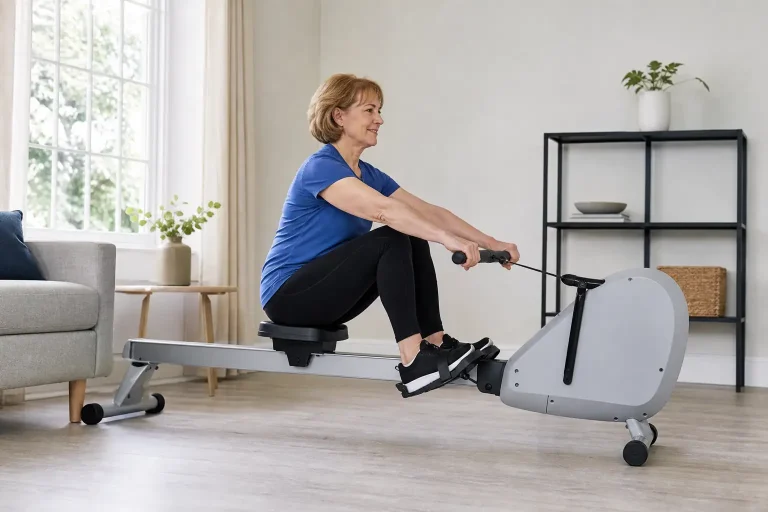
Best Rowing Machine for Beginners (2026): 5 Easy-to-Start Picks
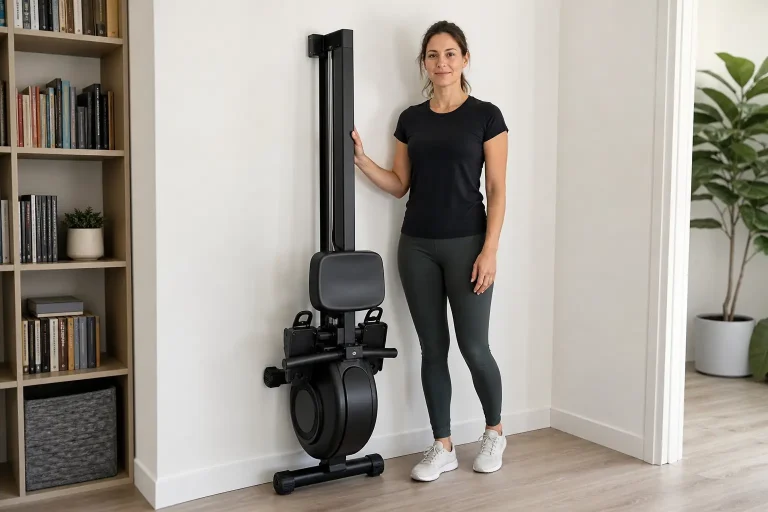
Best Folding Rowing Machine (2026): 5 Space-Saving Picks
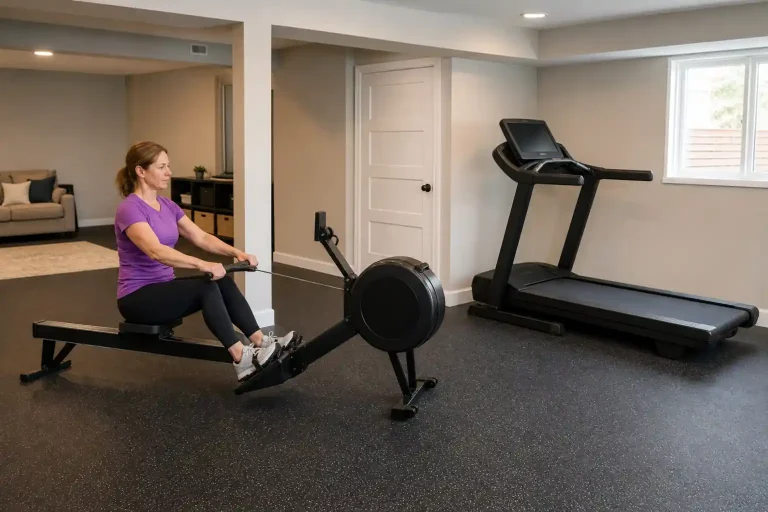
Rowing Machine vs Treadmill (2026): Which Is Better for Your Home?
This article contains affiliate links. If you click through and make a purchase, we may earn a small commission at no extra cost to you. As an Amazon Associate, we earn from qualifying purchases. We do not show prices because they change constantly: product details and availability can change at any time, so please check the current price and details directly on Amazon. Learn more. Amazon and the Amazon logo are trademarks of Amazon.com, Inc. or its affiliates.
