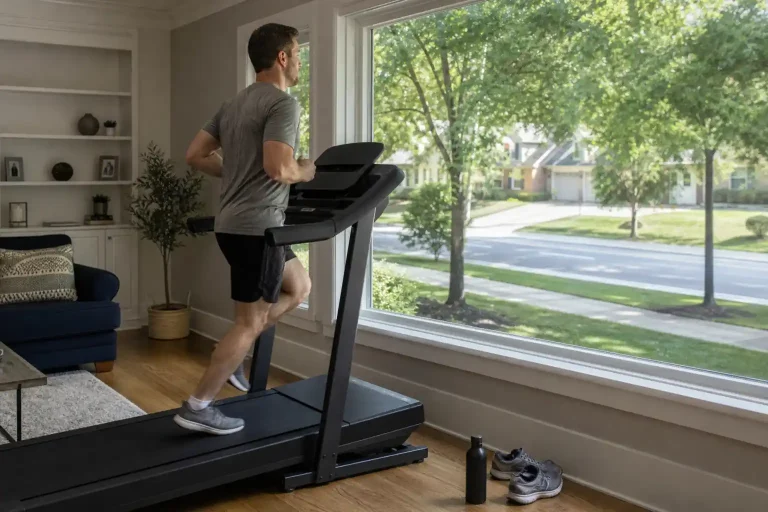
Short answer
Yes, you can do your marathon training on a treadmill. Run four times a week: two easy runs, one quality session and one long run that builds to 18 to 20 miles (or 3 hours), set the belt to 1% incline for steady runs, copy your race course hills, and taper for two weeks. The free 16-week plan below gives every session with its speed in mph and km/h.
Key takeaways
- Four runs a week are enough for a first or second marathon: two easy, one quality, one long.
- Set paces from a recent race with our race time predictor, then convert them to belt speeds.
- Use 1% incline for steady running above about 6.5 mph, and rehearse your course hills.
- Cap the longest run at 20 miles or 3 hours, fuel 30 to 60 g of carbohydrate per hour, and keep a fan on.
- Taper for two weeks: cut volume by about half and keep some marathon-pace running.
Marathon training on treadmill belts used to be a last resort for snowed-in runners. Today many people train for a marathon mostly indoors: the pace is exact, the footing is safe in the dark or in winter, and a home treadmill turns a missed run into a 45-minute window before work.
This guide gives you a complete plan built for the treadmill, not adapted from a road plan as an afterthought. You will set your paces, follow 16 weeks of sessions with speed and incline for each one, learn how to survive an 18- to 20-mile run indoors, and prepare for the differences you will meet on race day.
Marathon Training on Treadmill: Can You Train for a Marathon on a Treadmill?
Yes. The main training effects of marathon preparation, aerobic endurance, running economy and time on your feet, come from running steady miles at the right effort, and a treadmill delivers that with more control than most roads. Runners who move most of their training indoors often report fewer missed sessions, and some find their legs cope better with the even, cushioned deck.
This plan is for runners who can already run about 30 minutes without stopping and have run 15 to 20 miles a week for a month or two. It suits a first or second marathon and finish goals between about 3:30 and 5:00. If you are starting from zero, build to that base first with our treadmill workouts and easy walk-run sessions.
What a treadmill cannot fully reproduce: downhill running, the camber and turns of real roads, wind, and the mental side of running alone in a changing setting. The race-readiness section below covers how to close those gaps.
Watch out: Check with your doctor before marathon training if you have a heart or lung condition, high blood pressure, diabetes, a past injury that limits running, or if you are pregnant. Stop and seek help for chest pain, unusual breathlessness, dizziness or palpitations. This plan is general information, not medical advice.
Set Your Marathon Paces Before Week 1
Every session uses one of five effort zones. Find your marathon pace first: enter a recent 5K, 10K or half marathon in our race time predictor, then turn the pace into a belt speed with the treadmill pace converter. If you train by heart rate, the heart rate zone calculator gives the matching zones.
The table shows the speeds for four common goals. The plan below is written for a 4:30 goal; if your goal is different, replace each speed with the one from your row.
- Easy: you can speak in full sentences. Most of your miles go here; slower is fine.
- Marathon pace (MP): controlled and steady, the effort you could hold for hours.
- Half marathon pace (HM) and threshold (Thr): comfortably hard; you can say a few words at a time.
- Intervals (Int): hard but repeatable; you finish each one able to do one more.
| Goal timeGoal | Easy runsEasy | Marathon paceMP | Half marathon paceHM | ThresholdThr | Intervals (5K to 10K pace)Int |
|---|---|---|---|---|---|
| 3:30 | 6.6 to 7.0 mph (10.6 to 11.3 km/h) | 7.5 mph (12.1 km/h) | 7.9 mph (12.7 km/h) | 8.1 mph (13.0 km/h) | 8.6 mph (13.8 km/h) |
| 4:00 | 5.7 to 6.1 mph (9.1 to 9.7 km/h) | 6.6 mph (10.5 km/h) | 7.0 mph (11.2 km/h) | 7.2 mph (11.5 km/h) | 7.7 mph (12.3 km/h) |
| 4:30 | 4.9 to 5.3 mph (7.9 to 8.6 km/h) | 5.8 mph (9.4 km/h) | 6.2 mph (10.0 km/h) | 6.4 mph (10.3 km/h) | 6.9 mph (11.1 km/h) |
| 5:00 | 4.3 to 4.7 mph (7.0 to 7.6 km/h) | 5.2 mph (8.4 km/h) | 5.6 mph (9.1 km/h) | 5.8 mph (9.4 km/h) | 6.3 mph (10.2 km/h) |

The 16-Week Treadmill Marathon Training Plan
Run four days a week with at least one rest or cross-training day between the quality session and the long run. Every fourth week is a lighter recovery week, and mileage rises gradually so that your tendons and bones adapt along with your heart and lungs. All easy runs and long runs use 1% incline unless the session says otherwise; warm up for 10 minutes and cool down for 5 minutes around every quality session.
The plan peaks at 38 miles (61 km) in week 14. Experienced runners often follow plans with more days and miles; this one keeps the number of treadmill hours realistic for a busy week.
| WeekWk | Easy runsEasy | Treadmill quality sessionQuality session | Long run | Weekly totalTotal |
|---|---|---|---|---|
| 1 | 3 + 3 mi (5 + 5 km) | 6 x 1 min at 6.9 mph (11.1 km/h), 2 min easy between, 1% incline | 6 mi (10 km) | 16 mi (26 km) |
| 2 | 3 + 4 mi (5 + 6 km) | 3 x 5 min at marathon pace, 5.8 mph (9.3 km/h), 1% | 7 mi (11 km) | 18 mi (29 km) |
| 3 | 4 + 4 mi (6 + 6 km) | 6 x 90 sec uphill at 5.4 mph (8.7 km/h) and 5%, walk or jog down to 1% | 8 mi (13 km) | 21 mi (34 km) |
| 4 | 3 + 3 mi (5 + 5 km) | Recovery week: 2 x 8 min at 6.2 mph (10.0 km/h), 1% | 6 mi (10 km) | 16 mi (26 km) |
| 5 | 4 + 4 mi (6 + 6 km) | 3 x 8 min at threshold, 6.4 mph (10.3 km/h), 2 min easy between | 10 mi (16 km) | 23 mi (37 km) |
| 6 | 4 + 5 mi (6 + 8 km) | 3 miles at marathon pace inside a 6-mile run, 5.8 mph (9.3 km/h) | 11 mi (18 km) | 26 mi (42 km) |
| 7 | 5 + 5 mi (8 + 8 km) | 5 x 3 min at 6.9 mph (11.1 km/h), 2 min easy between | 12 mi (19 km) | 28 mi (45 km) |
| 8 | 4 + 4 mi (6 + 6 km) | Recovery week: 2 x 10 min at 6.2 mph (10.0 km/h) | 9 mi (14 km) | 22 mi (35 km) |
| 9 | 5 + 5 mi (8 + 8 km) | 5 miles at marathon pace inside a 7-mile run, 5.8 mph (9.3 km/h) | 14 mi (23 km) | 31 mi (50 km) |
| 10 | 5 + 6 mi (8 + 10 km) | 4 x 1 mile at threshold, 6.4 mph (10.3 km/h), 3 min easy between | 15 mi (24 km) | 33 mi (53 km) |
| 11 | 5 + 6 mi (8 + 10 km) | Rolling hills: 40 min alternating 2%, 4% and 1% every 3 to 5 min, easy effort | 16 mi (26 km) | 34 mi (55 km) |
| 12 | 4 + 5 mi (6 + 8 km) | Recovery week: 4 miles at marathon pace, 5.8 mph (9.3 km/h) | 12 mi (19 km) | 27 mi (43 km) |
| 13 | 5 + 6 mi (8 + 10 km) | 6 miles at marathon pace inside an 8-mile run, 5.8 mph (9.3 km/h) | 18 mi (29 km) or 3 hours, whichever comes first | 37 mi (60 km) |
| 14 | 5 + 6 mi (8 + 10 km) | 3 x 2 miles at 6.2 mph (10.0 km/h), 3 min easy between | 20 mi (32 km) or 3 hours, whichever comes first | 38 mi (61 km) |
| 15 | 4 + 5 mi (6 + 8 km) | Taper: 4 miles at marathon pace, 5.8 mph (9.3 km/h) | 12 mi (19 km) | 27 mi (43 km) |
| 16 | 3 + 3 mi (5 + 5 km) | Tuesday: 3 miles with 2 x 1 mile at marathon pace, 5.8 mph (9.3 km/h) | Race day: 26.2 mi (42.2 km) | 9 mi (14 km) + race |
Pro tip: Missed a week through illness or travel? Repeat the previous week rather than jumping ahead, and never double up two missed long runs.
How to Run 18 to 20 Miles on a Treadmill
The long run is where indoor marathon training is won or lost. Coaches disagree on how long it should be: some popular beginner plans peak at 20 miles, while others cap the long run at about 16 miles or at a set time to limit fatigue. A sensible rule for runners slower than about 10 minutes per mile is to stop at 20 miles or 3 hours, whichever comes first.
Fuel the way you will on race day. Joint sports nutrition guidance from the American College of Sports Medicine and its partners suggests about 30 to 60 g of carbohydrate per hour for efforts of 1 to 2.5 hours, and up to about 90 g for longer efforts if your stomach is trained for it (Thomas, Erdman and Burke, 2016).
- Break it into blocks: 4 x 5 miles, each with its own focus (easy, 1%, rolling 2 to 3%, last block at marathon pace in later weeks).
- Change incline every block: small changes between 0.5% and 3% move the load around your legs and break the monotony.
- Point a fan at your chest: there is no headwind indoors, and overheating slows long runs more than anything else.
- Fuel and drink on a schedule: a gel or drink every 30 to 40 minutes, practiced from week 9.
- Plan the entertainment: a podcast for the first hour, a film or race footage for the second, music for the last.
- Stay safe: clip the safety key on, slow the belt before you step off to refill a bottle, and never straddle the rails at speed.
Taper and Race Week
A 2007 meta-analysis of tapering studies found the best results with a two-week taper that cut training volume by about 41 to 60% while keeping the intensity and the number of sessions (Bosquet and colleagues, 2007). Weeks 15 and 16 follow that pattern: shorter runs, but marathon-pace segments stay in.
In race week, keep two short easy runs, sleep more than usual, eat familiar food and lay out your kit two days early. If your race is outdoors and you have trained mostly indoors, run your race-week easy runs outside to get used to the road again.
- Practice your race breakfast before one long run.
- Set your watch or race plan by effort for the first 10K, not by your treadmill speed.
- Start 5 to 10 seconds per mile slower than marathon pace for the first few miles.
From Treadmill to Road: Getting Race-Ready
Belt speed and road pace are not identical. At running speeds, there is no air resistance on a treadmill, so researchers found that a 1% grade best matched the energy cost of running outdoors (Jones and Doust, 1996). Set 1% for steady running above about 6.5 mph; below that, 0 to 1% is fine.
Treadmill displays are also only as accurate as their calibration. If your race-pace runs feel much easier or harder than your race results suggest, check the belt with a known-distance outdoor run or a watch with a foot pod. Many coaches also suggest judging treadmill runs by time and effort, not only by distance.
- Copy the course profile: download the race elevation chart and set the same climbs on your long runs from week 11.
- Train the downhills: a treadmill rarely goes below 0%; if your course has long descents, add a few outdoor downhill runs or use a treadmill with decline.
- Run outside when you can: even one easy run a week on the road helps with turns, camber and pacing without a belt.
- Keep your race shoes in rotation: wear them for at least two long runs before race day.

What Your Treadmill Needs for Marathon Training
Marathon training puts more hours on a treadmill than any other goal: often 4 to 6 hours a week at the peak, and single sessions of 3 hours. Look for a motor of at least 3 continuous horsepower, a running deck of 22 x 60 inches, a top speed of 12 mph, incline that changes quickly, and good cushioning. A fan, a reachable bottle holder and a stable console for your phone or tablet make the long runs far easier.
Keep the belt lubricated and clean: long runs heat the deck, and a dry belt wears the motor faster. Our treadmill maintenance guide has the schedule.
Checklist Before Your First Long Treadmill Run
8 checks
Tap a number to check off that step.
- 01
Run 30 minutes without stopping and 15 to 20 miles a week before week 1.
- 02
Set your marathon pace from a recent race with the race time predictor.
- 03
Convert every pace to a belt speed and write it on a card by the console.
- 04
Set 1% incline for steady running above about 6.5 mph.
- 05
Place a fan, a bottle and your gels within reach before you start.
- 06
Clip the safety key to your clothing every run.
- 07
Check the belt tension and lubrication before the long runs start.
- 08
Plan one outdoor run a week from week 12 if your race is on the road.
Common Mistakes to Avoid
Mistake 1Running every easy run too fast because the belt makes pace easy to hold.
Mistake 2Jumping straight from 10-mile to 20-mile long runs.
Mistake 3Skipping fuel on long runs and testing gels for the first time on race day.
Mistake 4Running every mile at 0% incline and finding the road harder than expected.
Mistake 5Never practicing downhills when the race course has long descents.
Mistake 6Ignoring a belt that slips or a deck that feels hot after long runs.
The Bottom Line
- Plan: 16 weeks, 4 runs a week, from 16 to 38 miles a week (26 to 61 km), with a recovery week every fourth week.
- A 1% treadmill grade matched the energy cost of outdoor running in a 1996 study by Jones and Doust.
- A two-week taper with a 41 to 60% cut in volume gave the best results in a 2007 meta-analysis.
- Sports nutrition guidance suggests 30 to 60 g of carbohydrate an hour for efforts of 1 to 2.5 hours, more for longer races.
- Every speed is shown in mph and km/h; adjust the plan to your goal with the pace table.
Frequently Asked Questions
Yes. Many runners finish marathons after training mostly or entirely indoors. Add 1% incline, copy the course hills, and if you can, run a few easy miles outside in the last month to get used to the road.
For most first-time marathoners, 18 to 20 miles or 3 hours, whichever comes first. Longer runs add fatigue and injury risk faster than they add fitness.
Use 1% for steady running above about 6.5 mph, and change between 0.5% and 3% on long runs. Add the climbs of your race course from about week 11.
Marathon pace for 4:00 is about 6.6 mph (10.5 km/h). Easy runs sit around 5.7 to 6.1 mph; see the pace table for every zone.
Split the run into blocks with a different incline or pace in each, plan your podcasts and films, and keep a fan and fuel within reach.
Close, if the treadmill is calibrated and you use 1% incline. Judge the first miles of the race by effort and your watch, not by your treadmill speed.
Four is enough for this plan: two easy runs, one quality session and one long run, with at least one full rest day.
Explore More Treadmill Running Guides

Best Treadmill for Marathon Training (2026): Top 5 Picks

Best Treadmill for Running (2026): Top 5 Picks

Treadmill HIIT Workouts (2026): Beginner to Advanced Interval Plans

Treadmill Pace Chart (2026): MPH to Min/Mile and Min/Km

Treadmill Incline vs Outdoor Running (2026): The 1% Rule, Hills and Downhills